

Black wildebeest hunting South Africa: 2026 Trophy fees and caliber guide
Black wildebeest hunting in South Africa represents more than a trophy; it is a direct connection to a remarkable conservation success story. Once driven to the brink of extinction, the future of the Black wildebeest (Connochaetes gnou) was secured primarily through the dedicated efforts of responsible hunting outfits. Our safaris are strictly committed to ethical fair-chase practices that ensure the long-term vitality of the White-tailed gnu and its native habitat. Whether you are researching 2026 trophy fees, comparing Black vs Blue wildebeest characteristics, or seeking the best caliber for Black wildebeest, this guide—compiled by senior staff with 29 years of experience—is your definitive resource.
The Black wildebeest, also widely known among international hunters as the White-tailed gnu (Connochaetes gnou), is a unique and highly sought-after trophy because it only occurs naturally in South Africa. It is one of Africa’s most visually distinct antelope, renowned for its dark, shaggy coat, prominent upright mane, and the long, flowing white tail from which it gets its alternate name. When researching Black wildebeest trophy fees for 2026, hunters will find that this species offers exceptional value as a cornerstone of a South African plains game safari.
Both bulls and cows possess the species’ characteristic, robust horns that curve powerfully forward. These animals are intensely gregarious and rely on the herd for safety. Their skittish nature and erratic movements make Black wildebeest shot placement a critical point of study for any marksman. Successfully hunting the White-tailed gnu is a true test of a hunter’s patience and precision in the open South African savanna.
Whether you are researching the best caliber for Black wildebeest or comparing Black vs Blue wildebeest hunting characteristics, South Africa is the only destination where you can experience this endemic challenge. If your specific goal is to secure a trophy Black wildebeest, there is no other destination—South Africa is your hunting destination of choice.
1. 2026 Black wildebeest trophy fees and price update
Below are the official 2026 trophy fees to hunt Black Wildebeest (Connochaetes gnou) in South Africa with African Bushbuck Adventures. This list ensures full price transparency for your planning. Please note that due to rising operational costs and increased de
Because this unique, endemic species is primarily pursued across open highveld plains alongside other native game, there are no standalone or dedicated black wildebeest hunts. Instead, this fee represents the definitive flat-rate cost when a mature bull is added as an asset to a broader plains game or custom hunting package.
1.1 How the costs are calculated
Our pricing framework maintains strict boundaries to give international sportsemen absolute financial clarity before arriving in camp:
-
Package add-on structure: Because this hunt is conducted exclusively as an add-on, it carries no standalone daily rates. You simply stack the fixed trophy fee onto your primary safari itinerary with zero added booking charges.
-
Tax exemption on trophies: Value added tax (VAT) is already fully factored into your primary safari's daily rates. For the trophy fee itself, all animals harvested by international clients for export are legally VAT exempt, meaning the price listed below is the exact amount you pay.
-
Harvest and wounding rules: The fixed fee is activated only when a mature bull is successfully harvested or wounded in the field under fair-chase conditions.
| Black Wildebeest Trophy Fee Structure | |
|---|---|
| Trophy & Safari Specification | 2026 Hunting Rate (USD) |
| Black wildebeest bull | $1,450 (Flat Trophy Fee) |
| Additional daily rates | $0 (When added to existing package) |
2. Best calibers for hunting Black wildebeest in South Africa
The Black Wildebeest is a medium-sized antelope, but its "bones and body weight" theory is defined by its environment and intense territorial drive. Because these animals are typically hunted in wide-open plains with minimal cover, the primary challenge is a combination of distance and wind drift. A mature bull weighs approximately 330 lbs to 400 lbs (150 kg – 180 kg). While they are lighter than the Blue Wildebeest, their skeletal density remains high, and their erratic behavior makes them incredibly difficult to anchor if the first shot is not placed with surgical precision. Our senior staff recommends flat-shooting calibers with high-velocity and high-ballistic coefficient (BC) bullets to counter the open savanna winds.
| Recommended Black Wildebeest Calibers | |
|---|---|
| Caliber | Expert notes and ammunition recommendation |
| .243 Winchester | Minimum: Suited for experienced marksmen using 100 gr bonded bullets at moderate ranges. |
| 6.5 Creedmoor | Modern Choice: Excellent for its low recoil and high precision; use 140 gr premium bonded bullets. |
| .270 Winchester | Versatile: A classic choice for the open plains; 130 gr – 150 gr bullets perform exceptionally well. |
| 7 mm PRC | Top Choice: The 2026 favorite for long-range efficiency and superior wind-bucking ability. |
| .30-06 Springfield | The Standard: 180 gr Barnes TTSX provides the necessary "punch" for older, tougher bulls. |
| .300 Win Mag | The Professional Choice: Provides the flat trajectory needed for 250-yard+ savanna shots. |
2.1 Key caliber considerations
-
Premium Ammunition is Mandatory: Always use high-quality, controlled-expansion bullets for reliable penetration and maximum energy transfer on this tough animal.
-
Shot Placement is Crucial: Regardless of caliber, focus on accurate shot placement to the heart and lungs to ensure a quick, ethical harvest.
-
Environmental Conditions: Black Wildebeest are typically hunted on open plains where wind and distance are factors, favoring the high-velocity, flat-shooting calibers listed above.
3. Species biology and conservation (Connochaetes gnou)
The Black Wildebeest, also known as the White-tailed Gnu, is a quintessential Southern African species. Unlike its more common relative, the Blue Wildebeest, this species is endemic to the open plains of South Africa. It is easily recognized by its unusual horn configuration, which curves forward and down before hooking upward, and its long, flowing white tail. Historically, this species was brought back from the brink of extinction through the dedicated efforts of private landowners and the hunting industry, making its current abundance a significant conservation success story.
| Aspect | Detail and hunting context |
| Scientific name | Connochaetes gnou |
| Common names | Black Wildebeest, White-tailed Gnu |
| Gender terms | Bulls and Cows |
| Identification | Dark brown to black coat, forward-curved horns, and a distinctive long white tail. |
| Habitat | Open highveld grasslands and Karoo scrub. |
| Conservation | Endemic to South Africa; thriving due to sustainable private land management. |
3.1 Why hunt the Black wildebeest?
Adding a trophy Black wildebeest (Connochaetes gnou) to your collection offers a completely different experience from its blue cousin. Known for their eccentric behavior and distinct white horse-like tails, these "Clowns of the Plains" are native only to the open grasslands of South Africa. Their territorial nature and sharp eyesight make them a formidable challenge for hunters who enjoy the patience required for an open-terrain stalk.
The Wildebeest Slam For those seeking the ultimate South African challenge, we offer the Wildebeest Slam, which includes:
4. Black wildebeest (Connochaetes gnou): Shot placement guide
The Black Wildebeest is a resilient and formidable plains game species, notorious for appearing larger than its actual vital zone might suggest. Success hinges on precise shot placement to ensure an ethical harvest. This guide, paired with our specialized shot placement imagery, highlights the two primary targets for a clean, humane kill on the open South African savanna.
4.1 The ethical mandate (Broadside shot)
| Factor | Detail and hunting context |
| Body type | High-backed and muscular with a deep chest; extremely hardy. |
| Target zone | The vital triangle is positioned surprisingly low and forward. |
| Ethical focus | A double-lung or heart shot is essential to minimize tracking. |
4.2 The target point: Aiming low
The Black Wildebeest fits the "High-Backed & Sloping" archetype, which can deceive the eye.
-
The heart/low lung shot: Aim in the lower third of the body, directly behind the shoulder. This shot typically breaks the shoulder and disrupts the heart/lung complex.
-
The high lung shot: Aim slightly higher but still below the midway point of the torso. This ensures a quick expiration if the animal is slightly angled or at a distance.
-
The "No-Man's Land" error: Avoid shots placed in the top third of the body. Shots hitting above the two-thirds line will hit non-vital muscle and the deceptive hump, leading to a wounded animal.
-
Bullet penetration: We recommend using premium, controlled-expansion bullets (minimum 140 gr) such as Barnes TTSX or Nosler Partition to guarantee an exit wound through dense bone and muscle.
4.3 Challenges and considerations
| Aspect | Field strategy |
| Habitat | Open plains require proficiency at ranges of 200–300 yards. |
| Movement | Avoid shooting at running animals; wait for a stationary broadside target. |
| Caliber | While the 6.5 x 55 is the minimum, the .270 Winchester and .30-06 offer superior terminal performance. |
Black wildebeest shot placement image

5. Black wildebeest trophy gallery: Ethical hunting success
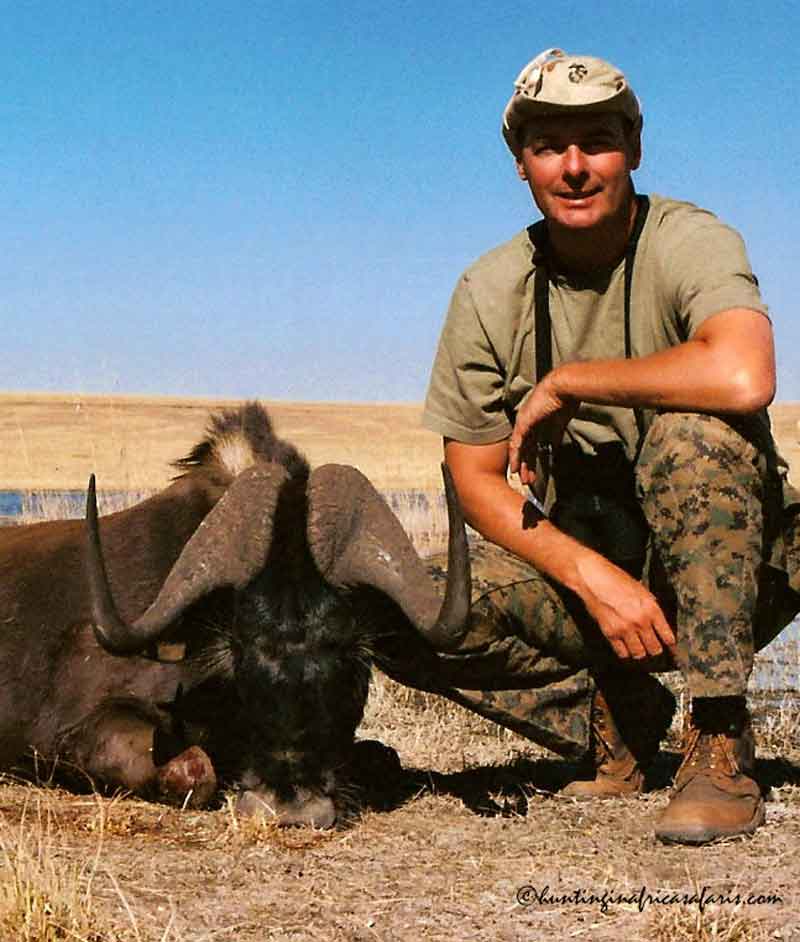
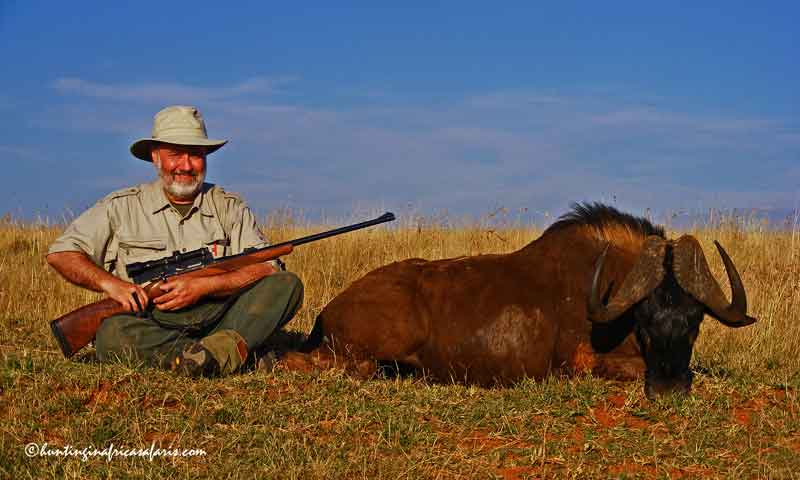
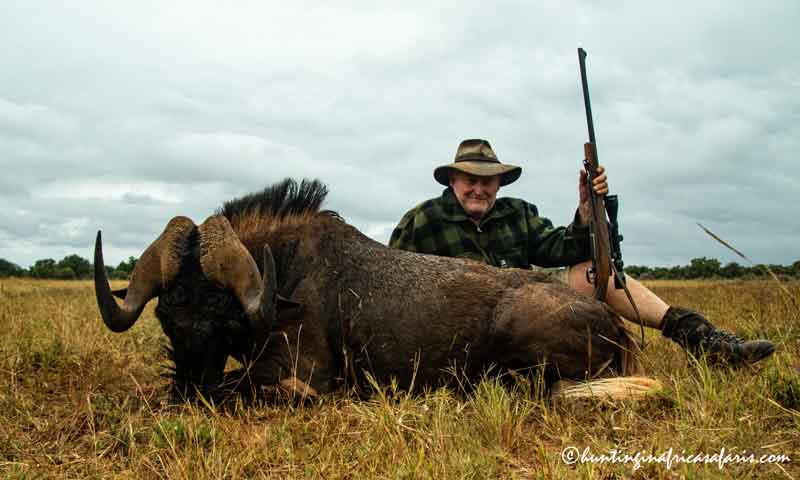
The successful harvest of a Black Wildebeest (Connochaetes gnou) is a rewarding achievement that requires precision and expert fieldcraft. Also known as the White-tailed Gnu, this species offers a unique challenge on the open South African highveld. These photos showcase the magnificent trophies taken by our clients, demonstrating the superior genetics of our concessions and our strict adherence to ethical hunting standards and sustainable conservation practice.




6. Black wildebeest hunting: Frequently asked questions
What is the difference between a Blue and Black Wildebeest?
While both belong to the same genus, the Black Wildebeest (Connochaetes gnou)—also known as the White-tailed Gnu—is smaller and more aggressive. It is easily distinguished by its forward-curving horns and its long, flowing white tail, contrasting with the slate-grey coat and black tail of the Blue Wildebeest.
What is the 2026 trophy fee for Black Wildebeest?
The 2026 trophy fee for a Black Wildebeest bull is generally in line with other premium plains game, reflecting its status as a unique South African endemic. Please refer to our 2026 Price List for current rates and stackable daily fees.
Is the Black Wildebeest difficult to hunt?
Yes. They are often found in open, flat grasslands with very little cover. Their incredible eyesight and "clown-like" erratic behavior make them a challenging pursuit. Success requires patience and a flat-shooting caliber capable of reaching out across the open savanna.
What is the best shot placement for a White-tailed Gnu?
Like its blue cousin, the Black Wildebeest has a deceptive profile. Our senior staff recommends a low and forward shot. Aim in the bottom third of the chest cavity to ensure the bullet reaches the heart and lungs, as these animals are exceptionally hardy and will cover great distances if the shot is placed too high or too far back.
Services
Contact
hunt@huntinginafricasafaris.com
+27 82 824 7681
on Whatsapp and Telegram
Hours
Mondays from: 06:00 - 20:00 (6 am - 8 pm)
Tuesday - Saturday from: 06:00 - 20:00 (6 am - 8 pm)
Sunday: Closed unless we are hunting.