1. Red hartebeest hunting in South Africa: 2026 Prices, calibers and guide
Welcome to the definitive field resource for hunting the red hartebeest (Alcelaphus buselaphus caama) in South Africa. Frequently referred to by professional outfitters as the Harley-Davidson of the veld due to its incredibly powerful, rocking-horse gallop and distinct sloping silhouette, this large antelope represents a prized addition for any dedicated plains game collector. To secure this fast-moving trophy on the open savannas, understanding the red hartebeest hunting cost and dialing in your red hartebeest rifle selection are critical early steps before launching into the tracking areas of the Northern Cape, Kalahari, and North West provinces.
Because this species thrives in wide-open, semi-arid country where shots routinely stretch across large distances, international sportsmen frequently research the best caliber for red hartebeest hunting to ensure their setup can handle the wind and distance. Reviewing the 2026 red hartebeest trophy fees as a plains game package inclusion allows you to seamlessly integrate this challenging walk-and-stalk pursuit into your broader safari itinerary alongside species like gemsbok or springbok.
1.1 The heart-shaped trophy of the African savanna
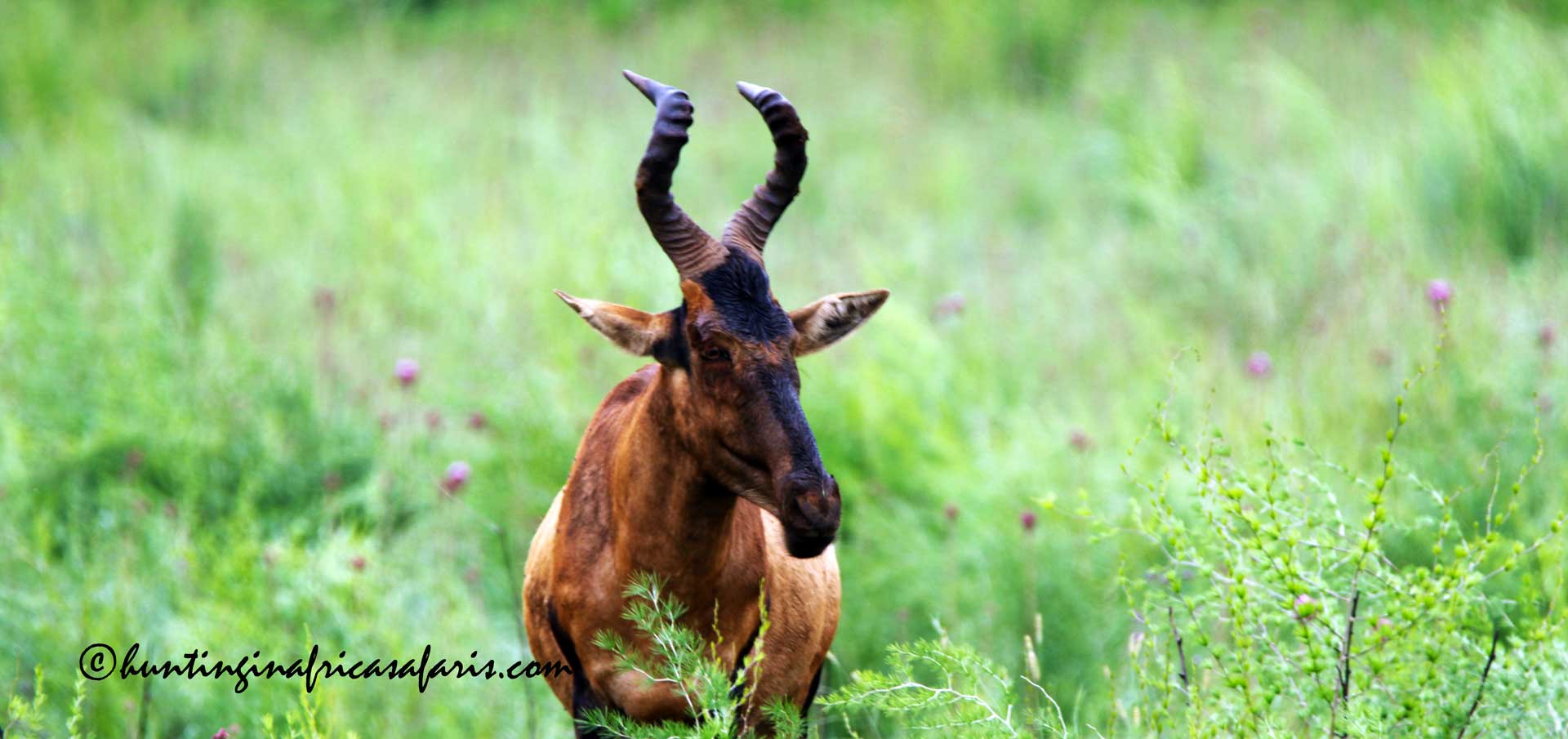
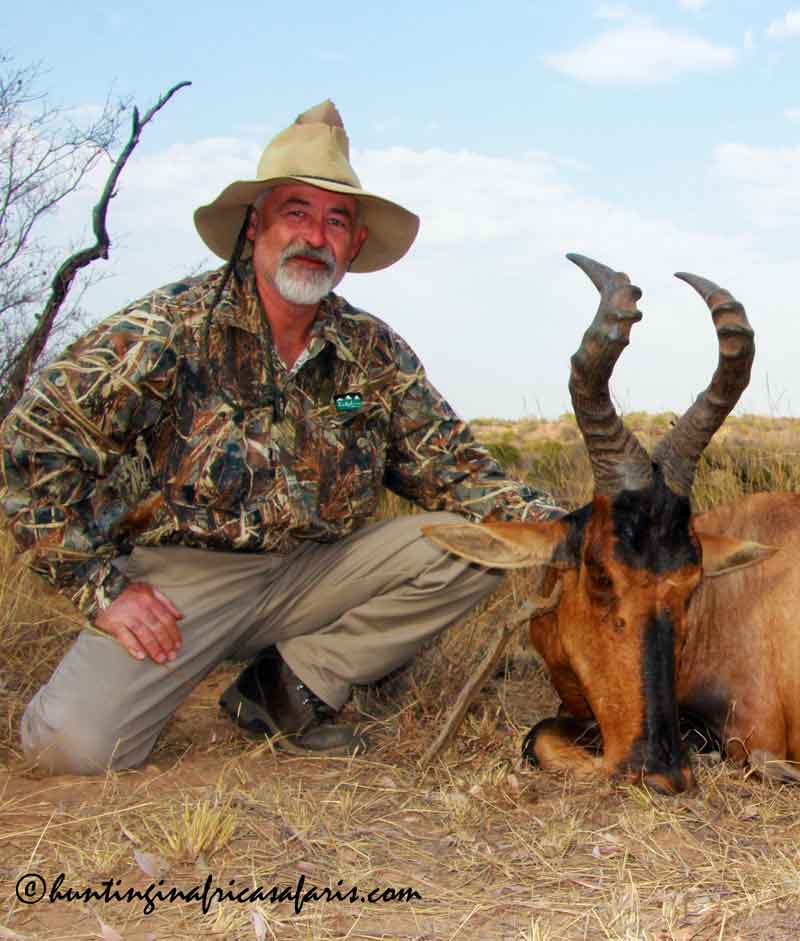
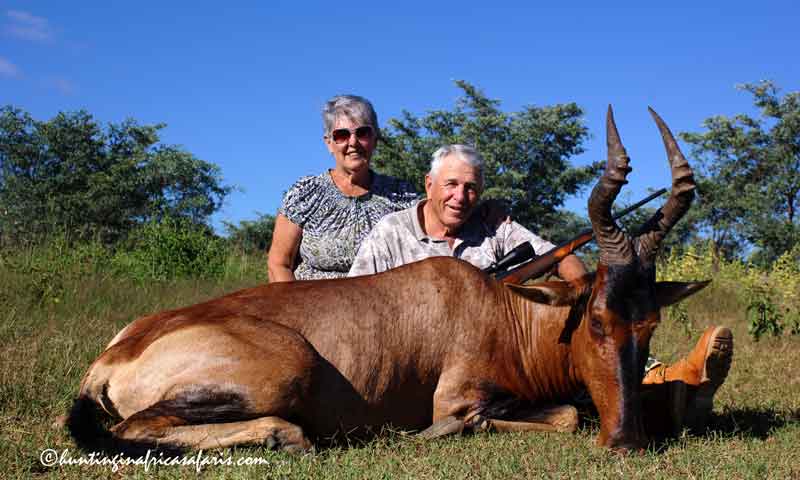
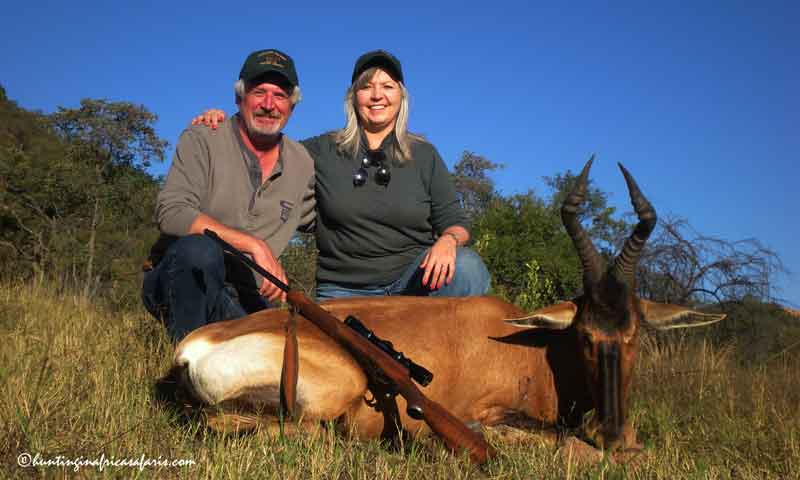
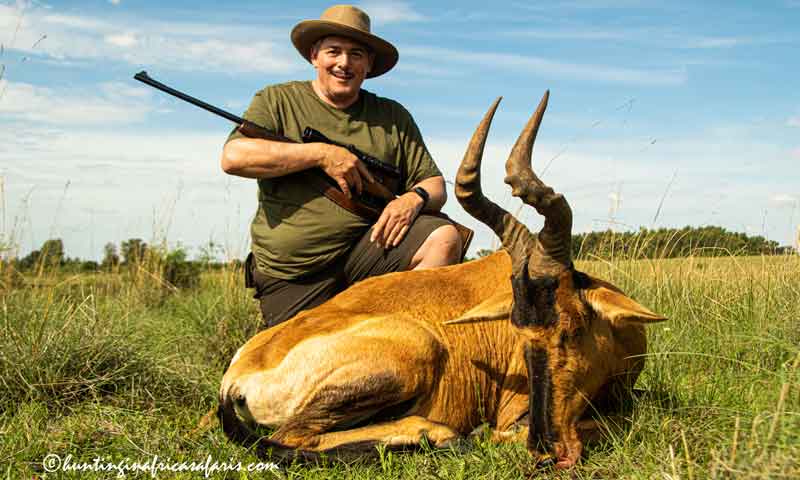
The red hartebeest is physically unmistakable across the bushveld landscape. Dressed in a vibrant, deep reddish-brown coat accented by a contrasting light patch on the rump and a notably elongated, narrow face, its most iconic anatomical feature is the uniquely ridged, heavy S-shaped horn configuration. When viewed directly from the front, these heavily ringed horns form a distinct heart-shaped silhouette—a signature, highly prized trophy layout that stands out dramatically in any custom trophy room collection.
1.2 A formidable plains game quarry: Speed vs intelligence
While the tsessebe holds the record as the absolute fastest antelope in Africa, the red hartebeest tracks closely behind as a dominant runner capable of maintaining blistering, sustained speeds over incredible distances. They are notoriously alert, community-minded sentinels that possess a deceptive, highly analytical intelligence. On savanna properties where they experience consistent hunting pressure, their sharp eyesight and excellent sense of smell make them a formidable quarry that easily tests the patience of any tracking team.
The red hartebeest is famous for its highly inquisitive nature; when startled, a herd will often gallop off at high speed, only to suddenly stop out at 200 to 250 yards, turning broadside to look back at their pursuer. This brief curiosity gap represents the fleeting, high-pressure window where a hunter’s long-range marksmanship, understanding of red hartebeest shot placement parameters, and overall rifle preparation are put to the ultimate field test. We prioritize ethical, fair-chase hunting standards to ensure this magnificent, resilient species continues to thrive natively across the South African interior.
2. Red hartebeest trophy fees and 2026 hunting prices
At African Bushbuck Adventures, we believe in full price transparency to help you plan your dream safari. For the 2026 season, we have updated our rates to reflect the increased demand for high-quality, mature Red Hartebeest trophies and the rising operational costs of maintaining prime Kalahari and North West concessions.
2.1 Official trophy fee for 2026
| Item | 2026 Rate & Details |
| Red hartebeest trophy fee | $ 1,950 |
| VAT information | 15% VAT is not payable on this fee if the trophy is exported. |
| Inclusions | Includes field preparation and delivery to a local taxidermist. |
PH Note on Value: While there has been a slight increase in the 2026 fee, it is important to remember that the Red Hartebeest yields an incredible amount of high-quality venison and a large, durable hide—offering exceptional "value-per-pound" for the traveling sportsman.
2. Red hartebeest hunting price: 2026 Trophy fees and safari costs
Maintaining complete, upfront pricing transparency is the absolute operational foundation of a successful African safari. When international sports hunters evaluate adding this dynamic species to their plains game itinerary, they rely on highly specific digital search queries to calculate their final out-of-pocket safari expenses. The four most prominent terms utilized globally by traveling sportsmen are: red hartebeest hunting price, red hartebeest hunting cost, red hartebeest trophy fee, and how much does a red hartebeest hunt cost.
To completely eliminate confusion and ensure a seamless budgeting process for our international clients, all government value-added tax parameters are already fully accounted for, meaning VAT is included in all prices listed below by African Bushbuck Adventures. For the current 2026 season, we have structured our hunting rates to reflect the premium quality of our mature, record-book caliber breeding bulls while ensuring this legendary savanna speedster remains an accessible, high-value addition to any custom plains game hunting package.
1.2 A formidable plains game quarry: Speed vs intelligence
While the tsessebe holds the record as the absolute fastest antelope in Africa, the red hartebeest tracks closely behind as a dominant runner capable of maintaining blistering, sustained speeds over incredible distances. They are notoriously alert, community-minded sentinels that possess a deceptive, highly analytical intelligence. On savanna properties where they experience consistent hunting pressure, their sharp eyesight and excellent sense of smell make them a formidable quarry that easily tests the patience of any tracking team.
The red hartebeest is famous for its highly inquisitive nature; when startled, a herd will often gallop off at high speed, only to suddenly stop out at 200 to 250 yards, turning broadside to look back at their pursuer. This brief curiosity gap represents the fleeting, high-pressure window where a hunter’s long-range marksmanship, understanding of red hartebeest shot placement parameters, and overall rifle preparation are put to the ultimate field test. We prioritize ethical, fair-chase hunting standards to ensure this magnificent, resilient species continues to thrive natively across the South African interior.
| 2026 Red hartebeest hunting cost and package inclusions | |
|---|---|
| Red hartebeest trophy fee (2026) | $1,950 USD (Flat rate trophy fee with all applicable value-added taxes fully included) |
| Expert PH and field staff | Included in daily rate: Full services of a dedicated Professional Hunter, experienced trackers, and a specialized skinning team trained to handle your cape with absolute care. |
| Luxury safari accommodation | Included in daily rate: Premium thatch-and-stone lodge accommodation featuring full modern amenities, private en-suite facilities, and daily laundry services in our prime Kalahari and North West concessions. |
| Catering and hospitality | Included in daily rate: All gourmet meals, daily track snacks, and full local beverage selection including premium South African estate wines. |
| Field trophy preparation | Included in daily rate: Meticulous field cape skinning, salting, and secure transport delivery from African Bushbuck Adventures directly to our preferred local South African taxidermy studio. |
| Ground logistics and transport | Included in daily rate: All regional ground transportation within the designated hunting area, dedicated 4x4 hunting vehicle logistics, and scheduled airport transfers. |
PH Field Note on Trophy Value: While calculating the final red hartebeest hunting cost, it is important for the traveling sportsman to recognize the exceptional value-per-pound this specific antelope delivers. A mature bull yields an incredible harvest of gourmet, fine-grained venison alongside a large, heavily textured, durable hide. This makes the red hartebeest one of the most rewarding and practical additions to any diverse South African plains game safari package.
3. Best caliber for red hartebeest hunting: Rifle selection and ballistics
When establishing the absolute minimum caliber for red hartebeest, standard small-bore centerfires like the .243 Winchester or .25-06 Remington can legally be deployed under ideal, perfectly calm conditions by highly experienced marksmen. However, to maintain an ethical safety margin against the intense crosswinds of the Kalahari flats, the professional outfitting team at African Bushbuck Adventures highly recommends stepping up to a true medium-bore or a modern precision magnum cartridge.
Terminal bullet construction is just as vital as your overall red hartebeest rifle selection. This antelope possesses an incredibly dense muscle structure and a heavy hide; therefore, deploying premium, controlled-expansion projectiles featuring high weight retention—such as the Nosler Partition, Barnes TTSX, or Swift A-Frame—is essential to guarantee deep, straight-line penetration through the vital chest cavity. For the vast majority of traveling sportsmen, hunting red hartebeest with a .30-06 Springfield, .270 Winchester, or a high-velocity 6.5 PRC provides the perfect combination of mild recoil, flat flight path, and devastating knockdown performance.
3.1 Recommended red hartebeest hunting calibers
| Red hartebeest rifle selection and ballistic performance tiers | |
|---|---|
| The minimum standard | .270 Winchester: Represents the absolute operational baseline for an ethical harvest on this resilient species. It requires premium, heavy 140gr to 150gr controlled-expansion bullets to guarantee full cavity penetration. Smaller light-bore calibers should be strictly avoided due to the animal's dense muscle structure. |
| The PRS/PRC modern class | 6.5 PRC & 7mm PRC: Recognized as the modern 2026 gold standard for wide-open terrain safaris. These specialized, high-velocity cartridges offer superior long-range ballistics, flat trajectories, and exceptional wind resistance when tracking herds across the unshielded Kalahari flats. |
| The pinnacle choice | .308 Winchester: Highly recommended by the African Bushbuck Adventures team for its legendary inherent consistency, mild shoulder recoil, and short-action efficiency. It remains a definitive favorite for fast-paced spot-and-stalk hunting in the dense brush vectors of the North West province. |
| The versatile family | .30-06 Springfield: The ultimate, time-proven all-rounder for African plains game safaris. When paired with a heavy 180gr premium bonded bullet, this classic setup is arguably the most reliable and effective red hartebeest medicine ever brought into the veld. |
| The 7mm family | 7x57 Mauser, 7mm-08, & 7mm Rem Mag: Spanning from the smooth-shooting, classic heritage calibers to the high-velocity belted magnums, the 7mm projectile diameter provides the ideal balance of sectional density and terminal knockdown power for this specific antelope. |
| The .30 caliber magnums | .300 Win Mag & .300 WSM: Highly effective powerhouses built for handling extended distance shooting parameters. These magnums are necessary for open savanna hunts where maintaining maximum kinetic energy retention past 300 yards is critical to anchor a mature bull cleanly. |
3.2 Technical PH note: The humped wither anatomy trap
The red hartebeest (Alcelaphus buselaphus caama) possesses a highly exaggerated, steep skeletal conformation defined by a pronounced, camel-like muscular hump directly above the front shoulders. This distinct structural outline creates an optical illusion that frequently tricks inexperienced sports hunters into misjudging their red hartebeest shot placement parameters.
When looking at the animal broadside, unguided shooters routinely aim too high up the body silhouette, tracking the center of the total vertical mass. A bullet placed along that top line will completely miss the vitals, passing harmlessly through the non-vital spinal fin extensions or wounding the high cartilage tissues without dropping the animal.
When establishing where to shoot a red hartebeest to guarantee an immediate, clean harvest, you must visually disregard the hump entirely. Bisect the true chest cavity by tracing the back edge of the front leg straight upward, placing your reticle roughly one-third of the way up from the belly line. This ensures your projectile punches directly through the thick rib layers to collapse the center of the heart-lung vault.
Because a fleeing herd will often put heavy brush, dense acacia limbs, or tall winter grasses between you and the target, selecting a bullet featuring exceptional sectional density and heavy structural integrity is paramount. You require a controlled-expansion projectile engineered to stay on its flight path without deflecting or breaking apart prematurely if it encounters a tough rib bone on entry.
3.3 Premium bullet selection: Terminal performance over muzzle diameter
While your specific choice of rifle caliber frequently receives the bulk of discussion among traveling sportsmen, it is the individual bullet design that executes the actual work in the veld. For a successful, ethical plains game safari with African Bushbuck Adventures, we strongly prioritize premium bonded or monolithic solid-transfer projectiles over standard soft-point factory ammunition:
-
Nosler Partition: A legendary dual-core design that remains a definitive standard for tough African game. The thin front lead core is engineered to expand rapidly upon initial impact to deliver immediate hydro-static shock, while the integral solid-center partition ensures the heavy rear core remains fully intact, driving deep through thick shoulder bone joints.
-
Barnes TTSX: For the current 2026 hunting season, these monolithic, all-copper hollow points stand as our premier field recommendation for harvesting mature bulls. Because they feature virtually 100% weight retention upon impact, they offer incredible straight-line penetration through the vitals, even when forced to drive through the animal at difficult quartering angles.
Professional Outfitter Advice: Raw muzzle velocity is merely a baseline guideline, never an absolute rule. Your personal familiarity with your rifle, paired with your absolute confidence to execute a clean shot under fluctuating field conditions—such as sudden Kalahari crosswinds, tall savanna grass, and shifting target distances—will consistently outperform a massive, heavy-recoiling magnum caliber that you are hesitant to squeeze under pressure.
4. Red hartebeest shot placement parameters: High-intent vital guide
Mastering precise red hartebeest shot placement parameters requires a technical understanding of the species' unique, highly asymmetrical skeletal structure. Unlike a standard African antelope ram, the red hartebeest (Alcelaphus buselaphus caama) displays a dramatic, aggressive slope running from its high, muscular withers down to its lower hindquarters. Visually aiming for the center of the vertical mass on a broadside animal routinely results in a disastrously high, non-lethal hit that passes through the non-vital spinal fin structure.
By studying the red hartebeest vital zone anatomy chart above, you can clearly see how the critical heart and lung cavity is tightly packed low and forward within the chest frame, sitting directly behind the heavy protective bone network of the front shoulder assembly.
4.1 Technical target zones for a clean harvest
| Anatomical vital zones and professional field guidance | |
|---|---|
| The heart zone (indicated in red) | Low and forward placement: Center your crosshairs precisely along the lower third of the body mass, directly in line with the rear edge of the front leg. Punching a bullet through this pocket disrupts the primary cardiac muscle walls, ensuring an immediate, humane anchor with minimal tracking required. |
| The lung vault (indicated in blue) | Broadside chest presentation: Target the exact intersection where the vertical line of the front shoulder crease meets the horizontal line one-third of the way up from the belly line. This entry path drives your projectile straight through the center of the respiratory vault, collapsing both lung lobes instantly. |
| The quartering-away angle | Highly recommended field setup: This specific presentation provides an incredibly high-percentage entry vector into the vitals. Aim for the opposite front shoulder by slipping the bullet through the rear ribs, completely bypassing the heavy, dense front leg bones while maintaining an expansive path to the heart-lung cavity. |
| The humped wither anatomy trap | Strictly avoid high shots: Do not let the heavy vertical silhouette of the forward body trick you into aiming high. The prominent hump rising above the shoulder line consists almost entirely of thick muscle fibers and structural bone fins; a high impact here leads to an unsuccessful, long-distance track. |
4.2 Professional hunter field tips for an ethical harvest
When executing a walk-and-stalk safari across our Kalahari concessions, our guiding team relies on practical field rules to ensure clean, unquestionable results when deciding where to shoot a red hartebeest:
-
The absolute one-third rule: Always visualize the entire vital pocket as sitting strictly within the bottom third of the chest cavity. Because of the animal's exceptionally elongated, narrow face and its high, sweeping withers, the body mass looks significantly deeper to the eye than it actually is.
-
Managing dense bone deflection: Red hartebeest possess incredibly compact, dense shoulder blade and brisket bones. To mitigate the risk of premature bullet fragmentation, the tracking team at African Bushbuck Adventures recommends avoiding a direct, centered shoulder bone shot. Instead, tuck your bullet directly behind the prominent crease of the front leg to gain immediate, unhindered access to the lung tissue.
-
Navigating the inquisitive turn: When a startled bull leverages its incredible speed to break away before stopping to look back at your position, it will rarely stand perfectly square. They almost always settle into a slightly quartering-on or quartering-away posture. Take that vital extra second on the shooting sticks to correctly assess the true angle of the spine, ensuring your bullet carries a clear, straight entry line directly into the red heart or blue lung zones.
Professional Outfitter Advice: Our 29 years of continuous experience in the South African outfitting industry have proven that a versatile
.30-06 Springfieldor a modern, flat-shooting7mm PRCloaded with premium bonded or monolithic bullets will easily handle minor rib bone contact. However, no amount of raw ballistic velocity can ever replace the absolute field discipline of waiting for the animal to present the correct physical angle before squeezing the trigger.

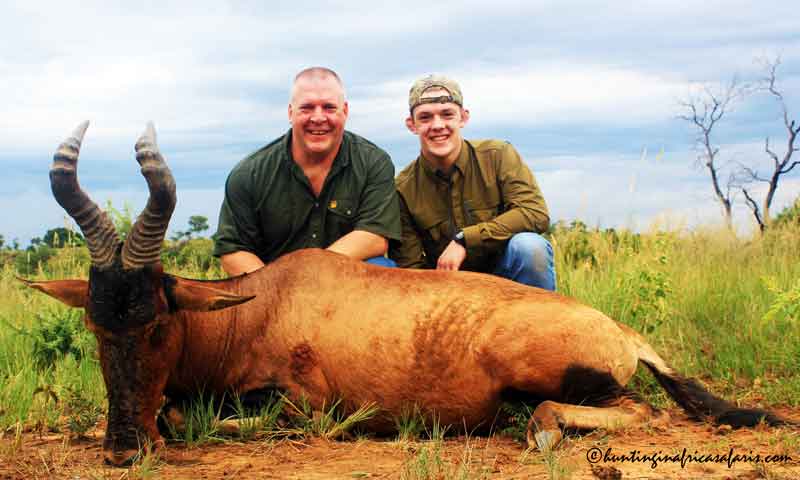
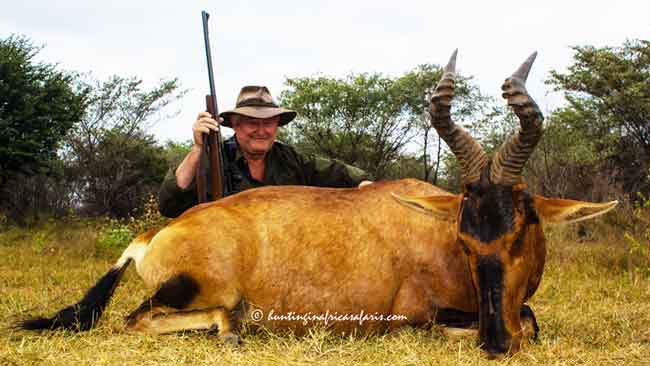
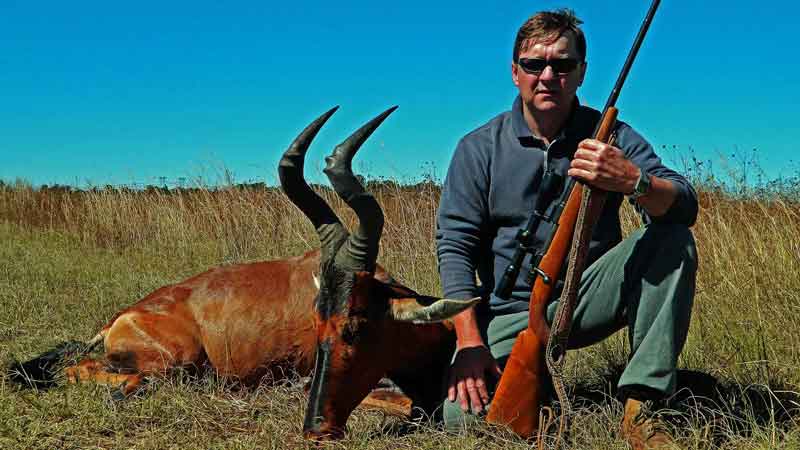
5. Red hartebeest trophy gallery: Plains game hunting in South Africa
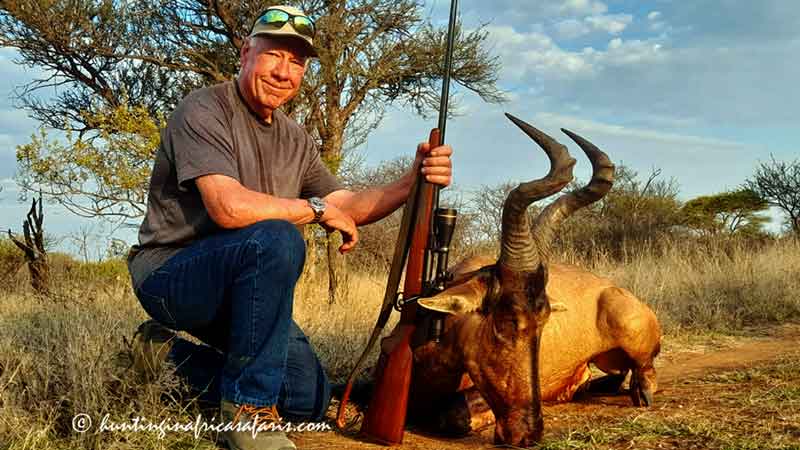
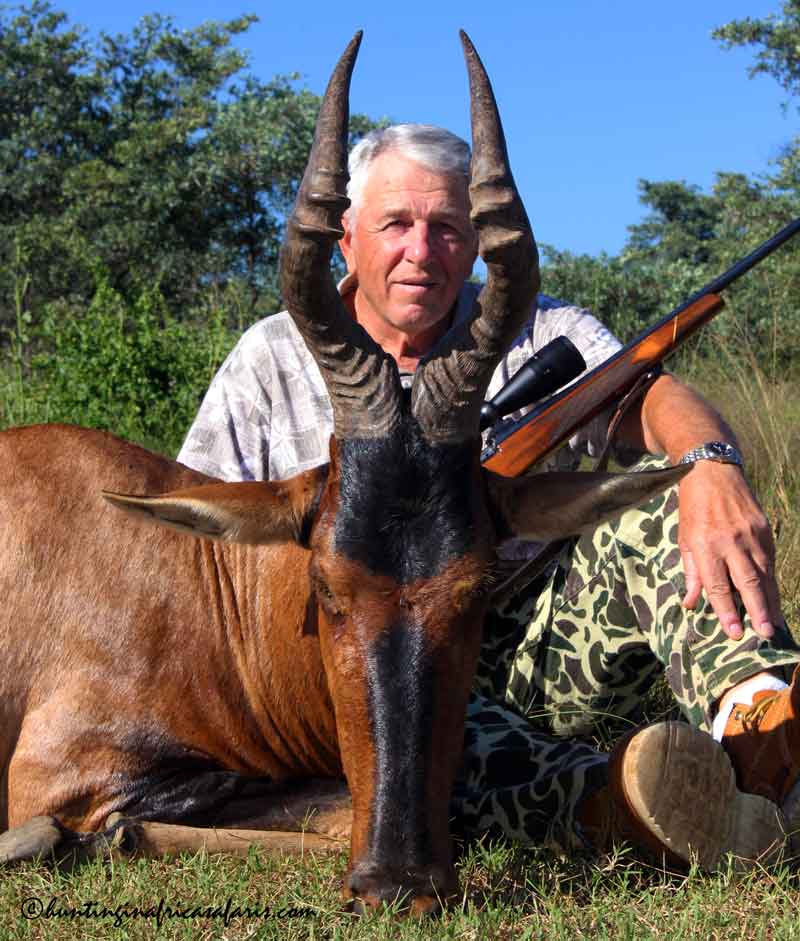
Explore our comprehensive visual log detailing successful walk-and-stalk pursuits across the vast South African interior. These images go significantly beyond a simple harvest portrait; they serve as an educational field record showcasing the elite red hartebeest trophy size and exceptional horn mass that mature Kalahari and North West province bulls consistently provide to our visiting sports hunters.
5.1 Field identification: Assessing a mature red hartebeest bull from photos
Securing your animal under strict fair-chase standards is only the first half of a lifelong memory. Preserving the striking physical profile of this unique antelope requires meticulous skinning techniques, immediate field salting, and professional cape management.
At African Bushbuck Adventures, our 29 years of hands-on industry experience ensure that your cape is treated with absolute care from the square moment of harvest. We deliver your raw trophy directly to our trusted local South African studios to create museum-quality red hartebeest taxidermy mounts.
Whether you select a classic upright shoulder mount to highlight the unique front-facing heart shape of the horns, a dramatic wall-pedestal display, or a beautiful flat-skin rug configuration, your finished trophy will stand as a permanent monument to a hunt that required defeating the finest open-country senses in the African bushveld.

6. Species biology and conservation (Alcelaphus buselaphus caama)
The red hartebeest (Alcelaphus buselaphus caama) is an intensely fascinating plains game animal displaying highly specialized anatomical adaptations perfectly engineered for thriving across the demanding South African bushveld and open savannas. Instantly recognized by its aggressively sloping backline, heavily muscled shoulders, and elongated, narrow skull structure, this resilient species stands as a true masterpiece of evolutionary design.
Every facet of its skeletal frame is optimized for extreme high-endurance running and long-term hydration survival within arid, unforgiving environments. Understanding these biological traits provides traveling sports hunters with the critical insights required to effectively anticipate herd movements during a walk-and-stalk safari tracker sequence.
6.1 Technical biological specifications
| Red hartebeest scientific specification and data profile | |
|---|---|
| Scientific classification | Alcelaphus buselaphus caama (Commonly referred to as the Red Hartebeest or the Harley-Davidson of the veld) |
| Average shoulder height | Standing between 125 cm to 135 cm (50 to 53 inches) tall at the high point of the withers. |
| How much does a red hartebeest weigh | Mature cows average up to 120 kg (265 lbs), while dominant breeding bulls scale out between 150 kg to 182 kg (330 to 400 lbs). |
| Gestation and reproduction | An average gestation period lasting 8 to 9 months, yielding a single, highly mobile calf typically dropped during the early summer calving season. |
| Herd social structure | Highly gregarious social groups forming dynamic family herds of 20 to 30 individuals, fiercely protected by a single, strictly territorial alpha bull. |
| Sustained red hartebeest top speed | Capable of reaching a blistering maximum speed of 75 km/h (46 mph). This ranks them as one of the fastest plains game animals on earth, running second only to the tsessebe. |
| Primary red hartebeest habitat | Arid Kalahari sandveld, wide grassland pans, open savannas, and lightly wooded camel thorn bushveld sectors. |
6.2 Why hunt the red hartebeest on a South African safari?
Hunting the red hartebeest offers traveling sportsmen one of the most intellectually engaging, physically testing, and rewarding safari experiences available on the continent. Because they are endowed with remarkable red hartebeest top speed metrics and intense physical stamina, these wary antelopes can completely outlast and outrun almost any natural predator across a prolonged tracking stretch.
When you book a plains game package with African Bushbuck Adventures, you are committing to a true test of fair-chase fieldcraft. Navigating their native red hartebeest habitat requires silent movement, expert wind management, and absolute steady nerves on the shooting sticks. Securing a mature, heavy-based bull not only provides a visually stunning, heart-shaped conversation piece for your trophy showroom, but it also supports vital, conservation-led hunting initiatives that directly fund the long-term habitat protection of this magnificent African speedster.
6.3 The Harley gait and open savanna survival
The red hartebeest possesses a highly distinctive, bouncing, rocking-horse gallop that professional hunters often refer to as the Harley gait. While this undulating movement pattern may appear somewhat uncoordinated to the untrained eye, it is actually a masterpiece of natural locomotion engineering. This specific gait allows the animal to maintain its blistering red hartebeest top speed metrics over immense distances without experiencing the rapid muscle fatigue that quickly plagues pursuit predators on the open plains.
In addition to this high-endurance running framework, their exceptionally elongated skulls feature high-set orbital sockets positioned near the very top of the head line. This strategic anatomical placement provides the herd with a nearly 360-degree field of vision while grazing, allowing them to spot movement above the tall winter grass lines effortlessly. Launching a walk-and-stalk safari within their native red hartebeest habitat stands as a definitive, high-stakes test of a sportsman’s absolute patience, silent footwork, and tactical use of available bushveld cover.
6.4 Wildlife conservation and the financial engine of sustainable hunting
The historical preservation and expansion of the red hartebeest across South Africa represents a monumental conservation success story driven almost entirely by the private game ranching sector. Once significantly reduced in native numbers across their historical range due to agricultural fence lines and cattle overgrazing, the species has experienced a massive, multi-decade population resurgence directly fueled by its high value within the sustainable hunting practices framework.
-
Natural habitat restoration: By establishing a clear commercial value for mature breeding bulls, vast tracts of marginalized land previously degraded by intensive cattle farming have been successfully cleared and restored back into pristine, unfragmented wild bushveld ecosystems.
-
Scientific population management: Implementing selective, controlled hunting quotas targeting past-prime, solitary bulls allows for healthier herd genetics, reduces intra-species territorial mortality, and actively prevents localized overgrazing within fragile semi-arid zones like the Kalahari sandveld.
-
Long-term ecological sustainability: Every single individual trophy fee contributed by the traveling clients of African Bushbuck Adventures is funneled directly back into the anti-poaching security, water infrastructure development, and day-to-day management of these wild herds. This direct financial engine guarantees that Alcelaphus buselaphus caama remains a thriving, permanent fixture on the South African horizon for generations to come.
7. Frequently asked questions: Red hartebeest hunting
The following are the questions about Red hartebeest we get asked most frequently:
Is the Red Hartebeest the fastest antelope in Africa?
No. While the Red Hartebeest is incredibly fast (reaching speeds of 70 km/h), the Tsessebe is officially the fastest antelope in Africa. However, the Hartebeest is known for its superior endurance and its unique "rocking-horse" gallop, which allows it to maintain high speeds over long distances across the savanna.
What is the best caliber for hunting Red Hartebeest?
For the open plains of the Kalahari or North West, we highly recommend flat-shooting calibers like the 6.5 PRC or 7mm PRC. Traditional favorites like the .30-06 and .308 Winchester remain excellent choices. The key is using premium bonded bullets (like Nosler Partition) to ensure penetration through their dense shoulder structure.
Why is it called the "Harley-Davidson of the veld"?
This nickname comes from the animal’s distinct silhouette and its heavy, rhythmic galloping gait. The high withers and sloping back, combined with its powerful movement, remind many hunters of the classic American motorcycle.
Where should I aim on a Red Hartebeest?
Because of their high shoulder hump, you must avoid aiming too high. The most effective shot placement is the lower third of the body, directly behind the front shoulder crease. This targets the heart (red zone) and lungs (blue zone) for an immediate, ethical harvest.
Do I have to pay VAT on my trophy fee?
In South Africa, the 15% Value Added Tax (VAT) is not payable on the Red Hartebeest trophy fee ($1,950) provided the trophy is exported to your home country. This represents a significant saving for international hunters.
Services
Contact
hunt@huntinginafricasafaris.com
+27 82 824 7681
on Whatsapp and Telegram
Hours
Mondays from: 06:00 - 20:00 (6 am - 8 pm)
Tuesday - Saturday from: 06:00 - 20:00 (6 am - 8 pm)
Sunday: Closed unless we are hunting.