
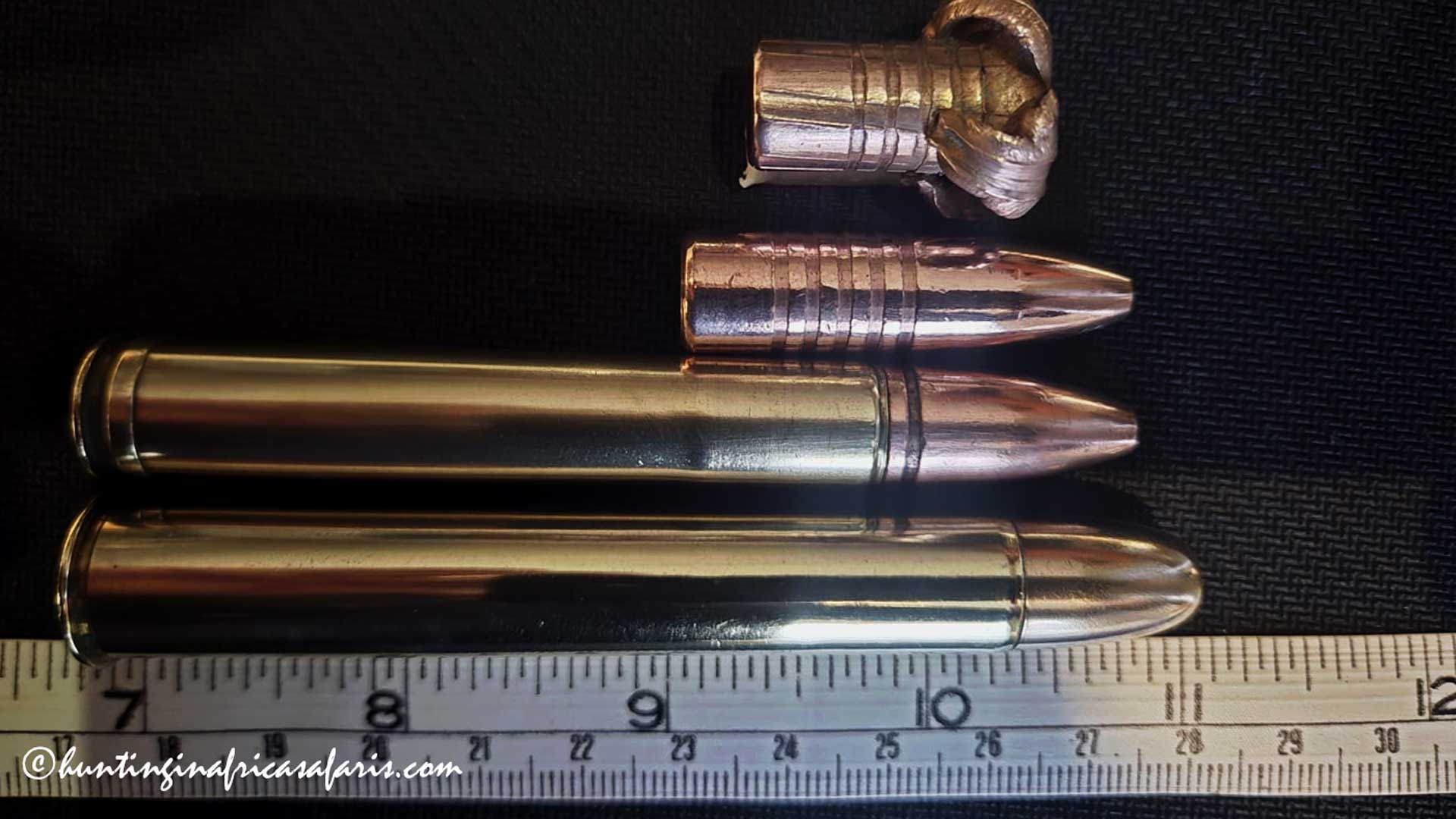
Selecting dangerous game ammunition
Selecting the right bullet construction for dangerous game is the most critical decision a hunter makes before a safari. While many focus on the rifle, the bullet is the only part of your gear that actually makes contact with the animal. In this guide, we analyze why premium bullet construction for dangerous game—specifically for heavy-hitters like Cape buffalo—is the difference between a successful harvest and a dangerous follow-up.
Selecting the right bullet construction for dangerous game is the most critical decision a hunter makes before a safari. While many focus on the rifle, the bullet is the only part of your gear that actually makes contact with the animal. In this guide, we analyze why premium bullet construction for dangerous game—specifically for heavy-hitters like Cape buffalo—is the difference between a successful harvest and a dangerous follow-up.
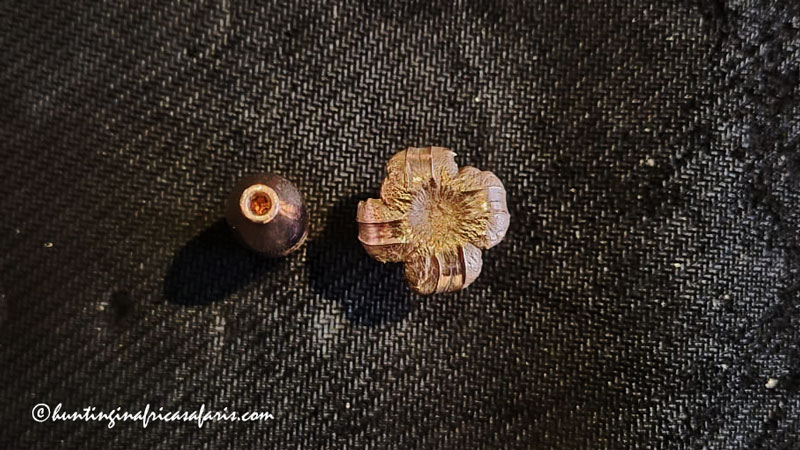
Top-down forensic analysis of expanded soft-point bullet diameter uniform growth.
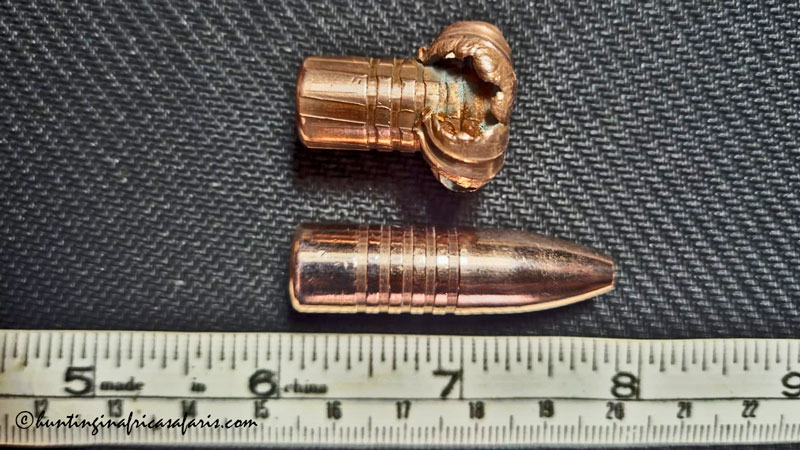
Barnes TSX copper monolithic bullet recovered with four razor-sharp expanded petals intact.
1. Momentum vs. velocity (The freight train effect)
Some modern hunters are obsessed with high velocity—the speed at which the bullet leaves the muzzle. While speed is great for flat shooting at long distances, in the world of dangerous game, momentum is the king of the bush.
- Velocity is like a sports car hitting a wall; it carries substantial kinetic energy, but it can shatter or deflect upon impact with heavy bone.
- Momentum is like a slow-moving freight train. Speed is secondary; once that mass starts moving, stopping it requires immense resistance.
When facing a Cape buffalo (Syncerus caffer) at 30 yards, you want a heavy bullet with high momentum that will punch through the heavy shoulder boss or thick ribs and keep traveling until it reaches the heart-lung vitals.
2. Sectional density (The spear factor)
Sectional density (SD) is the ratio of a bullet's weight to its diameter. Think of it like this: if you throw a golf ball and a long steel spear with equal force, the spear penetrates far deeper because its weight is concentrated behind a smaller frontal area.
For dangerous game, we look for high sectional density (typically .300 or higher). High SD ensures the projectile stays on its straight terminal path and does not tumble when striking massive muscle or heavy bone structure.
PH field note
In all our time professional hunting, we have seen high-velocity varmint-style bullets literally vaporize on the shoulder of a big bull without reaching the lungs. In Africa, we hunt for the exit hole. If a bullet does not have the construction to stay together and the momentum to pass through, it is not fit for dangerous game.
3. Terminal ballistics: Expansion vs. penetration
This is where the physical engineering of the projectile dictates the outcome of the hunt. A constant mechanical trade-off exists between how wide a bullet mushrooms and how deep it penetrates.
- Controlled expansion: Premium bonded soft-points. These are engineered to expand to roughly double their initial diameter, creating a massive permanent wound cavity while holding 90% or more of their weight together.
- Deep penetration: Solid homogeneous or steel-jacketed non-expanding bullets. Solids do not mushroom. Their sole mechanical purpose is traveling straight through feet of dense bone, heavy muscle, and thick hide. This is your insurance policy projectile.
4. The mechanics of the wound channel
When a premium expanding bullet strikes an animal, the front section peels back into symmetrical petals. This increased frontal area effectively doubles the bullet diameter. As the projectile rotates at high spin rates, these sharp petals act like a high-speed blender, severing major blood vessels to maximize hemorrhage. The more vascular infrastructure destroyed, the faster the animal expires.
5. Hypovolemic shock: The drain-plug effect
Hypovolemic shock occurs when an animal loses a massive volume of blood in a brief time frame. As arterial pressure collapses rapidly, the brain is starved of oxygen. The animal loses consciousness because the cardiovascular system can no longer supply blood to the brain. This remains the most reliable mechanism for bringing down thick-hided game with broadside vital shots.
6. Central nervous system (CNS) hits and the fake drop
When an animal drops instantly to the shot, it is usually due to electrical system failure rather than circulatory collapse. A direct hit to the brain or spinal cord causes immediate neurological failure.
However, if a heavy bullet passes close to the spinal column without severing it, the hydraulic shock wave can cause temporary neurological paralysis. The animal drops like a stone, but within a few seconds or minutes, the spinal shock dissipates, the system reboots, and the bull gets up—often with extreme aggression.
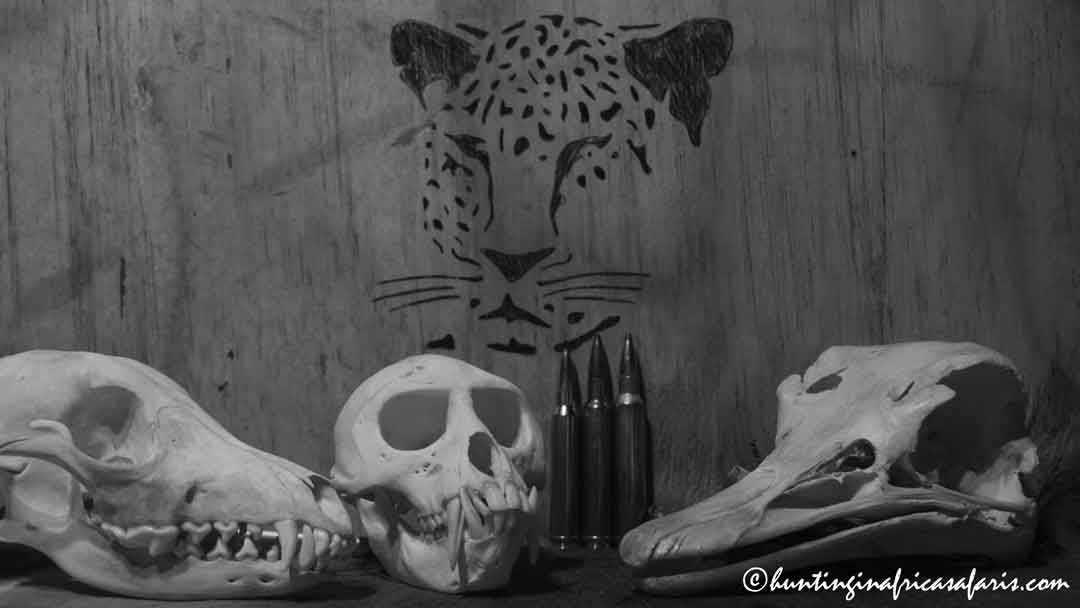
Anatomical skull and brain cavity alignment for central nervous system placement on dangerous game.
PH perspective
In 30 years of outfitting, we have seen many hunters celebrate a downed animal only to have it vanish into thick bush moments later. It is the dead ones that kill you. If an animal drops instantly on the spot, reload immediately, keep your crosshairs on the vitals, and wait for your professional hunter to give instructions. In the African bush, an animal is not dead until your PH confirms it.
7. Specifics of bullet construction
| Premium dangerous game bullet design comparison | |
|---|---|
| Swift A-Frame | The gold standard for big cats and buffalo softs. The internal copper divider ensures the rear core remains intact for penetration while the front jacket mushrooms perfectly to double caliber. |
| Barnes TSX | Monolithic copper construction famous for opening into four sharp petals with near 100% weight retention, shedding no lead fragments in tissue. |
| Banded Solids | Essential for elephant (Loxodonta africana) brain and hip shots. Non-expanding alloy construction ensures true, straight penetration through massive bone structures without deflecting. |
8. Recommended bullet weights for dangerous game
| Recommended bullet weights by dangerous game caliber | |
|---|---|
| .375 H&H / .375 Ruger | 300 to 380 grain: the classic all-rounder offering ideal balance of penetration and shock for lion, leopard, and Cape buffalo. |
| .416 Rigby / Rem / Ruger | 400 grain: the global standard for the .416 family, delivering the necessary momentum to reach vitals from heavy quartering angles. |
| .458 Win Mag / .458 Lott | 450 to 500 grain: heavy caliber option delivering massive crushing force required for backup and stopper rifles. |
| .500 / .505 Big Bores | 525 to 600 grain: heavyweight dangerous game projectiles that maintain straight tracking through thick bone and dense muscle. |
PH ballistic note
Care must be taken when selecting heavy bullet weights in specific calibers. In the .375 H&H Magnum, the 380 gr bullet by Rhino performs exceptionally well with perfect mushroom expansion and weight retention upon recovery.
However, the bearing shank of heavy projectiles is long. Over time, deep seating can lead to powder compression, which may cause erratic deflagration (inconsistent powder burn) and variable muzzle velocity.
The same principle applies to 500 gr bullets in the .458 Win Mag. While 500 gr weight functions perfectly in the longer .458 Lott case, we recommend using a 450 gr bullet in the .458 Win Mag to preserve powder space, ensure uniform ignition, and maintain reliable velocity.
Dangerous game safari resources
Confirm your rifle setup matches statutory provincial minimums by reading our full guide to dangerous game hunting calibers.
Ready to test your gear in the bush? Explore our Cape buffalo hunting packages or review all-inclusive dangerous game hunting safari packages.