
Duiker hunting South Africa: prices 2026, best calibers & safari guide
Welcome to the absolute guide for common duiker hunting in South Africa. The common duiker (Sylvicapra grimmia), also known as the grey duiker, is arguably the most resilient and widely distributed member of the prestigious Tiny 10 pygmy antelopes grand slam. Thriving across almost every ecological zone from the dense bushveld to the high-altitude grasslands, this master of camouflage presents a classic tracking challenge for international collectors.
Our 2026 common duiker safari packages are structured for hunters who value authentic spot-and-stalk tactics. Because of their compact size and thin skin, careful caliber and bullet selection are absolute technical necessities to balance clean harvesting with zero cape destruction at the skinning shed. At African Bushbuck Adventures, we provide the expert outfitting and meticulous field preparation required to secure a gold medal caliber representative of this cunning small antelope.
Planning a full pygmy antelope slam?
Explore the master guide to hunting the Tiny 101. Common duiker hunting prices and safari costs 2026
To ensure total transparency for our guests, we have structured our Tiny 10 hunting fees to be straightforward. The common duiker can be readily integrated into any multi-species safari or hunted as part of a dedicated small antelope package. The following rates apply for the 2026 season.
1.1 Common duiker hunting fee structure
| Service or trophy | Rate (VAT incl.) |
| Common duiker trophy fee | $650 |
| Professional hunter & tracker | Included |
| Field prep (delicate cape) | Included |
| Permit & conservation fees | Included |
| Wounded or lost animal | Full trophy fee |
1.2 Important safari pricing details
-
All-inclusive rates: To simplify your planning, all rates provided by African Bushbuck Adventures include the 15% south african Value Added Tax (VAT). We believe in flat, honest pricing with no hidden tax surprises at the end of your safari.
-
Abundant opportunity: Because common duiker are highly adaptable and abundant across our primary concessions in Limpopo, the North West, and the Free State, they are typically encountered naturally during regular plains game hunting operations.
-
Cape preservation: Our field preparation is meticulous. We prioritize the careful handling of the delicate facial skin and prominent scent glands, ensuring your trophy reaches your taxidermist in world-class condition.
2. Caliber selection for common duiker hunting South Africa
When hunting common duiker, the primary ballistic challenge is managing kinetic energy over variable distances. Traditional plains game expanding bullets traveling at velocities above 2,700 feet per second (823 meters per second) carry a hydrostatic shock profile that will instantly tear the delicate skin of a small antelope. Because these safaris are focused entirely on absolute trophy cape preservation for museum-quality taxidermy mounts, your bullet construction and velocity profile must minimize tissue disruption.
In the field, prepared international collectors utilize two distinct, deliberate ballistic strategies for duiker.
2.1 Dedicated low-velocity centerfires
Carrying a dedicated small-bore rifle is an exceptionally effective approach for targeted duiker safaris. Small, mild centerfire calibers deliver the flat trajectory needed for precise shot placement across open ground or acacia scrub without excessive energy transfer.
-
.22 Hornet: Excellent for close-range encounters along brush lines; its mild velocity leaves clean entry and exit holes that are effortlessly repaired by a taxidermist.
-
.222 or .223 Remington: Highly accurate and consistent for open plains stalking. When utilizing these calibers, choose tough, heavy-for-caliber monolithic solids or full metal jacket bullets rather than rapid-expansion varmint or cup-and-core loads.
-
.22-250 Remington or .243 Winchester: Ideal for longer shots across open veld where wind is a factor, provided they are loaded strictly with non-expanding solid bullets.
2.2 Heavy calibers with deliberate solid bullet selection
Many collectors prefer to hunt the entirety of their safari with a single, familiar medium or dangerous game rifle (ranging from a .30-06 Springfield up to a .375 H&H Magnum). This approach is highly effective, provided the hunter prepares explicitly by packing specialized ammunition.
Firing a standard expanding cup-and-core hunting bullet from these larger rifles will result in catastrophic cape destruction. To hunt pygmy antelopes successfully with a large caliber, you must deliberately chamber a non-expanding monolithic solid bullet or a heavy full metal jacket.
Field Note: A solid bullet deployed from a large caliber passes cleanly through the chest cavity of a small antelope like a solid steel rod. It punches a neat, caliber-sized hole through the ribs, disrupting minimal tissue and leaving the shoulder skin completely intact for a flawless full-mount.
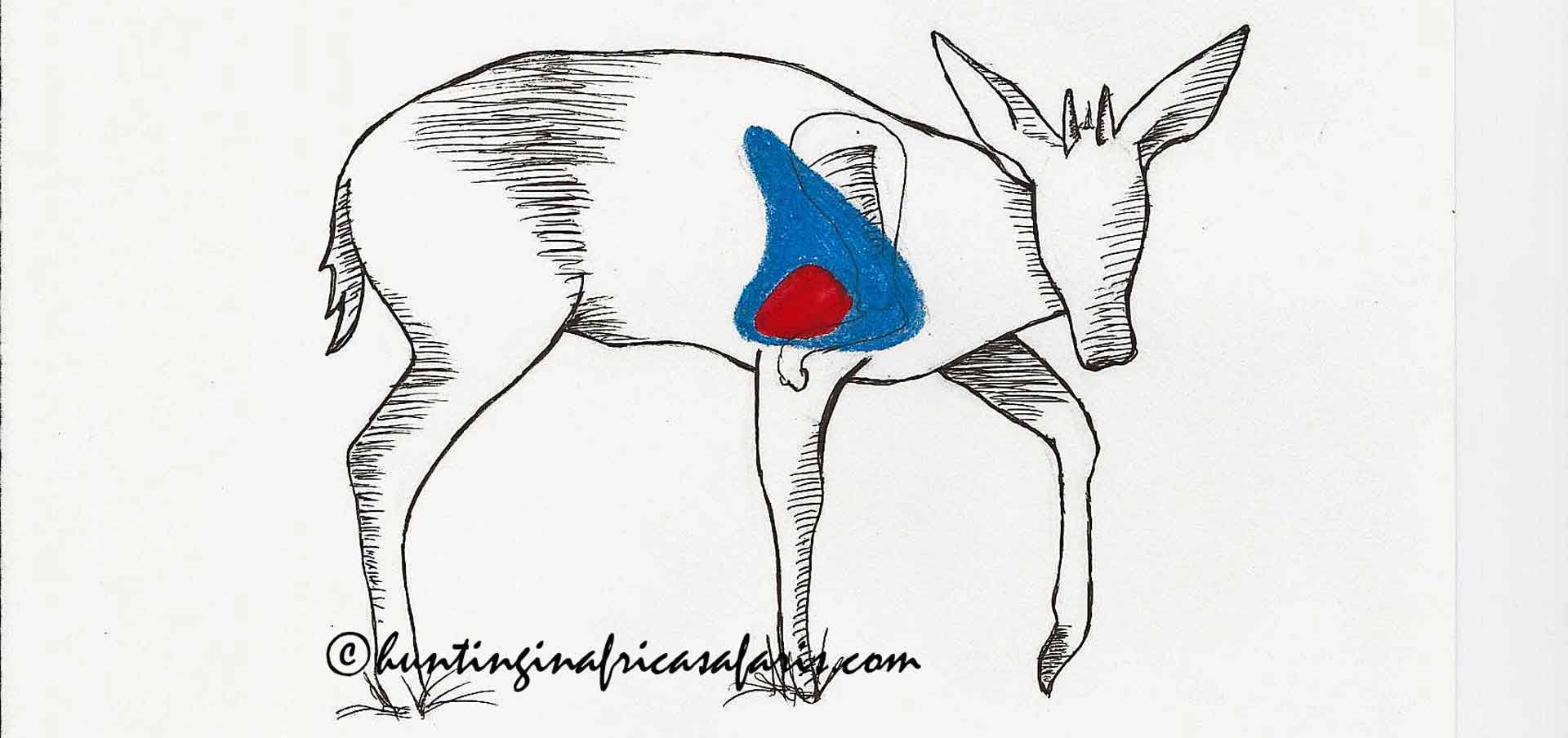
3. Shot placement: Common duiker (Sylvicapra grimmia)
Precision shot placement is the absolute hallmark of a successful duiker hunt. Because of their tiny internal vital zones and tendency to stand in thick cover, there is a very narrow margin for error.
3.1 Shot placement configurations
| Aspect | Details |
| Broadside aim | Aim straight up the front leg, approximately one-third up into the chest cavity. |
| The tiny target | The vital heart-lung area is roughly the size of a small orange or grapefruit. |
| The quartering angle | Aim for the off-side front shoulder to ensure a clean path through the chest. |
| Cape preservation | Avoid heavy bone structure if possible to prevent any pelt tearing from bullet exit paths. |
3.2 Technical PH insight: Stalking and habits
The common duiker gets its name from the Afrikaans word duiker, meaning diver, which perfectly describes its habit of diving into dense bushes when alarmed. Unlike open-plains game, common duikers rely heavily on freeze mode camouflage and freeze in place within thick scrub until they feel directly threatened.
When they bolt, they move in a frantic, stays-low-to-the-ground zig-zag sprint. Hunting them successfully requires a slow, deliberate walk-and-stalk approach along the edges of old lands or dense brush lines at first light. You must be completely set up on your shooting sticks, as shots often present themselves in a matter of seconds when a ram stops briefly before entering a thicket.
4. Common duiker trophy Gallery: Tiny 10 Success Stories
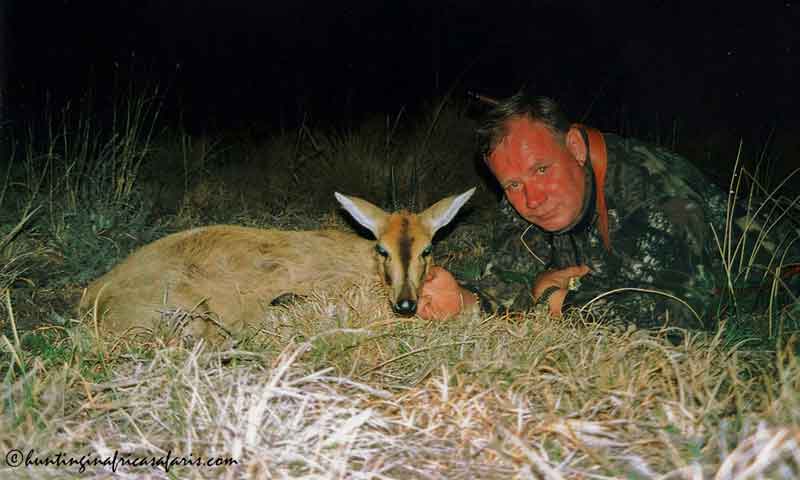
The Common Duiker (Sylvicapra grimmia) is more than just a widespread small antelope; for the international collector, it is a critical entry into the coveted Tiny 10 of Africa. These success stories highlight the patience required to glass for a mature ram’s horns amidst the dense wait-a-bit thorns of the South African bushveld.
Our gallery showcases the exceptional trophy quality possible through expert scouting and ethical, fair chase hunting practices. Each image demonstrates the distinct facial markings and vertical horn growth that define a record-class specimen. Browse our recent harvests to visualize the precision and stealth required to secure your own Grey Duiker trophy in the premier hunting concessions of South Africa.
4.1 Common duiker success stories
| Trophy Quality & Location | Safari Highlights & Field Notes |
| Gold Medal Class Ram | Method: Early morning glassing in the Limpopo Province. A massive ram with 5.5-inch horns taken with a single .223 headshot. |
| The Grey Ghost Specimen | Method: Walk and stalk in the Eastern Cape thickets. This old ram showcased incredible horn mass and the classic dark facial blaze. |
| Tiny 10 Starter Trophy | Method: Opportunistic harvest during a broader plains game safari. A clean, needle-hole harvest using a .308 with a monolithic solid. |
| Record-Book Mature Ram | Method: Stalking along a riverbed at dusk. This trophy is a prime example of the symmetry and length required for a top-tier mounting. |




5. Species biology and conservation (Sylvicapra grimmia)
Understanding the biology of the Common Duiker (Sylvicapra grimmia) is essential for any hunter pursuing the prestigious Tiny Ten collection. Often referred to as the Grey Duiker or the Grey Ghost of the Thicket, this species is the most widespread of all the small African antelope. Unlike its forest-dwelling cousins, the Common Duiker has adapted to a vast range of environments, from the arid Kalahari to the dense bushveld of the Limpopo. Its unique name is derived from the Afrikaans word duiker, meaning diver, which describes its distinctive habit of plunging into dense vegetation when startled. For the trophy hunter, identifying a mature ram requires a keen eye for horn mass and the characteristic dark blaze that runs down the center of its face.
5.1 Key species details & Taxonomy
| Biological Aspect | Technical Specification and Field Detail |
| Scientific Name | Sylvicapra grimmia |
| Common Names | Common Duiker, Grey Duiker, Bush Duiker, Grysduiker. |
| Shoulder Height | 45–60 cm (18–24 inches): A medium-sized member of the Tiny Ten, standing significantly taller than the Blue or Red Duiker. |
| Body Weight | 15–25 kg (33–55 lbs): A compact but hardy antelope; mature rams in prime condition lean toward the upper weight limit. |
| Preferred Habitat | Versatile Cover: They thrive in dense forests, thickets, and brushland, relying on heavy scrub for concealment during the heat of the day. |
| Distinguishing Feature | The Grey Pelt: A definitive grizzled-gray coat that provides perfect camouflage. They also feature a unique tuft of hair between the horns. |
Planning on adding a Blue duiker (Philantomba monticola)?
Explore the challenging hunt of the Blue duiker (Philantomba monticola)6. Common duiker hunting: Frequently Asked Questions
The Common Duiker is one of the most successful species in Africa, but hunting them requires a specific set of skills and expectations. Here are the answers to the most common questions our international clients ask.
Is the Common Duiker hard to find?
While they are widespread, they are masters of concealment. We glass for them at the "edge" of thickets during the early morning and late afternoon when they move to feed.
What is a "Gold Medal" Duiker?
In the Safari Club International (SCI) record books, a Common Duiker with horns over 4.5 to 5 inches is exceptional. We consistently harvest rams in this bracket.
Can I hunt Duiker on a standard safari?
Yes. The Duiker is the perfect "add-on" to any plains game safari. Because they are found in almost every concession, we can often hunt them opportunistically.
Do I need a special permit for Duiker?
Unlike the Crocodile, the Common Duiker generally only requires a standard provincial hunting permit, which we arrange as part of your safari package.
Services
Contact
hunt@huntinginafricasafaris.com
+27 82 824 7681
on Whatsapp and Telegram
Hours
Mondays from: 06:00 - 20:00 (6 am - 8 pm)
Tuesday - Saturday from: 06:00 - 20:00 (6 am - 8 pm)
Sunday: Closed unless we are hunting.