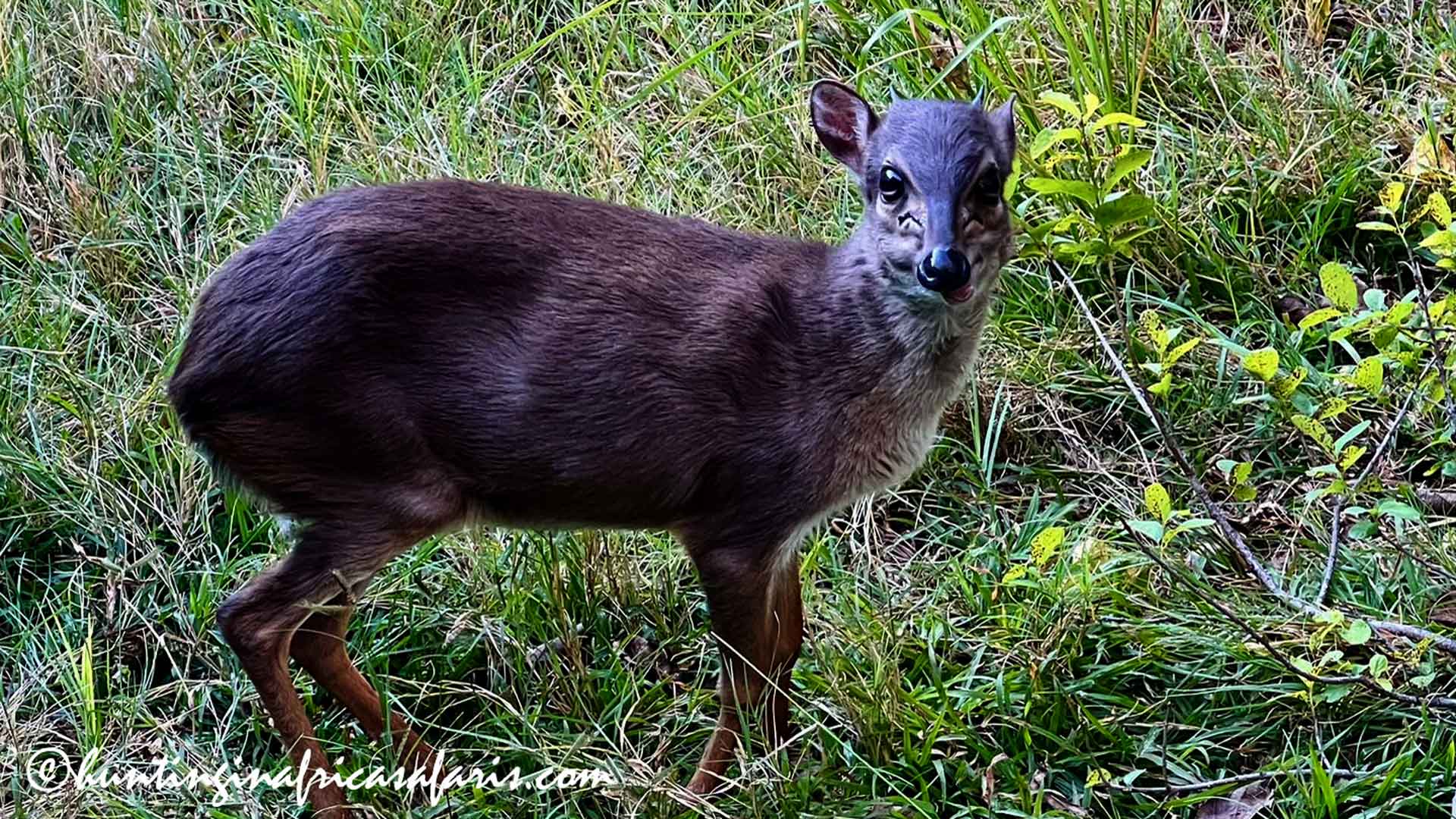
Blue duiker profile (Philantomba monticola)
← Return to the Tiny 10 Hunting Directory
The blue duiker represents the ultimate micro-trophy challenge for international hunters tracking down the elusive Tiny 10 collection. As the absolute smallest antelope in Southern Africa, this tiny forest dweller derives its common name from the distinct, slate-gray to dark brown coat that gives off a unmistakable bluish sheen under the filtered light of the forest canopy.
Because of their highly specialized habitat requirements and secretive, ghost-like movements through the thickest coastal undergrowth, securing a mature ram requires a patient, highly disciplined safari strategy.
| Species specification table | |
|---|---|
| Physical Attribute | Technical Measurement |
| Average Mass (Males) | 4.0 kg (roughly 9 lbs) |
| Average Mass (Females) | 4.7 kg (roughly 10 lbs) |
| Shoulder Height | 30 cm (12 inches) |
| Rowland Ward Minimum | 5.08 cm (2 inches) |
| SCI Minimum | 5 Points |
Planning a full pygmy antelope slam?
Explore the master guide to hunting the Tiny 10Blue duiker trophy fee
Our all-inclusive Blue duiker hunting safari prices are listed below as an add-on hunt. If you require a dedicated Blue duiker hunt we will gladly oblige at out standard daily rates as can be found at
| Blue Duiker Safari Pricing | |
|---|---|
| Safari Package Element | Cost Specification |
| Trophy Fee Only | From $1,750 USD (VAT Inclusive) |
| Success Guarantee | No Kill, No Pay Guarantee |
| Daily Rate (1x1 PH Guide) | Standard daily rates apply |
| Permit Requirements | TOPS permit and local forest concession clearance |
| Luxury Inclusions | Premium cape salvage, professional tracking, & luxury lodging |
Trophy Identification in the Shadows
Identifying a world-class blue duiker ram requires instantaneous focus under a dark, thick forest canopy. Because both rams and ewes carry horns, looking solely for spikes can lead to a critical field error. A mature, Rowland Ward-class ram is distinguished by heavy, deeply ridged horn bases that visibly emerge past the prominent, stiff tuft of hair on the forehead. Look for the distinct, constant flicking of the tail—this rhythmic white flash is often your only warning that a territorial ram is crossing a narrow, leaf-littered forest path.
Distribution and Habitat
The blue duiker is an uncompromising closed-canopy habitat specialist.
They are entirely absent from the open savannas, grasslands, and arid plains that support other small antelope.
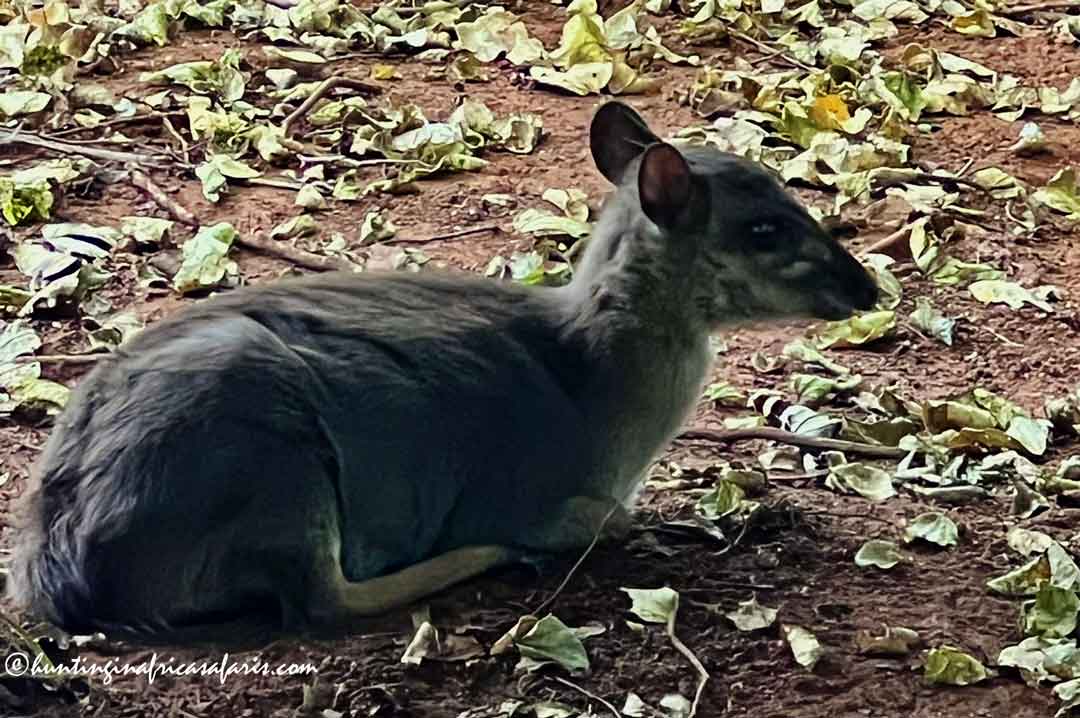
Species biology and conservation (Philantomba monticola)
To successfully hunt the blue duiker, a hunter must understand the clockwork biological habits that govern their daily routine inside the dark forest floor.
Monogamous territory mapping
Like several other pygmy species, blue duikers live in permanent, lifelong monogamous pairs.
3. Species biology and conservation (Philantomba monticola)
To successfully hunt the blue duiker, a hunter must understand the clockwork biological habits that govern their daily routine inside the dark forest floor.
| Forest Floor Foraging and Activity Markers | |
|---|---|
| Identification Factor | Behavioral Trait |
| Dietary Routine | Forest floor gleaners feeding on fresh fallen leaves, fruits, and seeds. |
| Primate Symbiosis | Frequently follow monkeys to forage on fruit dropped from the upper canopy. |
| Diurnal Baseline | Naturally active at dawn and dusk, but shifts to nocturnal habits if pressured. |
| Escape Strategy | Plunges instantly into the thickest underbrush at the slightest sound. |
Elevated vantage points
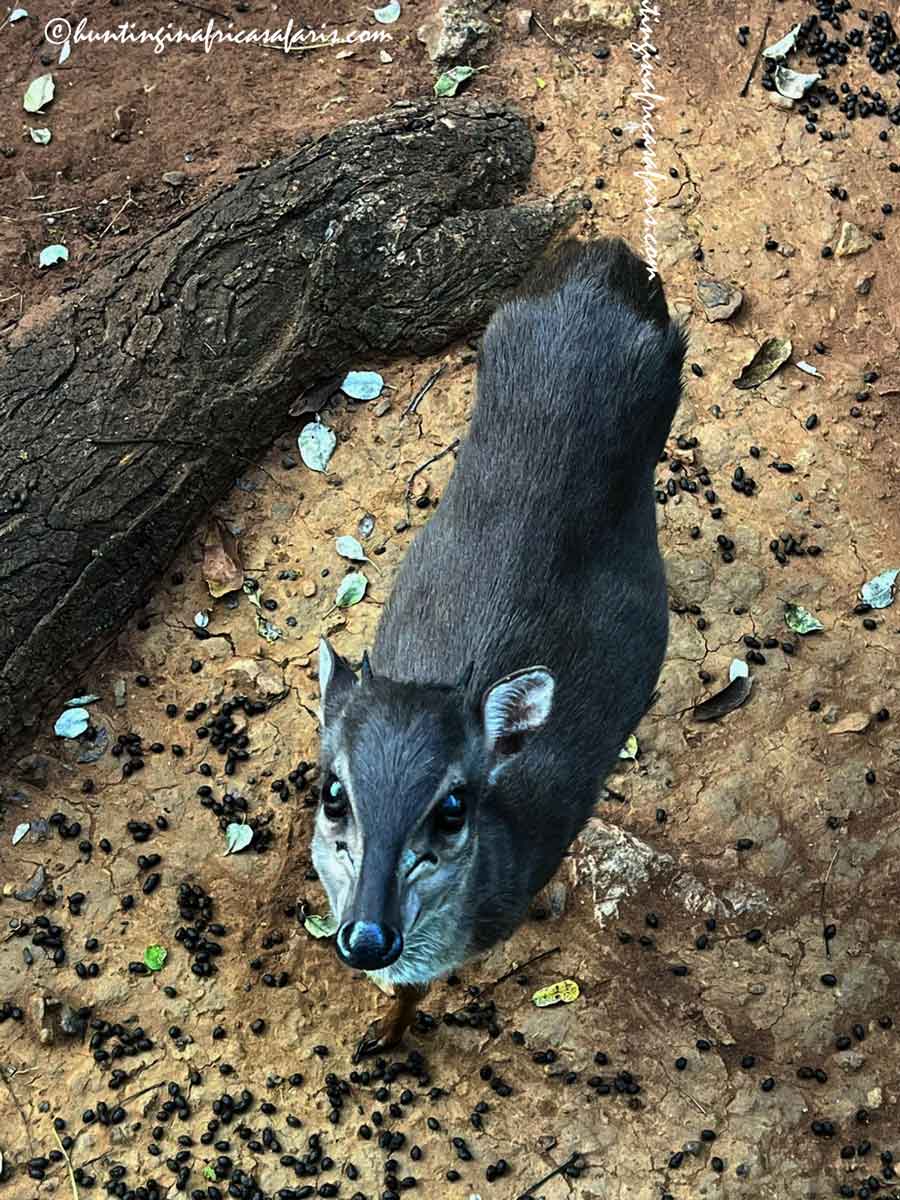
Because hunting these tiny antelope on foot in dense brush is incredibly difficult, utilizing an elevated blind or stand over known feeding paths is a highly effective strategy. Looking down into the undergrowth alters your perspective entirely, requiring a different approach to spotting and shot placement.
From an elevated position, the compact, uniform structure of the duiker's body becomes clear. When an animal senses movement from above, it will strain its neck directly upward, looking straight up toward the canopy or stand. This angle requires precise shot placement to ensure a clean harvest while entirely protecting the delicate cape for the taxidermist.
Ballistics and calibers for blue duiker
Preserving the exceptionally thin skin of a 9-pound antelope is the absolute top priority of a professional hunting guide.
The Shotgun Approach
In the dense, low-light understory where shots are taken rapidly at close ranges (typically under 15 yards), a 12-gauge or 20-gauge shotgun loaded with light birdshot (#5 or #6) is highly effective.
Rifle Configurations
If a rifle is preferred, small, mild centerfires like the .22 Hornet are standard. However, if you are carrying a larger rifle, you must exclusively use monolithic solid or full-metal jacket (FMJ) match bullets
Hunting tactics and safari strategy
Hunting the blue duiker is a game of high-stakes patience. Because their environment is completely enclosed, traditional spot-and-stalk glassing is utterly useless.
Still-Hunting and Ambush
The most effective method involves finding an active, heavily traveled path near a known fruit-bearing tree or an established dung latrine. Our lead PH will position the hunter in a ground blind or sit silently against the base of an indigenous hardwood tree during peak crepuscular hours.
Shot Placement in the Shadows
When a mature ram steps into a small clearing, target identification must be instantaneous. Both sexes carry short, sharp, spiked horns that are heavily ringed at the base, but they are frequently concealed by a prominent tuft of hair on the forehead.
PH Field Note & Trophy Evaluation: Look for a ram whose horns clearly extend past the prominent ridge of hair on the forehead. Because the animal is so small, a horn length exceeding 2 inches is a magnificent, Rowland Ward-class trophy.
Planning on adding a Red duiker (Cephalophus natalensis)?
Explore the challenging hunt of the Red duiker (Cephalophus natalensis)