
Blue wildebeest hunting South Africa: Prices & calibers
Blue wildebeest hunting in South Africa offers one of the most rewarding challenges on the open plains. Often nicknamed the Poor Man’s Buffalo for its sheer tenacity and bovine-like resilience, the Blue wildebeest (Connochaetes taurinus)—also known as the brindled gnu—is legendary for its ability to absorb heavy punishment if not addressed with precision.
Whether you are an American sportsman booking a classic plains game safari package or a European collector seeking a representative trophy bull on our elite concessions, our guide provides the technical expertise and ethical fair-chase foundation needed for a successful harvest. This is your definitive international resource for 2026 trophy fees, recommended calibers (including the modern 7mm PRC), and expert shot placement to ensure your African hunting safari doesn't turn into a grueling tracking job.
1. Blue wildebeest trophy fees 2026
Below are the official 2026 rates for hunting Blue wildebeest (Connochaetes taurinus) with African Bushbuck Adventures. We pride ourselves on clear, upfront pricing with no hidden costs. Whether you are looking for a high-quality brindled gnu trophy bull or a management-focused cull hunt, our fees reflect our commitment to sustainable and ethical hunting practices.
Because this classic plains game animal is typically integrated into broader bushveld itineraries, these flat-rate fees apply when a mature bull or management animal is added as an asset to your primary safari package.
1.2 How the costs are actually calculated
Our pricing framework maintains strict boundaries to give international sportsmen absolute financial clarity before arriving in camp:
-
Package add-on structure: Because these hunts are conducted exclusively as add-ons, they carry no standalone daily rates. You simply stack the fixed trophy fee onto your primary safari itinerary with zero added booking charges.
-
Tax exemption on trophies: Value added tax (VAT) is already fully factored into your primary safari's daily rates. For the trophy fee itself, all animals harvested by international clients for export are legally VAT exempt, meaning the prices listed below are the exact amounts you pay.
-
Wounding policy: In accordance with ethical standards, any animal wounded and lost in the field is charged at the full trophy fee. The full trophy fee applies to wounded and lost animals unless a replacement animal is successfully hunted.
| Blue Wildebeest Trophy Fee Structure | |
|---|---|
| Item | 2026 Rate (USD) |
| Blue wildebeest bull | $1,450 (Flat Trophy Fee) |
| Cull hunting blue wildebeest | $450 (Management Rate) |
| Wounded or lost animal | Full Trophy Fee Applicable |
2. Recommended blue wildebeest hunting calibers
The Blue wildebeest is the blueprint for African toughness. Our bones and body weight theory for this species focuses on its massive shoulder assembly and dense vital shielding. A mature bull can weigh up to 600 lbs (270 kg), with a skeletal structure designed to withstand the rigors of the savanna.
To ensure an ethical harvest, a hunter must utilize a caliber that provides deep penetration through heavy bone and muscle. We prioritize terminal performance—the ability of a bullet to stay together and travel through the thoracic cavity—over raw muzzle velocity.
2.1 Shot placement & bullet penetration dynamics
When matching your rifle selection to a brindled gnu safari, understanding bullet construction is far more important than selecting the fastest cartridge. Because a mature bull often presents a quartering angle or stands tightly packed in herd scenarios, your bullet must be capable of breaking heavy shoulder bone without breaking apart or deflecting.
Standard cup-and-core soft points will flatten out prematurely on the heavy shoulder joint of the "Poor man's buffalo," turning an ethical shot into a grueling, multi-day tracking job. Monolithic solid copper projectiles or heavy-jacketed premium bonded options are essential to drive deep into the vital cross-section.
| Recommended Blue Wildebeest Hunting Calibers | |
|---|---|
| Caliber Selection | Expert Notes & Ammunition Recommendation |
| .270 Winchester | Minimum requirement: Highly capable on open plains, but leaves zero room for error on heavy bones. Use 150 grain premium bonded bullets; shot placement must be perfect. |
| 7mm PRC | Modern choice: The ultimate long-range precision choice for savanna crosswinds. Exceptional stability using 160–180 grain high-BC bullets to buck the wind. |
| .30-06 Springfield | The standard: A timeless classic that has accounted for more African game than almost any other. A heavy 180 grain Barnes TTSX or Nosler Partition is the ultimate medicine for the brindled gnu. |
| .300 Winchester Magnum | Hard hitting: Highly effective for heavy-boned plains game. Provides critical energy reserves for out-of-position animals at distance. Recommended: 180 grain–200 grain premium grade. |
| .338 Winchester Magnum | Highly recommended: Exceptional knockdown power for massive bulls. The heavy frontal area delivers massive frontal tissue damage and deep tracking security with 225 grain–250 grain bullets. |
| .375 H&H Magnum | The PH favorite: Best caliber overall to reduce field tracking time. It hits like a freight train, destroys dense cranial and shoulder bone, and tracks straight through the vitals. Use a 300 grain Barnes TSX. |
2.2 Caliber Selection & Authority
To optimize your search visibility globally, our operational advice matches technical terminal performance with the practical environmental factors faced during an international safari.
| Caliber Selection & Authority Metrics | |
|---|---|
| Selection Factor | Professional Guidance |
| Environmental variables | Match your caliber to the bush density and expected shot distance. Thicker Kalahari thornveld blocks fast, light bullets, whereas open highveld landscapes demand higher ballistic efficiency. |
| Bullet construction | Premium bonded or monolithic solid copper bullets are mandatory for this species to ensure controlled expansion and survive impact with major bone structures. |
| Placement priority | Accuracy is paramount; choose a caliber you shoot with absolute confidence under field conditions rather than over-gunning yourself with heavy recoil. |
| Expertise & research | All field advice is directly compiled based on 29 years of active professional hunting experience and established ballistics data from John "Pondoro" Taylor’s African Rifles research library. |
3. Blue wildebeest shot placement: Respecting the Poor Man's Buffalo
The Anatomy of a Lead Eater The Blue Wildebeest (Connochaetes taurinus) has earned a formidable reputation among Professional Hunters as an animal that can "eat lead." This isn't just campfire lore; their dense bone structure and immense sheer will to survive mean that a marginal shot often results in a long, grueling day of tracking.
Avoid the Estate Agent walk-about Locally, we sometimes refer to a wounded Wildebeest or Zebra as an Estate Agent. Why? Because if your shot placement is off, they will take you on a tour of the entire property, showing you corners of the farm you’ve never seen before. To avoid this unwanted real estate tour, precision is paramount.
The target zone:
The one-third rule: Aim for a point approximately one-third up from the bottom of the brisket, directly in line with the back of the front leg.
The shoulder challenge: While the shoulder is heavy, a high-velocity premium bullet through the engine room is the only way to anchor this resilient bovine effectively.
Avoid the high shot: The Wildebeest has a prominent mane and a sloping back that often tricks international hunters into aiming too high into no-man's land. Always aim for the heart and lungs in the lower third of the cavity.

4. Species biology and conservation (Connochaetes taurinus)
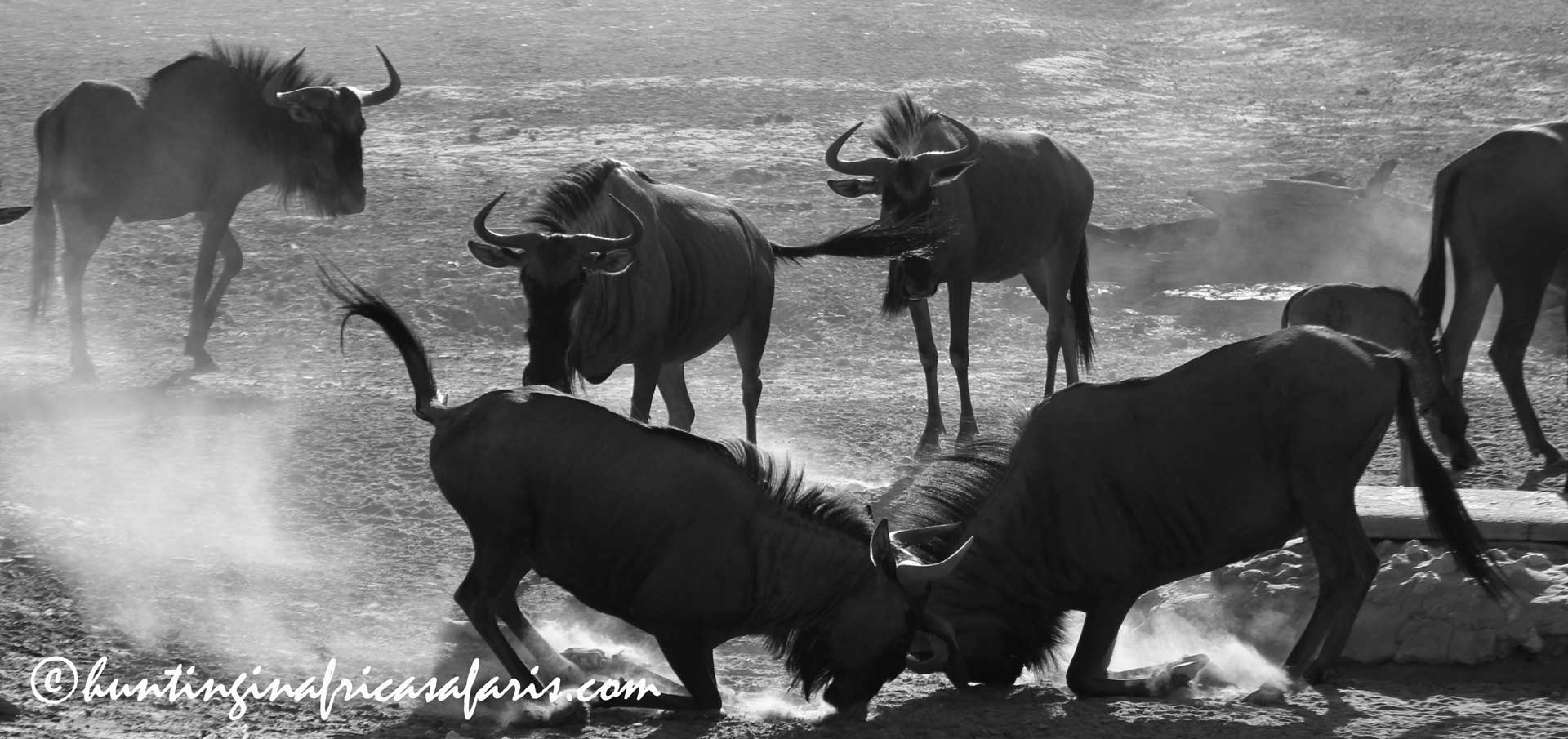
The Blue Wildebeest (Connochaetes taurinus) is a keystone species of the African savanna, playing a vital role in habitat management through its grazing patterns and seasonal migrations. Often referred to as the Brindled Gnu due to the dark vertical stripes on its slate-grey hide, this animal is the quintessential symbol of the South African plains. Through ethical, regulated hunting, we ensure the protection of the vast habitats and genetic diversity these herds require to thrive.
| Aspect | Detail and hunting context |
| Scientific name | Connochaetes taurinus |
| Common names | Blue Wildebeest or Brindled Gnu |
| Shoulder height | 115cm – 150cm (45 in – 59 in) |
| Weight (Bull) | 230kg – 290kg (510 lbs – 640 lbs) |
| Habitat | Open savanna, grassland, and acacia woodland. |
| Longevity | Up to 20 years in the wild. |
| Conservation | Sustained through private sector fair-chase hunting initiatives. |
4.1 Why hunt the Blue wildebeest?
Often referred to as the "Poor Man’s Cape Buffalo," the Blue wildebeest (Connochaetes taurinus) is a staple of the South African safari. They are incredibly tough animals with an uncanny ability to disappear into the shadows of the acacia thorns. A walk-and-stalk hunt for a mature Blue wildebeest bull is a test of marksmanship and persistence, making it an essential foundation for any African trophy room.
The Wildebeest Slam For those seeking the ultimate South African challenge, we offer the Wildebeest Slam, which includes:
While the Blue wildebeest is prized for its challenging nature and impressive trophy, it is equally respected as the undisputed biltong king of the African veld. A mature bull provides a significant amount of high-quality, lean venison, which we traditionally prepare as the world-renowned South African biltong. For many of our clients, knowing that their hunt contributes directly to sustainable meat production for our staff and local community adds a profound layer of purpose to the safari.
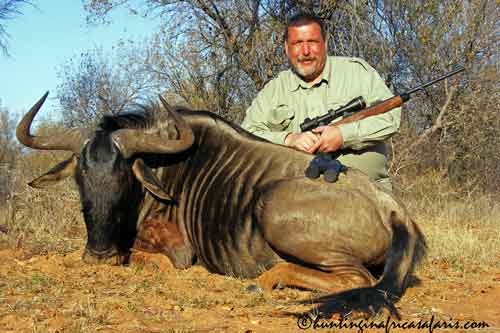
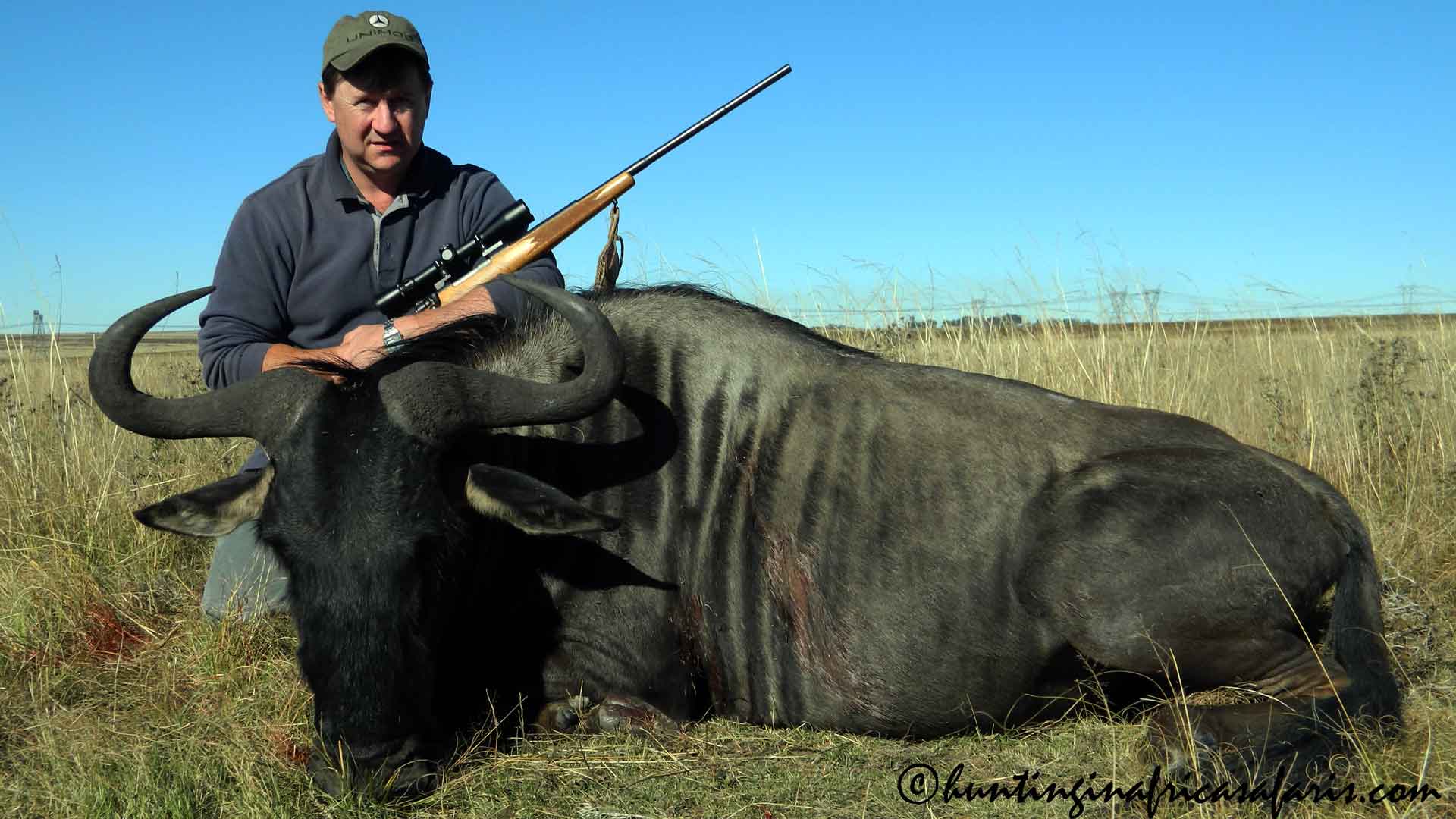
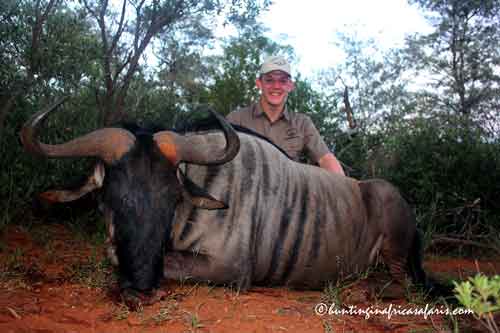
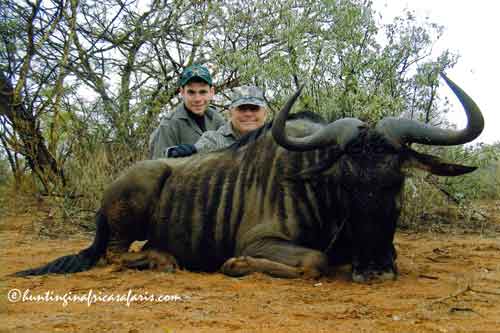
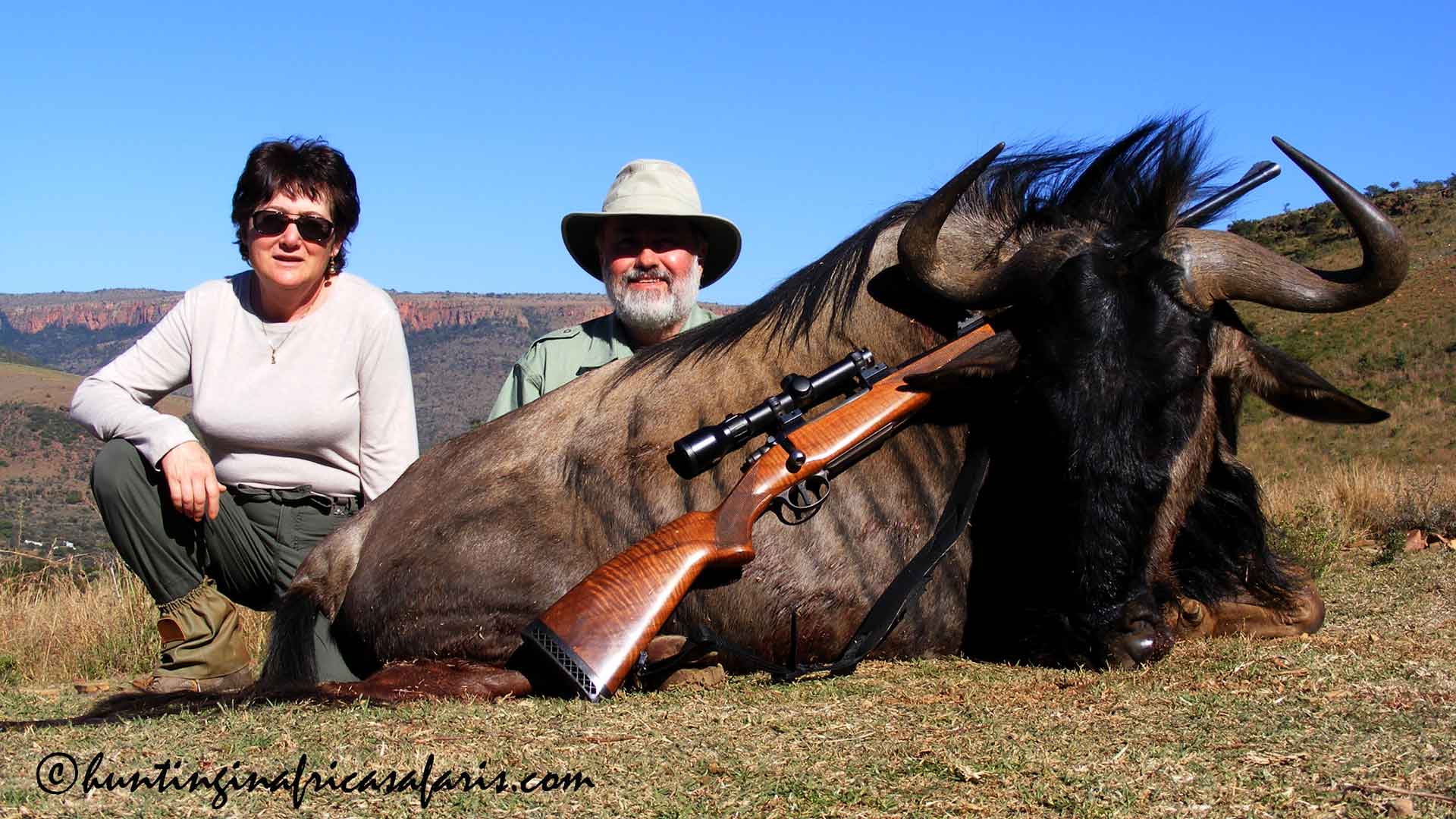
5. Blue wildebeest trophy gallery: Ethical hunting success
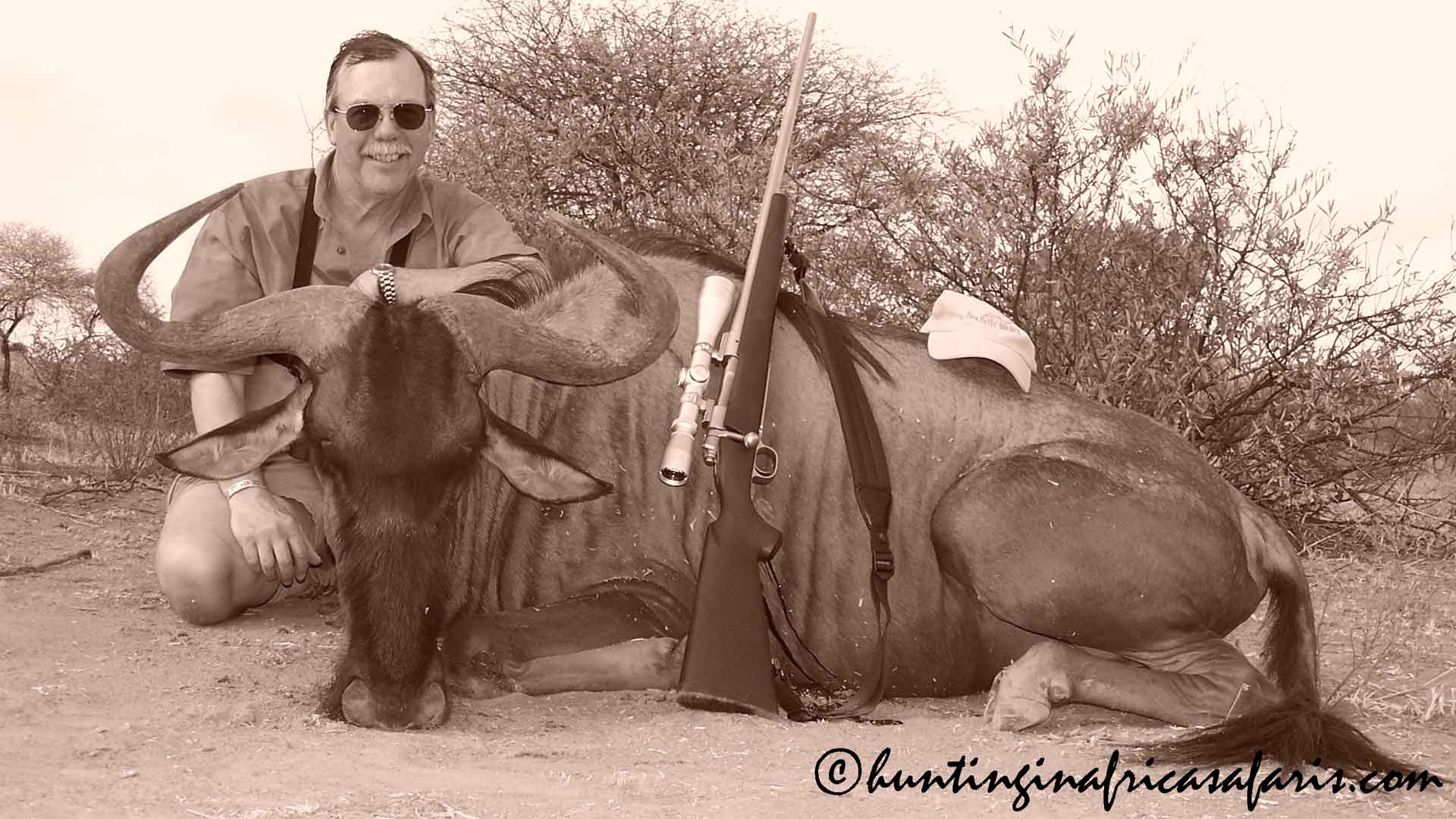
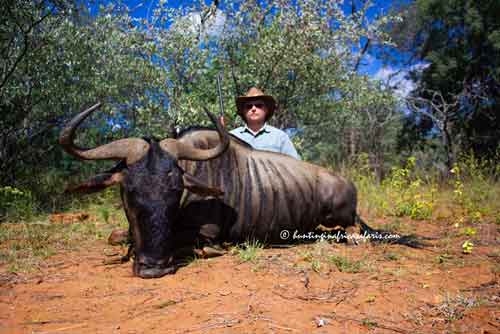
The successful harvest of a Blue wildebeest (Connochaetes taurinus) is a true test of a hunter’s fieldcraft and persistence. This gallery showcases the magnificent Brindled gnu trophies taken by our clients in South Africa, representing the high-quality genetics and wide-boss bulls found within our concessions.
Every photo in this collection is a testament to our strict adherence to ethical hunting standards and sustainable conservation practices. By hunting this iconic species, our clients directly support the habitat protection required to keep these Blue Bulls thriving on the open plains. These images highlight the success of a professional, fair-chase approach to one of Africa's most resilient plains game species.
6. Blue wildebeest hunting: Frequently asked questions
What is the best time of year to hunt Blue Wildebeest?
The prime hunting season in South Africa is during the dry winter months from May to August. During this time, the vegetation is sparse, and the Brindled Gnu congregates near water sources, making tracking and spotting significantly easier.
How much does a Blue Wildebeest hunt cost in 2026?
The 2026 trophy fee for a Blue Wildebeest bull is $1,450. Management or cull hunts are a cost-effective alternative for many hunters, priced at approximately $450.
Is the Blue Wildebeest dangerous to hunt?
While not classified as "Dangerous Game," the "Poor Man's Buffalo" is famously aggressive when wounded. Due to their incredible resilience and heavy bone structure, they can be dangerous to track in thick brush if not anchored with a precise first shot.
What is the recommended shot placement for a Wildebeest?
Because of the sloping back and shoulder hump, many hunters aim too high. The "Bisley" standard for an ethical harvest is low and forward—aiming in the bottom third of the body, roughly four inches above the elbow, to strike the heart and lungs.
7. Ready to hunt the Poor Man’s Buffalo?
Whether you are looking to complete your South African plains game Grand Slam or you want to test your mettle before moving up to the Big Five, we have a safari package designed for your goals. Explore our current 2026 offerings below.
Services
Contact
hunt@huntinginafricasafaris.com
+27 82 824 7681
on Whatsapp and Telegram
Hours
Mondays from: 06:00 - 20:00 (6 am - 8 pm)
Tuesday - Saturday from: 06:00 - 20:00 (6 am - 8 pm)
Sunday: Closed unless we are hunting.