

1. White springbok hunting South Africa: 2026 trophy fees & expert guide
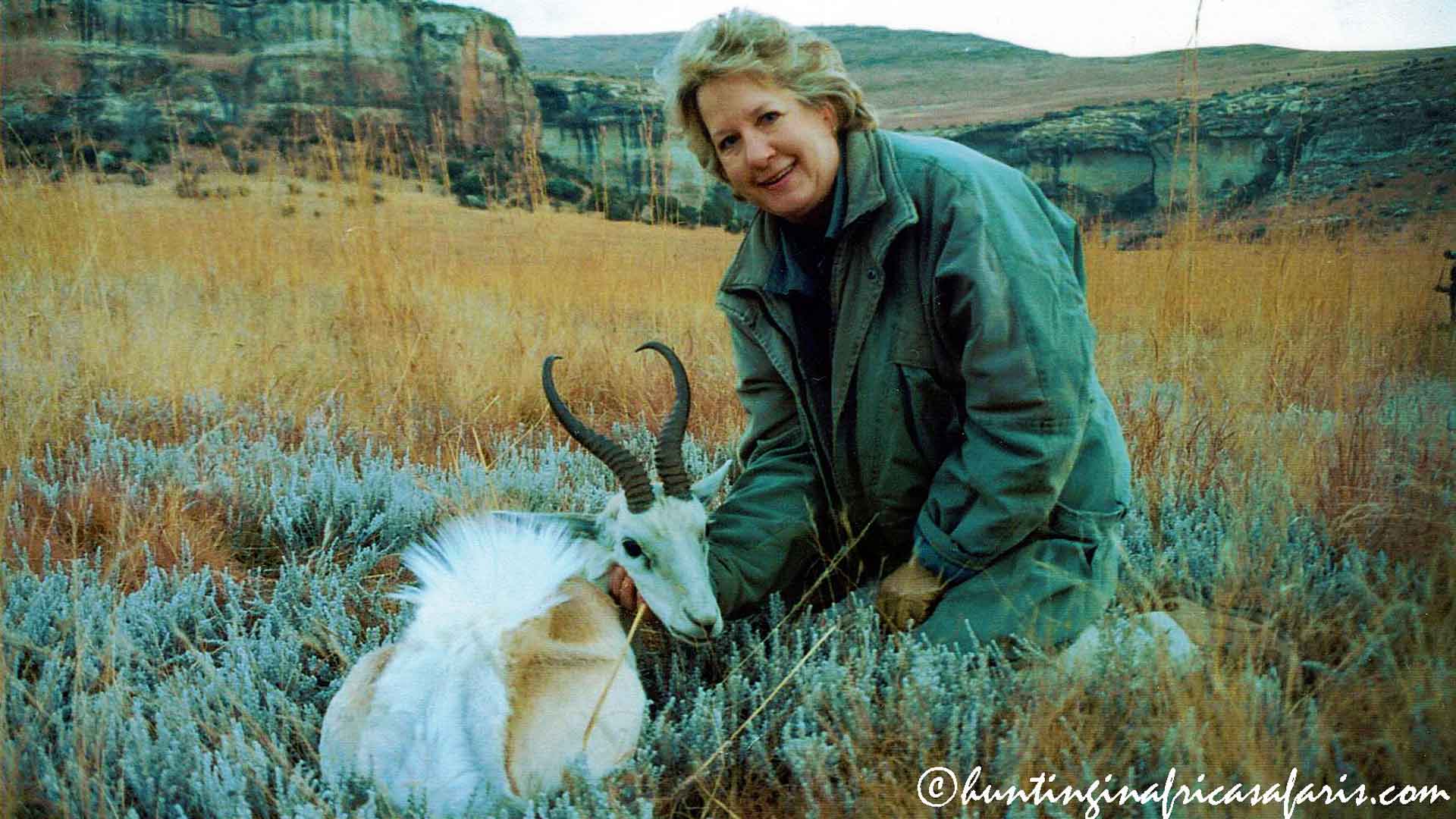
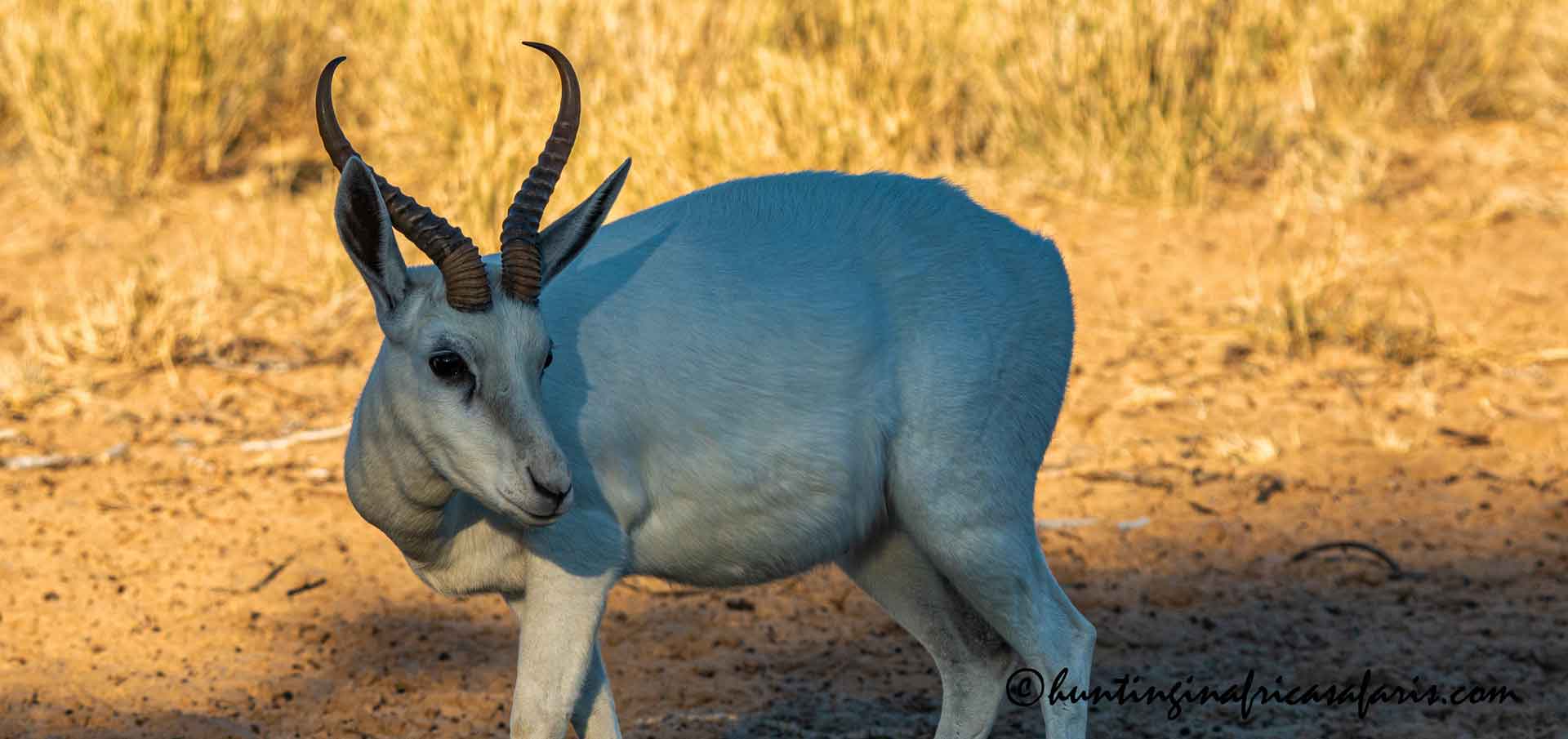
Known to many as the Ghost of the Karoo, the White springbok is a striking leucistic color morph and a centerpiece of the prestigious Springbok Grand Slam. A leucistic variant with a creamy-white to pure white coat, the White springbok is a prized addition to any safari. Unlike an albino, the White springbok (Antidorcas marsupialis) possesses dark eyes and hooves, presenting a ghostly, creamy-white silhouette that is famously difficult to range in the intense African midday heat haze.
For the 2026 season, precision planning is paramount; review our updated technical data, ethical shot placement strategies, and trophy information for this stunning species to ensure a seamless and successful hunt.
For the international trophy collector, this animal represents one of the most rewarding challenges in plains game hunting. Securing a mature, trophy-quality ram requires a blend of patient woodcraft, long-range marksmanship, and a deep understanding of the unique optical challenges presented by this variant on the open savanna.
1.1 Professional guide to your 2026 hunt
| White springbok hunting overview | |
|---|---|
| Species | White springbok (*Antidorcas marsupialis*) |
| Classification | Leucistic color morph |
| 2026 Trophy fee | Available upon request / Part of Grand Slam |
| Ideal Habitat | Open Karoo and Kalahari savanna |
| Difficulty Level | Advanced (Requires long-range proficiency) |
1.2 Expert insights for the discerning hunter
While it shares the same legendary speed as the common variety, White springbok hunting in South Africa offers a unique optical challenge. The animal’s light color can be deceptive, often appearing closer than it truly is due to the lack of contrast against the dry, sun-scorched veld.
Our 2026 all-inclusive trophy fees and specialized Springbok Grand Slam packages are engineered for the ethical hunter seeking a fair-chase pursuit. Whether you are fine-tuning your rifle selection with the best calibers for long-range plains game or focusing on precise shot placement to preserve the delicate cape for a world-class taxidermy mount, our veteran PHs provide the expertise required for a successful harvest.
We invite you to experience the ultimate test of marksmanship in the heart of South Africa’s premier hunting grounds, where history, conservation, and the spirit of the hunt converge.
2. White springbok trophy fees 2026 and Springbok Grand Slam pricing
Securing a trophy-quality White springbok (Antidorcas marsupialis) is a milestone for any serious plains game collector. To provide full transparency for your 2026 safari planning, we have outlined our official trophy fees below. While these individual fees apply to animals added to a custom safari itinerary, our curated Springbok Grand Slam package provides the most efficient value for hunters aiming to secure all four iconic color variants in a single, high-stakes excursion.
2026 trophy fee and package structure
| 2026 White springbok trophy fee schedule | |
|---|---|
| Species / Variant | 2026 Trophy fee (USD) |
| White springbok | $1,850 |
| Black springbok | View black springbok pricing |
| Copper springbok | View copper springbok pricing |
| Common springbok | View common springbok pricing |
2.1 Strategic value of the Springbok Grand Slam
For hunters targeting the full color spectrum, we highly recommend our Springbok Grand Slam package. This bundle streamlines your safari logistics, guarantees priority access to high-quality rams, and provides a significant cost advantage over individual trophy bookings. Our 2026 hunting rates are all-inclusive, covering daily rates, trophy fees, and expert PH guiding, ensuring no hidden costs during your time in the field.
3. Best White springbok hunting calibers for South Africa
The White springbok is a light-framed animal that demands a rifle system optimized for flat-trajectory performance and high-precision shot placement. When planning your 2026 safari, selecting the appropriate caliber is not merely about energy—it is about the marriage of ballistic efficiency and terminal performance. Your equipment must be precisely tailored to the specific environment of the Karoo and Free State, where the vast, open-veld distances require a rifle capable of minimizing wind drift and holdover.
Strategic ballistics for the open plains
For the discerning hunter, the objective is to secure a clean, ethical harvest while preserving the integrity of the unique white cape for a high-quality mount. This requires using premium, controlled-expansion projectiles that offer superior weight retention. On the open plains, we prioritize calibers that provide a stable flight path at distances ranging from 200 to 300+ metres. Whether you are favoring the speed of a high-velocity flat-shooter or the versatility of a proven safari standard, the ideal rifle is one you can operate with absolute confidence under field conditions.
3.1 Terrain specific White springbok calibers: Karoo and Free State
| Open plains strategy: Free State and Karoo (250m – 400m+) | |
|---|---|
| Strategy | High-velocity and flat trajectory are vital to combat distance and wind. |
| 6.5 PRC | The modern Long-Range King. Exceptional at 300m+ in the Karoo. High precision with low recoil. |
| 7mm PRC | The heavy hitter of precision rounds. Superior in high-wind conditions on the open plains. |
3.2 Terrain-specific bushveld white springbok calibers: North West, KZN and Limpopo
In thicker bushveld environments, the focus shifts. Shots are typically taken at closer ranges, where terminal performance and shot placement are critical to prevent unnecessary meat bruising or damage to the cape.
| Thick bushveld strategy: North West, KZN and Limpopo (50m – 150m) | |
|---|---|
| Strategy | Focus on moderate velocity to prevent excessive meat bruising and cape damage. |
| .22-250 Rem | A plains specialist. Incredible speed makes it a laser out to 300m on small game. |
| .243 Winchester | The classic all-rounder. 90–100 gr bullets provide the perfect balance for any terrain. |
| .270 Winchester | A bushveld favorite. Using heavier 150 gr bullets ensures penetration and minimizes damage. |
| .308 Winchester | Ideal for shorter bushveld shots. Accurate and minimizes excessive tissue destruction. |
| .30-06 Springfield | The versatile safari standard. Ideal if hunting the entire plains game spectrum. |
3.3 Terminal ballistics and field strategy
In professional hunting, we attach more weight to preserving the cape than the venison. The bullet’s terminal performance is the deciding factor in a successful harvest, ensuring that the high-value trophy remains pristine for taxidermy while guaranteeing a humane, instant kill.
Technical PH considerations for small antelope
| Professional field strategy | |
|---|---|
| Bullet Selection | Mandatory: Use premium bonded or monolithic projectiles (e.g., Barnes TTSX). This prevents explosive fragmentation at high velocities. |
| Long-Range Ethics | For shots between 250m and 400m, high-BC bullets are required to combat wind drift and ensure accuracy on the open plains. |
| Safety & Pass-Through | Critical: Due to the small-framed anatomy, a pass-through is guaranteed. Always confirm your backstop to avoid hitting non-target animals. |
| Trophy Integrity | Avoid shots to the head or neck. Precise heart/lung placement preserves the cape and prevents irreparable hide damage. |
The PH perspective on cape preservation
A world-class mount begins with field care. We advise our clients that the damage caused by high-velocity, non-bonded bullets often creates large exit wounds that are difficult to camouflage during the taxidermy process. By selecting controlled-expansion monolithic projectiles, you ensure the energy is transferred efficiently into the vitals while maintaining the structural integrity of the skin.
4. Species biology and conservation (Antidorcas marsupialis)
The White springbok is not a separate species, but a leucistic color variant of the Common springbok (Antidorcas marsupialis). Unlike albinism, which involves a total lack of pigment, leucism is a genetic condition characterized by reduced pigmentation, resulting in the characteristic creamy-white coat while the eyes and hooves retain their normal, dark color.
In the wild, these variants are rare as their lack of natural camouflage often makes them more visible to predators. However, through dedicated conservation and selective management on private South African game ranches, these striking animals now thrive, ensuring their long-term survival while maintaining the genetic health of the wider Antidorcas marsupialis population.
4.1 Springbok color variants at a glance
| Springbok color variant guide | |
|---|---|
| White springbok | Leucistic; creamy-white coat. Lacks the dark lateral stripe. |
| Common springbok | Classic light brown with a distinct dark lateral stripe. |
| Black springbok | Melanistic; dark charcoal to deep brown coat. |
| Copper springbok | Rich, reddish-brown coat; the rarest of the four phases. |
4.2 The Springbok Grand Slam
For hunters pursuing the Springbok Grand Slam, the White springbok represents a significant milestone. The Slam is awarded to those who successfully harvest one of each of the four variants. Because these animals often run in mixed herds, the true test lies in the hunter's ability to identify and isolate the specific trophy ram among a sea of shifting colors. Our veteran professional hunters assist in this process, ensuring an ethical and selective harvest that upholds the principles of fair chase.
Ready to secure your 2026 Springbok hunt?
Speak directly with our outfitting team to confirm availability and personalize your trophy package.
Inquire about 2026 availability5. White springbok shot placement: Professional PH Guide
Achieving an ethical, one-shot harvest is the absolute priority when hunting the White springbok (Antidorcas marsupialis). Because this is a small, alert animal often hunted at long ranges, your margin for error is slim. Precise placement is not just about the kill; it is about ensuring the preservation of the cape for your trophy collection.
5.1 Shot placement strategy
| Professional PH instruction | |
|---|---|
| The Broadside Aim | Aim in the bottom third of the chest, vertically aligned with the back edge of the front leg. This ensures a strike through the top of the heart and the center of the lungs. |
| Vital Anatomy | Heart: Low, just above the brisket. Lungs: Large target area extending higher and slightly further back. |
| The White Coat Factor | Visual Challenge: On the open plains, the white coat can glow in high sun, making it difficult to see muscle definition. Use your optics to find the point of the elbow as your primary reference. |
| Quartering-In | Aim for the on-side shoulder. The bullet must pass through the shoulder and into the vitals to ensure the animal does not run into thick cover. |
5.2 PH pro-tips for the shot
-
The 3D Visualization: Do not just aim at a spot on the skin. You must visualize the bullet’s path exiting the other side. Because a pass-through is almost guaranteed, ensure the exit path is clear of non-target animals in the background.
-
The Drop-Back Trap: Springbok are famous for their pronking and sudden movements. If the animal is alert and looking at you, wait for it to settle. A high-velocity miss can easily clip the spine or the haunch, ruining the meat and the cape.
-
Use Your Sticks: In the Karoo and Free State, the wind is your greatest enemy. Even with a 6.5 or 7mm PRC, always use a stable tripod or shooting sticks to anchor your shot.

6. Frequently Asked Questions: White springbok hunting
These are the most commonly asked questions, followed by the expert answers:
6.1 Is the White springbok a separate species?
No. It is a leucistic color variant of the Common springbok (Antidorcas marsupialis). It is the same species, just with a different coat color.
6.2 Are White springbok more difficult to hunt?
Yes. Their white coat lacks natural camouflage, making them extremely wary of predators. They tend to be the first in a mixed herd to bolt.
6.3 Is a White springbok hunt all-inclusive?
When booked as part of our Springbok Grand Slam package, the price is all-inclusive. If added to an existing safari, only the individual trophy fee applies.
6.4 Can I hunt all four color variants at once?
When booked as part of our Springbok Grand Slam package, the price is all-inclusive. If added to an existing safari, only the individual trophy fee applies.
6.5 Does the white coat affect trophy quality?
Not at all. The trophy is judged by the horns (Soudi score) just like a common springbok. The white cape is simply a highly prized aesthetic variation.
Services
Contact
hunt@huntinginafricasafaris.com
+27 82 824 7681
on Whatsapp and Telegram
Hours
Mondays from: 06:00 - 20:00 (6 am - 8 pm)
Tuesday - Saturday from: 06:00 - 20:00 (6 am - 8 pm)
Sunday: Closed unless we are hunting.