

Springbok hunting South Africa: 2026 trophy fees, calibers & field guide
Hunting the common springbok (Antidorcas marsupialis) is the quintessential test of the plains game hunter. For a professional hunter, these vryburgers represent one of the most honest challenges in the veld. They are a species defined by their incredible eyesight, wary nature, and an uncanny ability to vanish into the heat haze of the Karoo or the vast open plains of the northern provinces.
Historically, the Springbok Flats—a fertile basin stretching north of Pretoria—served as a primary stronghold for these animals. While much of that landscape has changed, the spirit of the Flats remains at the core of our management philosophy. Hunting here demands deep respect for the terrain; successful trophy collection often requires patience, precision, and the skill to execute shots exceeding 250 meters in shifting crosswinds. It is a game of calculated strategy and careful stalking.
Whether you are planning a traditional hunt or pursuing the coveted "Springbok Grand Slam"—a collection of all four color variants (Common, Black, White, and Copper)—our 2026 guide provides the technical expertise you need. Below, you will find our latest trophy fees, professional caliber recommendations, and proven shot placement strategies to ensure an ethical, fair-chase safari.
1. Springbok hunting trophy fees and safari costs 2026
At African Bushbuck Adventures, we believe in complete transparency regarding your safari investment. Our 2026 pricing structure is built on a clear, honest foundation: your daily rate covers the comprehensive field experience, while trophy fees are applicable only upon the successful harvest of your animal.
When planning your hunt, we recommend considering both your target species and the specific color variants you wish to pursue. Whether you are focused on a single trophy or the full "Springbok Grand Slam," our team is here to help you design a custom itinerary that balances your goals with the realities of the veld. All prices listed below are current for the 2026 season.
| 2026 Springbok hunting cost and package inclusions | |
|---|---|
| Common Springbok | Trophy fee $650 |
| Black Springbok | View black springbok trophy fee |
| White Springbok | View white springbok trophy fee |
| Copper Springbok | View copper springbok trophy fee |
| Expert PH and field staff | Full services of a dedicated Professional Hunter, experienced trackers, and a specialized skinning team trained to handle your cape with absolute care. |
| Luxury safari accommodation | Premium lodge accommodation featuring full modern amenities, private en-suite facilities, and daily laundry services in our prime hunting concessions. |
| Catering and hospitality | All gourmet meals, daily track snacks, and full local beverage selection including premium South African estate wines. |
| Field trophy preparation | Meticulous field cape skinning, salting, and secure transport delivery from African Bushbuck Adventures directly to our preferred local South African taxidermy studio. |
| Ground logistics and transport | All regional ground transportation within the designated hunting area, dedicated 4x4 hunting vehicle logistics, and scheduled airport transfers. |
1.2 Understanding the cost of a springbok safari
When researching the cost of hunting springbok in South Africa, it is vital to distinguish between the daily rate and the trophy fee.
-
Trophy fee structure: The trophy fee for a common springbok is an additional cost relative to your daily rate or custom hunting package. This fee is payable upon the successful harvest of the animal or in the event of a wounded and lost animal—a standard ethical practice within the South African hunting industry.
-
The Springbok Grand Slam: For hunters pursuing the distinct color variants (Black, White, and Copper), we recommend a bespoke package. Bundling these variants into a single safari significantly optimizes the logistical costs and provides a better overall value than pursuing them as individual trophy fees.
-
Export and logistics: Your trophy fee covers meticulous field preparation, including skinning and salting. Please note that this fee does not include third-party services such as professional dip-and-pack, veterinary certification, or international shipping to your home country.
1.3 Why choose African Bushbuck Adventures for your 2026 hunt?
Our pricing reflects a commitment to genuine, fair-chase hunting on the open plains. We do not participate in, nor do we support, canned operations. By choosing to hunt with us, you are supporting the long-term conservation of the Antidorcas marsupialis gene pool across our managed properties in the Pretoria and North West districts. Our trophy fees are structured to ensure that habitat protection and wildlife management remain the primary focus of our operations, providing you with an authentic and ethical hunting experience.
2. Springbok Grand Slam package (5 days / 6 nights)
The Springbok Grand Slam represents the pinnacle of plains game hunting in South Africa. This specialized 5-day safari is engineered for the marksman who seeks to secure all four iconic color variants—Common, Black, White, and Copper—in a single, high-stakes outing. Hunting these rams across the vast, open veld requires more than just long-range proficiency; it demands the tactical precision, patience, and woodcraft that define a true master of the stalk. As some of the most alert and skittish quarry in Southern Africa, the Springbok Grand Slam is the ultimate test for any serious collector.
| 2026 Springbok Grand Slam investment | |
|---|---|
| All-inclusive package rate: US $4,850 | |
| 4-Species Trophy Fees | 100% legal trophy fees covered for the complete 4-species Springbok Grand Slam collection (Common, Black, White, and Copper). |
| Spot-and-Stalk Hunting | Full services of an experienced, licensed Professional Hunter (PH), expert trackers, and a professional skinning team dedicated to cape preservation. |
| Luxury Safari Lodging | 6 nights of premium 5-star lodge accommodations featuring full modern amenities, private en-suite facilities, and daily laundry. |
| All-Inclusive Catering | Three gourmet meals daily, track-side snacks, beverages, and premium South African estate wines. |
| Field Trophy Prep | Meticulous on-site field cape skinning, salting, and secure transport to our preferred South African taxidermy studio. |
| Ground Logistics | All regional ground transport in custom-rigged 4x4 safari vehicles and scheduled airport shuttle transfers. |
2.1 Additional details and booking requirements
-
Arrival Night Accommodation & Meet & Greet: $150 USD per person. Covers your initial arrival night lodging, dinner, and airport reception logistics before your official 5-day safari hunting clock begins.
-
Exclusions: International or domestic flights; professional trophy dipping, packing, and taxidermy shipping; standard rifle rental and ammunition (if not bringing your own); personal travel insurance; and staff gratuities. Additional trophy fees apply for any animals harvested outside the core 4-species slam.
-
Booking Process: Secure your preferred 2026 dates by submitting a formal booking inquiry. A standard deposit is required to confirm your Professional Hunter and luxury lodge block. Upon confirmation, our team provides comprehensive documentation, including South African firearm import permit guides (SAPS 520) or rifle rental options, customized packing lists, and recommended insurance providers.
3. Best springbok hunting calibers & bullet strategy in South Africa
For hunters pursuing the springbok (Antidorcas marsupialis) in South Africa, the synergy between cartridge choice, bullet weight, and muzzle velocity is the difference between a clean harvest and a long day of tracking. Weighing between 60–93 lbs, the springbok presents a remarkably small target—the vitals are roughly the size of an orange—often situated in the center of a wind-swept Karoo plain or the open Springbok Flats.
Choosing the correct caliber and bullet construction is vital for an ethical hunt. Because shots often range from 200 to 400 meters, the primary enemy is not the animal's toughness, but the wind. A "wind-cheating" bullet with a high Ballistic Coefficient (BC) is essential. While the springbok is thin-skinned, a premium, controlled-expansion bullet is still recommended to ensure a pass-through for a clear blood trail, especially when hunting the prized color variants where trophy hide preservation is a priority.
The following calibers are recommended by our professional hunters for their flat trajectory and consistent performance in the shifting crosswinds of the South African veld.
| 2026 Open plains caliber strategy | |
|---|---|
| .243 Winchester | A surgical choice for springbok. The low recoil allows for extreme precision on the small vitals of a trophy ram. |
| 6.5 Creedmoor | The modern standard for US hunters. Its high-BC bullets are specifically designed to "buck the wind" on open grasslands. |
| .25-06 Remington | Renowned for its laser-flat trajectory. It is arguably the best "pure" springbok caliber ever produced. |
| 7mm PRC | The powerhouse option. If you are hunting a Springbok Grand Slam, this caliber provides the confidence to take 300-yard shots with ease. |
| .270 Winchester | A versatile classic. When loaded with 130-grain bullets, it offers the perfect balance of speed and knockdown power. |
3.1 The rise of a new generation: Modern long-range calibers
In recent years, the landscape of African plains game hunting has been reshaped by what many call the Precision Rifle Revolution. While the classics will always have a place in the salt, a new generation of calibers has emerged, specifically designed to solve the two greatest challenges of the Springbok Flats and the Karoo: long-range trajectory and wind deflection.
These modern cartridges are designed around high-BC (Ballistic Coefficient) bullets and fast-twist barrels. They allow the hunter to maintain supersonic velocities and stability much further downrange than traditional options.
| The new guard: 2026 cartridge evolution | |
|---|---|
| 6.5 PRC | The "big brother" to the Creedmoor. It offers the same precision but with a significant boost in velocity, making it the ultimate flat-shooting springbok cartridge for 2026. |
| 7mm PRC | Designed for heavy, aerodynamic bullets that ignore crosswinds better than almost anything in its class. It is the perfect "one-rifle" solution for a diverse plains game safari. |
| 6mm Creedmoor | This has replaced the .243 for many technical hunters. Its faster twist rate stabilizes the long, heavy 6mm bullets that traditional .243 rifles simply cannot shoot accurately. |
| 6.8 Western | A powerhouse for those who want .270 performance but with the heavy, long-range projectiles required for ethical shots at extended distances in the veld. |
3.2 The PH’s perspective on fast-twist barrels
The true advantage of this new generation of cartridges is not merely increased powder capacity; it is the integration of optimized twist rates. Traditional rifles often utilize a 1-in-10 twist, which is sufficient for conventional hunting bullets. However, to effectively buck the wind on the open plains, you must utilize the long, sleek, high-BC projectiles that require a 1-in-8 or 1-in-7.5 twist.
When you are planning a Springbok hunt and considering a new rifle build or purchase, these modern configurations provide a significantly larger margin for error. In the unpredictable gusting winds of the flats, a fast-twist barrel ensures your bullet maintains stability and ballistic integrity, translating directly into ethical, one-shot harvests on trophy rams at extended ranges.
3.3 Bullet construction and weight for springbok
Because the springbok is a light-skinned and small-framed animal, your bullet strategy should focus on absolute accuracy and rapid, controlled expansion. Unlike hunting heavy-boned plains game such as the gemsbok or zebra, you do not require deep-penetrating solids; instead, you need a high-performance projectile that delivers its energy quickly within the chest cavity to ensure an ethical, instantaneous harvest.
3.4 Optimized projectile selection
| 2026 projectile selection criteria | |
|---|---|
| Terminal performance | Prioritize rapid, controlled expansion. We recommend premium bonded-core or polymer-tipped projectiles such as the Nosler Ballistic Tip, Hornady ELD-X, or Swift Scirocco II to ensure reliable performance at extended distances. |
| Recommended weights | For .243 and .25-06 platforms, weights between 85–100 grains (5.5–6.5 g) are ideal. For 6.5mm and 7mm cartridges, 120–145 grain (7.8–9.4 g) bullets offer the superior ballistic coefficients necessary to mitigate crosswind drift. |
| Velocity advantage | High-velocity configurations are a distinct advantage in the Karoo and Free State. A flatter trajectory minimizes the need for extreme hold-over, which is critical when a ram is alert or moving between grazing patches. |
4. Springbok shot placement: Precision on the plains
The springbok (Antidorcas marsupialis) is a small, light-boned animal, but its vital organs are positioned lower and further forward than many international hunters anticipate. Because these animals are frequently harvested at distances exceeding 200–300 m (220–330 yards), your shot placement must be surgical. A common error is aiming too high, misled by the prominent dark lateral stripe; this often results in a high-lung or back shot, leading to a long, difficult track in the exposed, high-temperature environment of the veld.
4.1 Professional shot placement guide
| Springbok shot placement: Aiming strategy | |
|---|---|
| Broadside | Follow the back of the front leg up and aim approximately one-third (1/3) of the way up the body. This secures a high-heart and double-lung shot for an ethical harvest. |
| The "V" Hold | For an instant drop, aim slightly forward into the "V" formed by the shoulder blade and humerus. This placement disrupts the central nervous system and major arteries. |
| Quartering Away | A highly effective angle. Aim for the off-side (opposite) shoulder. The bullet will traverse the vitals diagonally, ensuring a rapid and humane dispatch. |
| Quartering In | Aim at the point of the near shoulder. Due to their light frame, the bullet will easily reach the vitals, though some hide damage on the shoulder may occur. |
4.2 The lateral stripe trap
A critical piece of guidance from the field: Do not use the dark brown lateral stripe as your vertical center. The anatomical vitals sit significantly lower than this line. On the open Springbok Flats or across the Karoo, where the light can be deceptive, always "bracket" the animal from the bottom up. This ensures you remain in the lower third of the chest cavity, where the primary vital organs are located.
4.3 Equipment for precision
Given the surgical nature of these shots, we highly recommend the use of stable shooting sticks (tripod or bipod) and optics with a minimum of 10x magnification. When the wind intensifies across the plains, maintaining a rock-solid rest is non-negotiable for achieving consistent, ethical shot placement at 300 m (328 yards) and beyond.

5. Springbok hunting in Africa gallery: Celebrating the safari experience
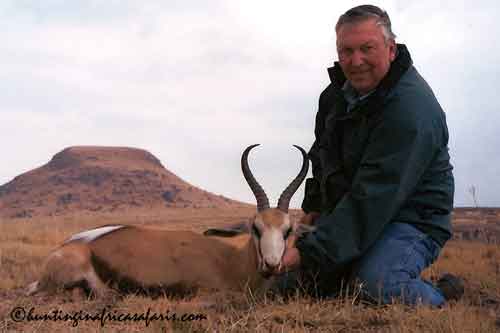
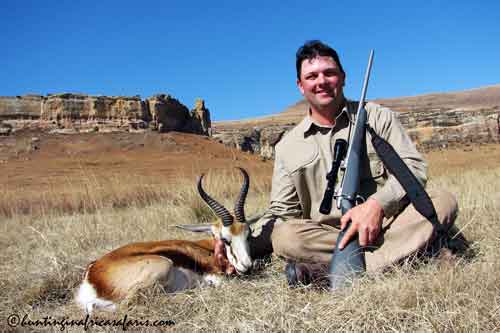
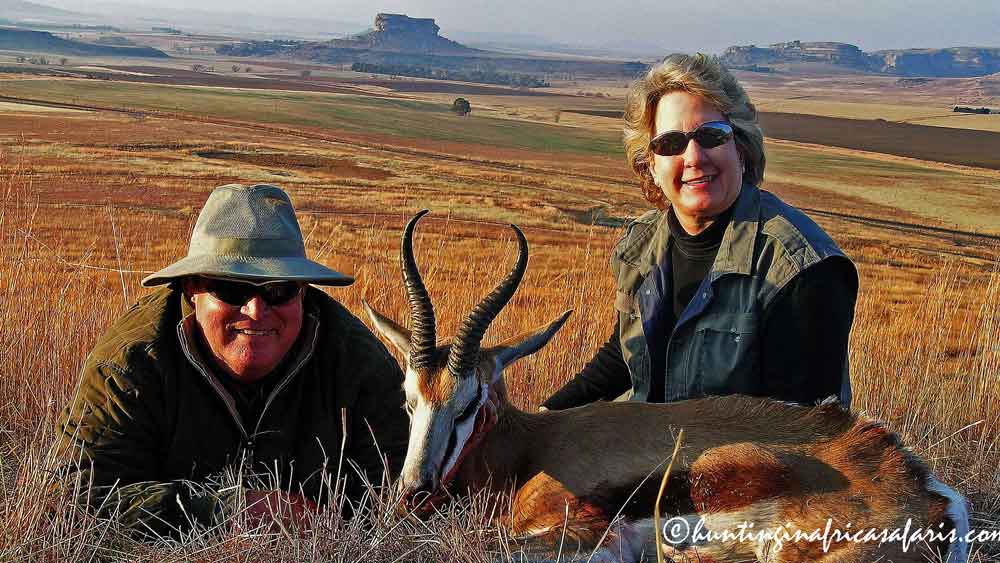
A successful springbok (Antidorcas marsupialis) safari in South Africa results in a premier trophy, commemorating the pursuit of this exceptionally fast and wary antelope. This curated gallery showcases the exceptional quality of trophies harvested by our clients, featuring the Common, Black, White, and Copper color variants required to complete the coveted Springbok Grand Slam.
Whether your objective is a single record-book mount or the pursuit of the complete Springbok Grand Slam, these images reflect the precision and commitment required for world-class springbok hunting in South Africa. Every photograph documents a unique success story: a professional stalk combined with a surgical long-range shot, executed under the guidance of our experienced PH team.



6. Species biology and conservation (Antidorcas marsupialis)
The springbok (Antidorcas marsupialis) is a marvel of evolutionary adaptation, perfectly suited for the arid environments of Southern Africa. They remain the only members of the genus Antidorcas, distinguished from true gazelles by the unique pocket of white hair on their backs—the "pronk"—which they unfurl during displays of excitement or alarm.
6.1 Biological detail: Technical specifications
| Springbok biological profile | |
|---|---|
| Weight (Rams) | 33 kg – 48 kg (73 lbs – 105 lbs) |
| Weight (Ewes) | 30 kg – 44 kg (66 lbs – 97 lbs) |
| Diet | Mixed feeders; they switch between grazing and browsing depending on seasonal rainfall. |
| Water requirements | Highly water-independent; they can survive for extended periods by consuming succulent roots and tubers. |
6.2 Conservation through sustainable hunting
Historically, springbok were renowned for treks involving hundreds of thousands of animals migrating across the plains. Today, through the diligent efforts of private landowners and professional outfitters, the species has been successfully reintroduced to its historical ranges, including the Springbok Flats near Pretoria.
On Farm Rietfontein, our conservation strategy focuses on maintaining optimal "veld" carrying capacity. By harvesting older, past-prime rams, we prevent overgrazing and ensure that the habitat remains resilient for the next generation of vryburgers. Every trophy fee contributes directly to the anti-poaching and habitat management programs that maintain the integrity of these wild plains.
7. Frequently asked questions: Springbok hunting
The following are the most commonly questions asked by hunters getting in contact with us to arrange a springbok hunt. We trust these will answer your initial questions:
7.1 What is the best time of year to hunt springbok in South Africa?
While we hunt year-round on our P3 exempt properties, the optimal time is during the cooler winter months (May to August). The visibility is high, and the movement of the herds increases as they seek out the best remaining grazing.
7.2 How far are the typical shots on a springbok safari?
Be prepared for long-range engagements. While we always strive to get as close as possible, the open terrain of the Springbok Flats and the Karoo often dictates shots between 200 and 350 meters.
7.3 Can I hunt all four springbok color variants on one property?
Yes. Through our management programs, we offer the "Springbuck Slam," which includes the Common, Black, White, and Copper variants, all within our managed hunting areas.
7.4 Is a springbok hunt suitable for first-time African hunters?
Absolutely. It is the perfect introduction to plains game hunting. It requires fundamental stalking skills and marksmanship without the physical intensity of hunting dangerous game.
7.5 What happens if I wound a springbok?
In accordance with ethical hunting standards and our "wounded-is-killed" policy, any animal that is wounded and lost is payable in full. Our trackers are world-class, and we make every effort to recover every animal.
Services
Contact
hunt@huntinginafricasafaris.com
+27 82 824 7681
on Whatsapp and Telegram
Hours
Mondays from: 06:00 - 20:00 (6 am - 8 pm)
Tuesday - Saturday from: 06:00 - 20:00 (6 am - 8 pm)
Sunday: Closed unless we are hunting.