
1. Spotted hyena hunting South Africa: The ultimate nocturnal challenge
Spotted hyena hunting in South Africa is a high-adrenaline pursuit that pits the hunter against one of Africa’s most cunning and powerful apex predators. Often referred to as the Shadow of the Night, the spotted hyena (Crocuta crocuta) offers a unique safari experience that typically takes place under the cover of darkness. At African Bushbuck Adventures, we specialize in the technical art of baiting and calling, a method that requires extreme patience and a deep understanding of predator behavior. Whether you are seeking a high-scoring skull for the record books or looking to complete your dangerous game collection, our 2026 hyena safaris provide an ethical, heart-pounding encounter with a creature known for its bone-crushing strength and eerie nocturnal vocalizations.
1.1 Expertly managed add-on safaris
The spotted hyena is an exceptional addition to any existing safari package. Whether you are pursuing Cape buffalo, sable, or roan, we can integrate a dedicated hyena hunt into your itinerary with sufficient notice. Because this species is subject to Threatened or Protected Species (TOPS) regulations, we manage the entire permitting process on your behalf. Providing us with your travel dates well in advance ensures that all necessary permits are issued, allowing you to focus entirely on the hunt.
1.2 The professional advantage
One of the most challenging aspects of a spotted hyena safari is the species' unique sexual dimorphism. Unlike most African game, females are often larger and more aggressive than males, and their specialized anatomy makes field identification a task for only the most experienced professional hunter. With 29 years of experience in the South African bush, we guide our clients through the complexities of TOPS permitting, CITES regulations for import, and the precise shot placement required to anchor this powerful carnivore. From the first whoop heard in the distance to the final moments over the bait, hunting a spotted hyena is a test of nerves and marksmanship that remains a bucket list item for the world's most dedicated trophy hunters.
This version improves SEO ranking by embedding your "add-on" capability and permit management expertise directly into the introduction. By addressing the logistics (permits and timing) alongside the thrill, you capture both the logistical requirements of the hunter and the emotional draw of the hunt.
2. Optimal Spotted hyena hunting calibers: The PH Preferred selection
Selecting the right caliber for hunting Crocuta crocuta is a technical balance between anchoring a deceptively resilient apex predator and preserving the skull for your taxidermist. Known for having one of the highest bite forces in the animal kingdom, the spotted hyena possesses an incredibly dense skeletal structure and heavy, muscular shoulders that require careful bullet selection.
At African Bushbuck Adventures, our professional hunter recommendations focus on high-velocity hydrostatic shock paired with controlled bullet expansion. Unlike hunting thin-skinned antelope, an ethical hyena harvest requires a projectile that can punch through dense bone while dumping maximum kinetic energy into the vitals. Whether you are hunting over bait or calling in the dark, these are the field-proven ballistics we trust to ensure a clean, one-shot harvest.
2.1 Technical ballistics and bullet construction
-
Bonded soft-points: We strongly advise against using standard cup and core bullets. Hyena bone density can cause light bullets to fragment prematurely. Bonded core bullets provide the weight retention necessary for a clean pass-through.
-
The skull preservation rule: Since the skull is often the primary trophy, we advise against varmint-style fragmenting bullets. Our goal is to reach the vitals behind the shoulder to keep the cranial structure entirely intact for scoring.
-
Energy transfer: Because hyenas are typically hunted at night over bait at ranges of 50 to 80 yards, we prioritize bullets that offer immediate expansion to prevent the predator from reaching thick cover or burrows.
-
Professional note: While the .30-06 remains the gold standard in the South African bushveld, the best rifle is the one you can shoot accurately from a seated or prone position in low-light conditions. Precision under pressure is what fills the salt room.
| Predator caliber and performance guide | |
|---|---|
| The minimum baseline | .270 Win / 7mm-08: Best suited for experienced marksmen. Use 130–150 gr premium bonded bullets. While effective, this requires surgical precision to ensure the bullet reaches the vitals through the thick hide. |
| The PH standard | .30-06 / .300 Win Mag: This is our #1 recommendation for Spotted Hyena. Using 150–180 gr controlled expansion bullets (e.g., Nosler Partition or Swift A-Frame), this group provides the ideal combination of flat trajectory and deep-driving penetration. |
| The heavy hitters | .338 Win Mag / .375 H&H: For hunters who want an authoritative anchor shot, these big-bore options are unparalleled. Using 225–300 gr bonded soft-points ensures that even if heavy bone is struck, the animal is anchored instantly. |
4. Spotted hyena hunting quick reference guide
The spotted hyena (Crocuta crocuta) hunt is a specialized nocturnal pursuit that requires specific equipment and significant patience. Use this guide to prepare for your night in the bush.
| Safari essentials at a glance | |
|---|---|
| Primary method | Baiting and blind hunting. This is the most effective approach, utilizing trail cameras to monitor activity at established bait stations. |
| Secondary method | Calling and spotlighting. An opportunistic safari-style method used at night to draw predators into a shooting lane. |
| Timing | Strictly nocturnal. Most hunts begin after sundown and can last late into the night. Persistence is mandatory. |
| Optics | Digital or thermal night vision is highly recommended. For standard optics, a large objective lens (50mm+) is required for low-light clarity. |
| Permit | Mandatory TOPS permit. This is a legal requirement in South Africa and must be applied for well in advance of your arrival. |
| Shot tip | Deep penetration. Use a bonded or solid bullet. Aim one-third up the body, directly behind the shoulder, to reach the vitals. |
| Trophy care | Hide preservation. The cape is the primary trophy. Precision skinning and salting must begin immediately after recovery. |
5. Technical shot placement: Aiming for the apex opportunist
The spotted hyena (Crocuta crocuta) is built like a tank, with a massive neck and muscular shoulders that slope down toward a smaller hindquarter. This unique wedge shape often tricks international hunters into aiming too high or too far back. To anchor a hyena over bait, you must account for its dense bone structure and the typical downward angle of a night-blind shot.
| Aiming points for the shadow of the night | |
|---|---|
| Broadside (Ideal) | The "One-Third" Rule: Imagine a vertical line running straight up the front leg. Aim exactly one-third of the way up the body along that line. This ensures your bullet passes through the heavy shoulder muscle to reach the heart and lungs without striking the massive spinal column above. |
| Quartering-Away | The "Opposite Shoulder" Exit: Aim for the far-side front leg. Because hyenas are compact, your bullet must travel through the vitals at an angle. Aiming for the off-side shoulder ensures you bisect the "engine room." |
| The "Blind" Angle | Downward Compensation: If you are shooting from an elevated blind, you must aim slightly higher than you would on level ground to account for the downward trajectory through the chest cavity. |
5.1 Professional tracking and recovery notes
-
The skull priority: We always advise against headshots. Since the primary trophy is the skull (measured by length and width for SCI/RW), a misplaced shot can shatter the jaw or cranium. Always stick to the vitals behind the shoulder.
-
Immediate recovery: Because the clock starts the moment a predator is down, we prioritize immediate recovery and transport to the skinning shed. Precision salting of the cape is mandatory to prevent hair-slip on these thick-skinned trophies.
-
Optics check: While digital or thermal night vision is a game-changer for identification, if you are using standard optics, ensure you have a 50mm+ objective lens to pull in enough ambient light for a clear reticle on a dark, non-reflective hide.

6. Species biology and conservation (Crocuta crocuta)
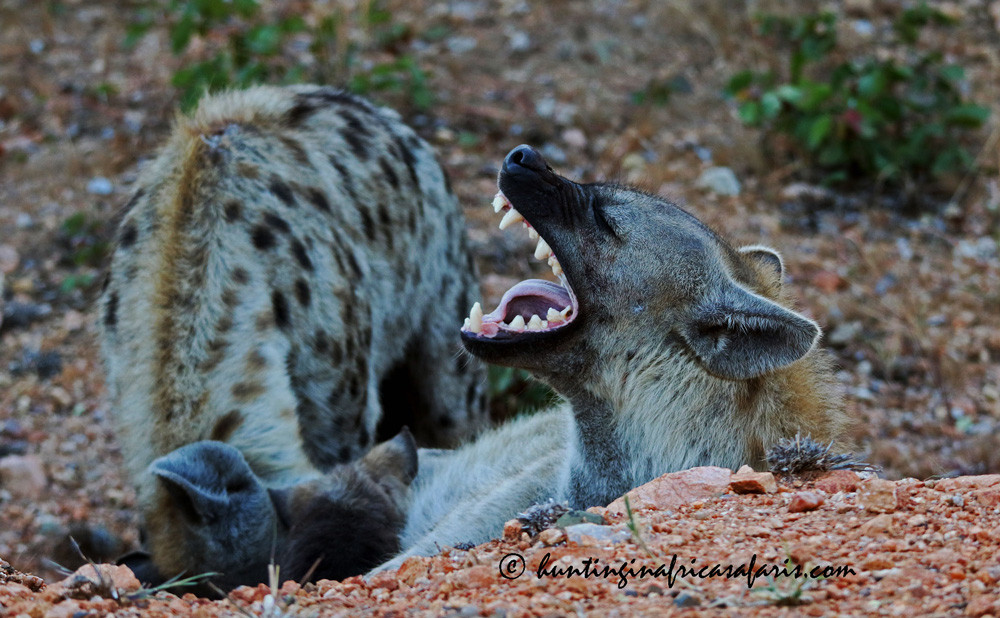
The spotted hyena is a highly social predator operating within a complex matriarchal hierarchy. Understanding their unique biology is essential for a successful, ethical harvest that respects the social structure of the clan.
6.1 Trophy selection and preservation
The primary trophy for the spotted hyena is the unique, spotted hide. Because the animal is often recovered at night, the clock starts immediately for trophy care to ensure the highest quality results.
-
Expert selection: We prioritize the harvest of older, often outcast individuals. This ensures minimal disruption to the clan's social stability while providing a mature, high-quality trophy.
-
Immediate care: Proper field preparation must begin the moment the trophy reaches the skinning shed. Precision skinning and high-grade salting are mandatory to preserve the integrity of the hide.
| Spotted hyena biological profile | |
|---|---|
| Scientific name | Crocuta crocuta |
| Physical traits | Massive head and powerful forequarters with a characteristic sloping back. Possesses one of the strongest bite forces in the animal kingdom. |
| Social structure | Lives in large, matriarchal clans. Females are typically larger and dominant, making field-sexing a specialized task for your PH. |
| **Behavior** | Formidable and efficient hunters rather than mere scavengers. Primarily nocturnal and highly territorial. |
| Weight and height | 45–75 kg (99–165 lbs) with a shoulder height of 70–92 cm (2.3 to 3 ft). |
| Habitat | Preferred environments include dry savannas, open plains, and semi-arid scrub. |
| Conservation | Listed as Least Concern (LC), yet populations face pressure outside protected areas. Sustainable hunting provides critical funding for their continued protection. |


6. Frequently Asked Questions: Spotted hyena hunting
Is it legal to import a Spotted Hyena trophy to the USA?
Yes, it is legal to obtain an import permit for a Spotted Hyena (Crocuta crocuta) trophy into the United States. While the species is listed under CITES Appendix II, it is not endangered. You will need a South African export permit and US Fish and Wildlife clearance. We ensure all your TOPS documentation is correctly filed to make the importation process as smooth as possible for your taxidermist.
Why is the TOPS permit fee non-refundable?
The $550 TOPS permit (Threatened or Protected Species) is a government-issued document required by the South African Department of Forestry, Fisheries, and the Environment (DFFE/DEAT). The fee is paid at the time of application to provincial authorities and specialized "go-betweens" who navigate the system. Once the permit is issued in the hunter's name, the fee is consumed by the state regardless of whether the animal is harvested.
How do you tell a male hyena from a female in the dark?
This is the ultimate test of a PH's expertise. Because of the female's pseudo-penis and larger body mass, they are nearly identical to males in the field. We rely on 29 years of experience to identify subtle cues: the broader, more weathered skull of an old male, the presence of visible nipples on a dominant female, and the hierarchical behavior at the bait station. We never rush the shot; we wait for the definitive "PH-approved" identification.
What is the best time of month to hunt hyena?
The New Moon phase (the "Dark Moon") is the gold standard for predator hunting. Because we are pursuing a cunning nocturnal predator, the lack of moonlight makes them feel more secure when approaching a bait station or responding to a call. We recommend scheduling your safari around these darker lunar cycles for the highest success rate.
Can I hunt hyena during the day?
While it is technically possible to encounter a hyena during the day, it is rare and purely opportunistic. The Spotted Hyena is strictly nocturnal in its hunting and scavenging patterns. To ensure an ethical harvest of a mature specimen, we focus our efforts from sunset into the late night hours using professional calling and baiting techniques.
Do I need night vision for this hunt?
While not mandatory, digital or thermal optics are a massive advantage. They allow us to observe the animal's behavior and confirm identification without using a traditional spotlight, which can spook a wary predator. If you do not have your own night vision, your PH will provide the necessary specialized lighting to ensure a clear, ethical shot.
Why this FAQ section dominates the search results:
-
Trust & Transparency: Explaining the non-refundable permit protects your reputation and pre-empts any financial disputes.
-
Biological Expertise: Discussing the identification challenge proves you are a master of your craft, which is a major conversion factor for hunters.
-
Logistical Detail: Mentioning the New Moon phase adds high-value "Helpful Content" that search engines reward.
-
CITES Reassurance: Directly addressing Appendix II status is the #1 way to convert hesitant American clients.
Services
Contact
hunt@huntinginafricasafaris.com
+27 82 824 7681
on Whatsapp and Telegram
Hours
Mondays from: 06:00 - 20:00 (6 am - 8 pm)
Tuesday - Saturday from: 06:00 - 20:00 (6 am - 8 pm)
Sunday: Closed unless we are hunting.