

Sable antelope hunting South Africa: 2026 Prices and packages
The sable antelope (Hippotragus niger) represents a cornerstone species within elite South African plains game portfolios. Mature sable bulls are highly sought after by international sportsmen due to their distinctive physical profile, characterized by a deep jet-black coat, white counter-shaded underbellies, and prominent, backward-curving scimitar horns. This specialized species demands meticulous field discipline; mature bulls display exceptional sensory awareness, high agility, and a notoriously aggressive defensive temperament when closely pressured within the field.
This digital repository provides comprehensive, data-driven operational intelligence regarding sustainable sable hunting parameters within South Africa, focusing entirely on low-impact concession management frameworks that directly fund habitat protection and regional population stability. South Africa maintains the most biologically stable and accessible wild populations of Hippotragus niger on the African continent, providing optimal conditions for executing a disciplined, fair-chase safari. Our managed harvesting structures utilize strict, low-impact quotas designed to ensure long-term genetic preservation while delivering high-density field data for international tracking teams.
The primary habitat of the sable antelope spans dense open woodlands and complex savanna biomes, providing a highly technical tracking environment that requires excellent physical endurance and precise rifle handling. Securing a mature, post-reproductive sable bull with heavy horn mass remains a premier achievement for dedicated plains game collectors, representing a significant long-term investment in sustainable African wildlife conservation.
2. Sable antelope hunting prices and trophy fees 2026
Evaluating a sable antelope (Hippotragus niger) harvest requires a precise operational breakdown of trophy tier metrics, concession management allocations, and strict horn measurement boundaries. To maintain absolute transparency for international safari budgeting, our 2026 fee structure is partitioned into audited horn length classifications. These tiered rates reflect the exceptional physical maturity, selective hunting pressure, and long-term population investment required to yield world-class specimens on our South African concessions.
2.1 Sable pricing and trophy fee classification matrix
| Sable trophy fees and horn classification metrics | |
|---|---|
| Sable trophy fee (Up to 42”) | $5,000 |
| Sable trophy fee (42” to 45”) | $6,500 |
| Sable trophy fee (Exceeding 45”) | $7,500 |
| Sable trophy fee (Elite 50”+) | Price on application (POA) |
Professional Hunter’s field note: Tracking an elite sable bull exceeding the 45-inch or 50-inch threshold requires deep tracking penetration into remote woodland concessions where mature bulls naturally isolate. These upper-tier prices represent slow-matured, post-reproductive bulls possessing heavy horn ridges and massive tip sweeps. Utilizing our multi-tiered table ensures complete, uncompromised price transparency before booking your itinerary.
3. Best calibers for hunting sable antelope
Selecting an appropriate firearm configuration for a sable antelope (Hippotragus niger) safari requires deep familiarity with the species' physical resilience and bone density. Mature sable bulls carry heavy muscle structures over their primary skeletal frames, demanding a disciplined approach to cartridge and projectile selection. Utilizing standard, rapidly expanding soft-skinned bullets is a significant technical error that frequently results in insufficient terminal penetration. Clean field success requires medium-bore or large-bore centerfire rifle setups firing premium, controlled-expansion or monolithic solid projectiles engineered to maximize sectional density and retain cross-sectional integrity through dense shoulder joints.
3.1 Sable hunting caliber and ballistics performance matrix
| Sable caliber and projectile load recommendations | |
|---|---|
| .30-06 Springfield | The operational baseline for sable. Mandates a minimum of 180-grain premium bonded or structured monolithic projectiles (such as the Barnes TTSX, Nosler Partition, or Norma Oryx) to ensure complete penetration into the thoracic vitals. |
| .308 Winchester | Highly effective when restricted to short-range or medium-range woodland tracking environments. Requires a minimum of 165-grain to 180-grain controlled-expansion ammunition to maintain optimal weight retention and straight terminal paths. |
| .375 H&H Magnum | The definitive medium-bore to large-bore choice for absolute stopping authority. Firing heavy 270-grain to 300-grain premium bonded or solid projectiles provides maximum knockdown force and deep, multi-angle bone crushing capabilities. |
3.1 Terminal ballistics and velocity verification
It is imperative to chronograph your specific handloads or factory cartridge selection to determine verified muzzle velocities and accurately analyze downrange terminal ballistics before arriving at your concession.
For high-velocity magnum cartridges—including the .300 WSM, .300 Win. Mag., or 7 mm RUM—the selection of a premium controlled-expansion or chemically bonded projectile (as opposed to a standard cup-and-core factory design) remains critical. This structural requirement guarantees maximum weight retention upon initial impact, driving the core cleanly through major bone shields while completely eliminating excessive fragmentation or premature jacket separation. Identifying the precise bullet structure and powder charge pairing that optimizes your specific barrel harmonic is the central prerequisite for securing consistent field success when hunting sable in South Africa.
3.2 Technical factors for tracking configuration setup
When finalizing a custom rifle and optic configuration for a sable safari, outfitters assess several interconnected mechanical and field parameters to optimize terminal efficiency:
-
Kinetic energy conversion: Cartridges must retain sufficient downrange striking energy to achieve deep, crushing penetration through the heavy skeletal framework protecting the vital cavity.
-
Recoil mitigation and accuracy: Managing rifle recoil profiles is essential for maintaining consistent accuracy. A sportsman must execute precise shot placement without introducing a defensive flinch.
-
Aerodynamic flight trajectory: Utilizing flat-shooting cartridges offers distinct operational advantages when navigating longer, open shooting lanes interspersed throughout dense woodlands.
-
Sectional density and weight: Selecting heavier, premium-structured projectiles directly yields deeper penetration depths, a vital factor when tracking heavy-bodied African game.
-
Total system tracking weight: A heavier rifle configuration naturally absorbs recoil forces but introduces increased physical fatigue during prolonged foot-stalking sequences across broken terrain.
-
Mechanical action reliability: Traditional bolt-action rifles remain the industry standard due to their absolute mechanical reliability, structural strength, and inherent out-of-the-box accuracy.
-
Optic structural quality: Incorporating a high-end rifle scope engineered for superior light transmission is mandatory for resolving precise vital placement during low-light dawn and dusk tracking windows.
4. Southern sable antelope hunter gallery: A testament to the hunt
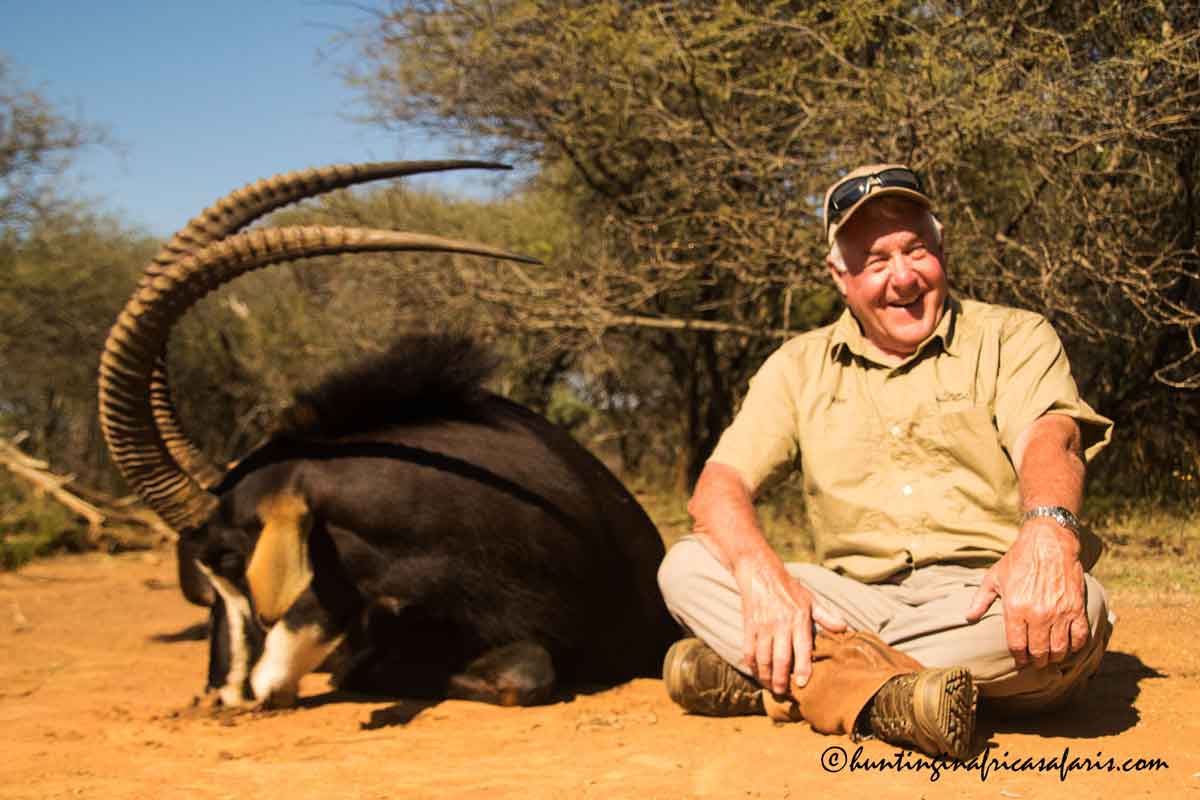
The completion of a successful sable antelope (Hippotragus niger) safari stands as a major milestone within a professional plains game portfolio, documenting the tactical patience and field discipline required to secure an adult bull. This curated archive displays the physical characteristics, deep horn ridges, and heavy horn sweeps of mature specimens harvested by our clients across our South African tracking concessions. Our operations focus entirely on selective, low-impact harvesting methods that consistently yield mature, post-reproductive bulls while actively supporting the regional conservation ecosystems that protect these animals.
Whether a sportsman is targeting a classic, representative 45-inch bull or negotiating a specialized itinerary for an elite specimen exceeding the 50-inch threshold, our adherence to systematic scouting and fair-chase principles ensures your safari concludes with a clean, ethical harvest. Each archival entry represents a precise execution of ballistic planning, expert tracking under local bushveld conditions, and a long-term investment in sustainable South African wildlife management.


5. Species biology and tracking strategies (Hippotragus niger)
The sable antelope (Hippotragus niger) occupies an elite position within South African conservation and management frameworks. Developing a precise understanding of their distinct herd biology, nutritional dependency, and seasonal movement patterns is critical for planning an effective and successful stalk. Selective harvesting structures focus strictly on post-reproductive adult bulls to ensure long-term genetic preservation within our regulated hunting concessions.
5.1 Species specification and hunting context matrix
| Species specifications and management parameters | |
|---|---|
| Scientific designation | Hippotragus niger |
| Common designation | Sable antelope |
| Physical stature | Average shoulder height measures 120 to 140 cm (approx. 47 to 55 inches). Mature adult bulls scale between 180 kg and 270 kg (approx. 400 to 600 lbs). |
| Concession habitat | Primarily restricted to open grasslands, bi-seasonal savannas, and dense woodlands maintaining permanent proximity to surface water sources. |
| Distinguishing features | Displays a dark jet-black coat in mature bulls, sharp white facial masking, and heavy, backward-arching, deeply ridged scimitar horns measuring up to 1.2 meters in length. |
5.1 Optimal hunting season and seasonal parameters
Sable antelope can be successfully harvested throughout the calendar year, but planning your safari around specific seasonal shifts provides severe tactical advantages that directly increase field visibility and trophy quality.
| Seasonal tracking and visibility parameters | |
|---|---|
| Optimal field window | The winter dry season spanning from may through september. |
| Concession benefits | Sparser bushveld vegetation drastically increases downrange visibility; herd movements become highly predictable as natural surface water sources diminish. Winter coats display maximum dark contrast. |
| Tactical advice | Coordinate directly with your professional hunter prior to arrival to analyze local herd movements, current bush density variations, and waterhole game camera telemetry. |
Sable antelope shot placement: Best target & tips for South Africa
The most effective and ethical shot placement for a sable antelope (Hippotragus niger) during your safari is the lower third of the body, tightly behind the front shoulder. This prime target area ensures a clean shot to the heart and lungs for a rapid, humane kill.
Note: Sable anatomy is very similar to the roan antelope. Due to their size and dense bone structure, precise placement and adequate caliber are vital for an ethical harvest.
General shot placement tips for sable
-
Aim: Focus on a clean shot through the heart and both lungs.
-
Broadside shot: This is the gold standard, offering the largest target to the vitals.
-
Visualization: Target the point where a line running up the back of the front leg intersects the body one-third to one-half of the way up.
-
Preferred angle: A quartering-away shot is highly effective as it targets the vitals diagonally, away from the dense shoulder bone.
-
Avoid: Shoulder shots due to a high risk of deflection, and neck or head shots because they present a small, high-risk target.
-
Practice: Consistent practice and a thorough understanding of anatomy are crucial for success.


Services
Contact
hunt@huntinginafricasafaris.com
+27 82 824 7681
on Whatsapp and Telegram
Hours
Mondays from: 06:00 - 20:00 (6 am - 8 pm)
Tuesday - Saturday from: 06:00 - 20:00 (6 am - 8 pm)
Sunday: Closed unless we are hunting.