
1. Mountain reedbuck hunting price: 2026 Safari costs and mountain rifle selection
Welcome to the definitive digital outfitter guide for planning a fair-chase mountain reedbuck safari in South Africa. When international sportsmen begin mapping out their seasonal high-altitude hunting itineraries, they rely heavily on search engine queries to gauge their total out-of-pocket expenses, focusing intensely on terms like mountain reedbuck hunting price, mountain reedbuck hunting cost, and mountain reedbuck trophy fee. To provide total financial transparency and ensure a seamless budgeting experience, all applicable South African government value-added tax parameters are fully included in all rates listed by African Bushbuck Adventures.
The mountain reedbuck (Redunca fulvorufula), often referred to simply as the southern mountain reedbuck, represents a highly specialized pursuit for the selective mountain collector seeking an authentic, challenging high-altitude safari. Renowned for the dense, forward-curving horns carried exclusively by the rams, this specialized antelope thrives across the rugged, broken hill slopes, mountain koppies, and elevated shale ridges of the North West and Pretoria districts.
1.1 The highland challenge: Spot-and-stalk field execution
The mountain reedbuck is a absolute master of high-altitude camouflage, perfectly adapted to blending seamlessly into the steep, rocky slopes and scree fields of the South African highlands. While smaller in physical stature than its low-lying riverine cousin, the common reedbuck, the true trophy value of a mature ram lies in its unique horn character and the sheer physical difficulty of the traditional walk, climb, and stalk required to harvest one.
For the international traveling sportsman, this species represents far more than just a record-book entry; it is a definitive test of precision shooting and physical endurance. Because these animals inhabit high-wind alpine environments, executing long-range shots and maintaining a deep understanding of uphill and downhill angled ballistics are essential to finding success. If you are actively pursuing a mountain reedbuck, your first introduction to the species in the field is often the sharp, piercing sound of their explosive whistle alarm call, a clear warning that they have spotted your tracking party long before you have glassed them in the rocks.
1.2 An important anatomical distinction for the collector
It is highly critical for international sportsmen to distinguish the mountain reedbuck from the sympatric vaal rhebok (Pelea capreolus). While these two distinct species routinely share the exact same mountain neighborhood and rocky slopes, the mountain reedbuck is physically smaller, carries much shorter, forward-curving horns, and exhibits a completely different behavioral profile than the long-eared, straight-horned vaal rhebok.
Understanding these subtle physical nuances is the ultimate hallmark of an experienced professional hunter and ensures a highly successful African safari. Whether you are looking to expand your specialized small game portfolio or seeking a deeply rewarding high-altitude mountain challenge, our 2026 mountain safaris offer a world-class experience across South Africa's most pristine alpine concessions.
1.3 Innovation in the field: Tactical calling methods
While a traditional walk, climb, and stalk sequence remains the gold standard of mountain hunting, our 29 years of continuous outfitting experience have led our tracking teams to master a far more tactical approach: predator and vocalization calling. By utilizing highly specialized, regional acoustic calls, we have discovered that we can successfully draw curious, dominant rams out of dense mountain cover and off entirely inaccessible rock ridges.
This innovative field method has proven to be an absolute game-changer, particularly for traveling clients who may find the extreme physical demands of high-altitude mountain climbing a severe challenge. By bringing the game down to the hunter, we ensure that the deeply rewarding experience of an alpine safari remains completely accessible to all clients, regardless of individual field mobility, while providing a thrilling, up-close encounter that very few modern outfitters can replicate.
2. Mountain reedbuck hunting prices: 2026 Outfitter cost breakdown
At African Bushbuck Adventures, we are deeply committed to providing full price transparency for your international safari planning. Whether you are actively pursuing a mature mountain ram as a standalone trophy or integrating him as a specialized addition into a larger South African plains game package, we provide clear, upfront 2026 pricing. Due to the highly specialized nature of these alpine hunts—which require access to low-density mountain concessions and veteran mountain trackers—we have updated our mountain reedbuck hunting cost structures for the 2026 season.
2.1 Mountain reedbuck trophy fee schedule
| 2026 Core trophy fee and field wounding policy | |
|---|---|
| Mountain reedbuck trophy fee | $1,550 USD (Includes specialized provincial permit administration, professional mountain caping, primary salting, and concession transit) |
| Wounded animal policy | Full trophy fee applies: In accordance with strict ethical hunting codes, any animal drawing blood that is not successfully recovered after a diligent tracking sequence is considered harvested. |
2.2 Analyzing your total mountain reedbuck hunting price
When investigating competitive mountain reedbuck hunting prices in South Africa, it is vital to analyze the exact terrain parameters and professional infrastructure supporting your safari.
-
Trophy fee policy framework: The $1,550 mountain reedbuck trophy fee is a fixed, one-time charge incurred exclusively upon the successful harvest or wounding of a mature ram (Redunca fulvorufula). We do not employ hidden size surcharges, meaning a single flat rate covers any top-ranking record-book trophy ram encountered in the field.
-
Flexible safari add-on configurations: The vast majority of international clients choose to hunt this mountain species as a specialized add-on to a standard plains game package. However, we also design dedicated, short-duration mountain safaris for collectors specifically targeting high-altitude specialist species.
-
Comprehensive rate inclusions: Your daily hunting rates fully include one-on-one supervision from a licensed professional hunter, specialized mountain trackers, expert field preparation of trophies, luxury lodge accommodations, all meals, local drinks, and regional airport ground transfers.
-
Price validity parameters: These listed outfitter rates are strictly valid and locked in for the 2026 South Africa hunting season.
PH Field Journal Note on Value: While you may occasionally encounter bargain basement prices for this species across the web, traveling hunters must be aware that cheap packages are routinely conducted on flat, high-fenced ground where the animals have been artificially introduced. Our hunts are conducted exclusively across their natural, rugged mountain habitats, ensuring a true 100% fair-chase, walk, climb, and stalk experience that authentic mountain hunters demand.
3. Best caliber for mountain reedbuck hunting: Technical rifle and bullet guide
Selecting the ideal tool for mountain reedbuck rifle selection requires a highly calculated ballistic balance between an exceptionally flat trajectory capable of cutting through unpredictable alpine canyon winds and absolute surgical accuracy over longer distances. Because the mountain reedbuck (Redunca fulvorufula) is a relatively small, light-framed antelope ram, massive terminal knockdown energy is far less critical to a successful harvest than a flat-shooting bullet design that minimizes spatial errors when executing steep uphill or downhill angled shots across rugged shale slopes.
For the international traveling sportsman, the tracking team at African Bushbuck Adventures recommends highly accurate, fast, flat-shooting cartridges that excel in high-wind mountain environments. Cartridges like the classic .243 Winchester, the highly efficient 6.5 Creedmoor, the flat-shooting 6.5 PRC, and the traditional .270 Winchester represent the absolute gold standards for this specific montane pursuit. These cartridge choices provide the ideal sectional density and high ballistic coefficients required to execute a clean, ethical harvest at typical alpine hunting ranges that routinely vary anywhere from 150 to 300 yards.
3.1 Technical caliber and bullet specifications
| Proven alpine cartridges and terminal bullet selection | |
|---|---|
| The light mountain caliber group (.243 Win / 6.5 Creedmoor) | Surgical alpine accuracy: Utilizing an 85-grain to 140-grain premium aerodynamic projectile provides an incredibly flat trajectory with virtually zero hunter flinch, making it absolutely perfect for placing a precise bullet directly into the tight vital pocket of a distant, cliff-dwelling ram. |
| The high-velocity caliber group (6.5 PRC / .270 Win) | Superior crosswind mitigation: Opting for fast, modern 130-grain to 145-grain streamlined bullets delivers the exceptional velocity and wind-bucking capability needed to defy steep mountain thermal updrafts and anchor a trophy ram cleanly before he can drop over an inaccessible ledge. |
Professional Field Journal Note: Our 29 years of continuous outfitting experience across the rugged mountain ranges of South Africa have taught us that mountain hunting is defined by severe crosswinds and steep shooting angles. While selecting the best caliber for mountain reedbuck hunting gives you a major mechanical advantage, success always hinges on your ammunition selection and drop verification. We highly recommend utilizing premium, rapid-expansion polymer-tipped or sleek boat-tail bullets that expand reliably at extended ranges, ensuring maximum energy transfer inside the vital vault and eliminating a perilous mountain tracking sequence.
3.3 Trophy preservation: Calibers to AVOID for mountain reedbuck
While the tracking team at African Bushbuck Adventures always believes in using the specific rifle setup you shoot best, a dedicated montane safari requires a highly calculated ballistic approach. If you are specifically targeting this specialized highland antelope, we strongly advise against choosing to be over-gunned in the field. The overarching goal is to achieve a clean, ethical harvest that completely preserves the delicate, woolly cape and forward-curving horns for your taxidermist.
Below are the specific calibers we recommend avoiding if this highland ram is your primary objective.
| Caliber avoidance and trophy warning matrix | |
|---|---|
| 7mm RUM / 7mm Rem Mag | Extreme velocity damage: These high-stepping ultra-magnums are engineered for much larger alpine game at extreme distances. On a light 30kg mountain ram, the resulting hydrostatic shock and violent bullet expansion often result in extensive cape destruction. |
| .300 WSM / .300 Win Mag | Excessive kinetic energy: While these prominent calibers are excellent choices for heavy plains game like kudu or eland, they carry far too much terminal punch for a fragile mountain frame, risking immense meat loss and massive pelt tearing. |
| .338 Lapua Magnum | Total highland overkill: This heavy cartridge is a specialized long-range tactical round. Utilizing it on a small highland antelope is completely unnecessary, and the heavy recoil often hinders the absolute precision needed to execute a steep mountain-angle shot. |
| Large bore calibers (.375+) | Unpredictable terminal results: While a dead-is-dead philosophy certainly exists among some hunters, the heavily constructed bullet designs of dangerous game calibers often fail to expand correctly on light-boned animals, leading to pencil-through holes or erratic, unpredictable tearing. |
3.4 The spur of the moment
We fully understand that traditional African safaris are incredibly dynamic environments. If you are already actively moving through the high ridges hunting larger plains game and an unexpected opportunity for a trophy mountain reedbuck arises, you must naturally utilize the specific rifle currently carried in your hand. In these fast-paced, spur of the moment field scenarios, your professional hunter will immediately guide you on alternative shot placement options, such as a high-shoulder or high-neck shot, to deliberately minimize heavy skin damage from high-velocity or heavy-grain rounds.
However, for the dedicated trophy collector focusing entirely on this specialized mountain pursuit, packing a light-bore precision mountain rifle like a .243 Winchester or a 6.5 PRC remains the definitive professional choice.
4. Mountain reedbuck shot placement parameters: The mountain outfitter guide
Mastering the precise anatomical nuances of mountain reedbuck shot placement parameters requires a deep understanding that goes far beyond simply knowing where the heart and lung cavity is located within the frame. It demands a practical, technical mastery of high-angle alpine ballistics. Because these specialized highland rams (Redunca fulvorufula) spend their lives traversing steep, rocky slopes, crumbling cliffs, and elevated shale ridges, a traveling sportsman will rarely find himself executing a shot on a perfectly level shooting plane.
Absolute precision shooting is your number one priority when operating across this vertical terrain under the African Bushbuck Adventures banner. A single misplaced or erratic bullet on an alpine ridge can easily result in an incredibly long, grueling, and dangerous recovery sequence through entirely inaccessible mountain crevices and steep scree slopes.
4.1 Where to shoot a mountain reedbuck: High-angle technical guide
| Anatomical points of aim and angled ballistics | |
|---|---|
| The classic broadside point of aim | The heart and lung center: Aim directly for the center of the front shoulder blade, or merely a finger-width behind the shoulder crease, exactly one-third of the way up from the bottom line of the chest cavity. This classic double-lung trajectory represents the most reliable, humane choice for pristine trophy preservation. |
| The tactical high-shoulder anchor placement | Instant drop execution: When hunting on severe, near-vertical rock faces where you must stop the animal from falling over a cliff edge, aim for the upper third of the front shoulder. This heavy impact breaks the skeletal structure, disrupts the central nervous system, and immediately anchors the ram right where he stands. |
| The technical quartering-away angle | Aiming for the far side shoulder: When a ram is facing away at an angle, place your crosshairs further back along the rib cage, angling the bullet trajectory forward toward the off-side front leg to ensure a clean, devastating passage straight through the center of the vital vault. |
| High-angle shooting mathematics | Compensating for gravity: Whether you are shooting at a severe uphill angle or a steep downhill slope, your projectile will always strike noticeably higher than it would on a flat shooting range. You must deliberately aim slightly lower on the body profile to compensate for this mathematical angle distortion. |
4.2 Key mountain hunting strategy and animal behavior
| Behavioral profiles and tracking implications | |
|---|---|
| The classic final glance pause | Exploiting a brief shooting window: This species displays a highly predictable habit of running a short distance up a ridge and then stopping cold to look back down at the source of danger. This fleeting 2 to 3-second window is routinely your absolute best opportunity to settle your crosshairs and execute a shot. |
| Target vital area constraints | The grape-fruit sized target: The combined heart and lung vault of a mature, 30kg mountain ram is roughly equivalent in size to a standard grapefruit. This compact target area makes a rock-steady field rest, such as a high-quality bipod or modular tripod system, mandatory for long distances. |
| Alpine tracking complications | Navigating broken rock crevices: Due to the fractured nature of their high-altitude environment, a poorly hit animal can easily crawl into deep rocky crevices or dense alpine scrub. Utilizing heavy-for-caliber bullets with an aerodynamic profile ensures immediate energy delivery to mitigate tracking failures. |
Professional Field Journal Note: Our 29 years of continuous outfitting across South Africa's rugged mountain terrain have proven that managing your personal breathing cycle during an intense mountain stalk is just as important as reading the crosswinds. After a grueling vertical climb to gain a vantage point on a ridge, your heart rate will naturally be elevated. You must take a moment to drop your pack, lock your rifle securely into your shooting sticks, and allow your respiration to normalize completely before attempting to squeeze the trigger on a grapefruit-sized target positioned 250 yards away across a steep canyon.
5. Species biology and conservation (Redunca fulvorufula)
The mountain reedbuck stands out as the smallest representative member of the Redunca genus, displaying unique physical adaptations specifically designed for an existence among the steep, broken rock slopes and elevated highland ridges of South Africa's high-altitude mountain chains. Widely recognized by its sharp, distinctive alarm whistle and its dense, insulating woolly coat, this specialized animal represents a unique mountain-dwelling species that requires a completely different hunting and tracking approach than its larger, valley-dwelling cousins found on the open savanna plains.
5.1 Mountain reedbuck taxonomy & physical facts
| Taxonomic classification and physical attributes | |
|---|---|
| Scientific name | Redunca fulvorufula |
| Family / genus | Bovidae / Redunca |
| Adult weight (ram) | 28 – 35 kg (60 – 77 lbs) |
| Adult weight (ewe) | 24 – 30 kg (53 – 66 lbs) |
| Shoulder height | 70 – 80 cm (27 – 31 inches) |
| Trophy feature | Short, thick ridges forming forward-curving horns on mature rams |
| Glandular patch | Distinctive bare black circular patch positioned directly below each ear |
| Gestation period | Approximately 240 days which translates to roughly 8 months |
| Conservation status | Least concern under the current IUCN Red List criteria version 3.1 |
6. Mountain reedbuck hunting gallery: Success in the South African mountains
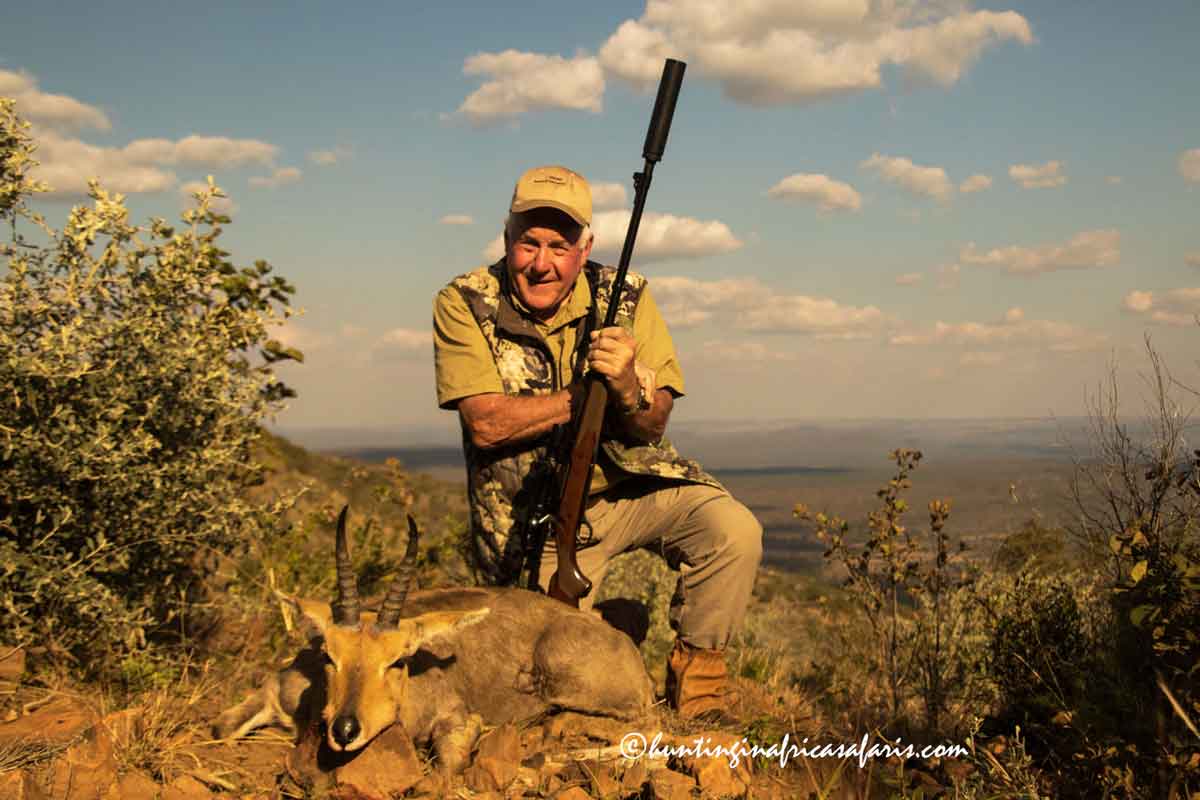
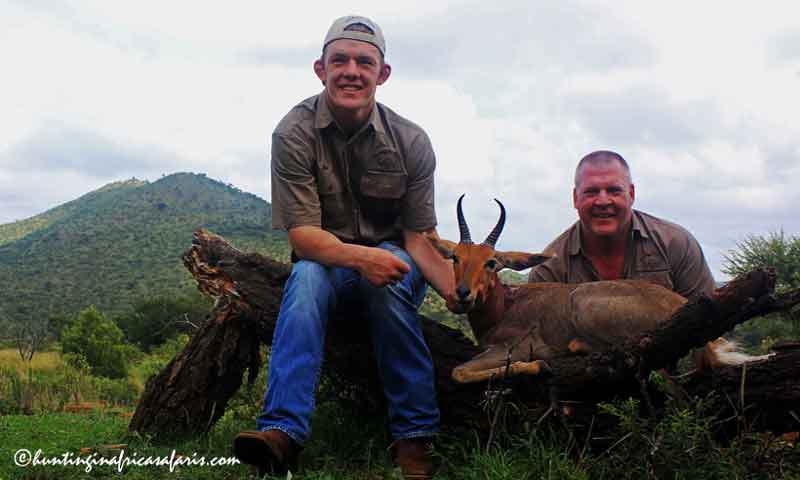
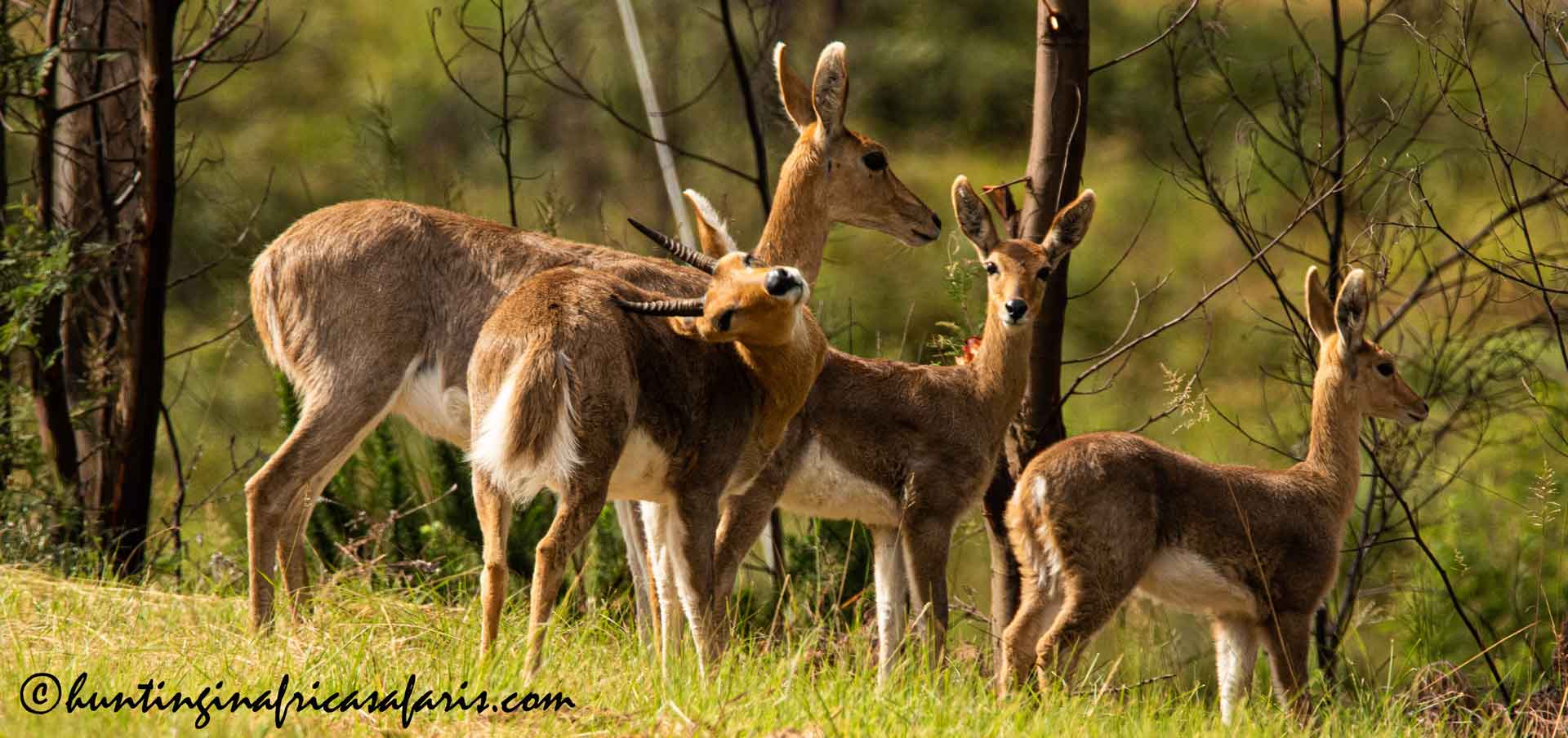
Browse our exclusive visual gallery documenting highly successful mountain reedbuck hunts conducted across South Africa's premier, high-altitude outfitting provinces, including the steep ridges of the eastern Free State and the rugged hillsides of Natal.
These field photographs capture the demanding, raw beauty of pursuing this elusive mountain dweller (Redunca fulvorufula) across its fractured, vertical habitat. Each individual photograph serves as a clear testament to the specialized shooting skills, physical stamina, and patience required on an authentic highveld safari, alongside highlighting the exceptional trophy quality harvested in tandem with our expert professional hunters. Use this curated gallery to fully visualize the rocky terrain, the unique forward-curving horns, and the deeply rewarding nature of a dedicated mountain reedbuck hunting safari in South Africa.
Field photography note: When capturing your trophy photographs on these high-altitude slopes, our guiding team always takes special care to position the ram naturally on a steady, forward-facing rock incline. This deliberate composition beautifully mirrors their high-country lifestyle, frames the unique curve of the horns perfectly against the open sky, and pays proper, ethical tribute to a magnificent alpine quarry.


7. Frequently Asked Questions: Mountain reedbuck hunting
1. Is the Mountain reedbuck part of the "Tiny Ten"?
Yes. While not the smallest member, the Southern Mountain reedbuck is a core species for hunters looking to complete the African Tiny Ten collection. Its inclusion is based on its small stature, specialized habitat, and the unique physical challenge required to harvest one.
2. How do you distinguish a Mountain reedbuck from a Vaal rhebuck?
This is a common point of confusion. The Mountain reedbuck has shorter, forward-curving horns and a distinctive black glandular patch below the ear. The Vaal rhebuck (Grey Rhebuck) is larger, has straight, needle-like horns, and possesses a much thicker, woolly grey coat. Their behavior also differs; the Mountain reedbuck whistles when alarmed, while the Vaal rhebuck is known for its "rocking horse" gait.
3. What is a good trophy size for a Mountain reedbuck?
A mature Mountain reedbuck ram typically carries horns between 6 and 8 inches. Anything exceeding the Rowland Ward minimum of 8 inches is considered an exceptional trophy. We focus on harvesting old, post-prime rams with thick bases and well-defined forward hooks.
4. How difficult is the terrain for a Mountain reedbuck hunt?
The hunt is physically demanding. You will be operating in steep, rocky "koppies" and high-altitude ridges. While our calling techniques can assist with drawing rams closer, a baseline level of fitness is recommended to navigate the uneven scree slopes safely.
5. Can I hunt Mountain reedbuck and Common reedbuck on the same safari?
Absolutely. While they inhabit different niches—the Common reedbuck in the marshy vleis and the Mountain reedbuck on the high slopes—both can often be found within the same South African concessions. We frequently include both in our comprehensive plains game packages.
Services
Contact
hunt@huntinginafricasafaris.com
+27 82 824 7681
on Whatsapp and Telegram
Hours
Mondays from: 06:00 - 20:00 (6 am - 8 pm)
Tuesday - Saturday from: 06:00 - 20:00 (6 am - 8 pm)
Sunday: Closed unless we are hunting.