
Bushpig hunting in South Africa: Prices 2027, calibers & night-hunting methods
For international sportsmen looking to secure one of the most elusive nocturnal trophies on the continent, bushpig hunting in South Africa represents the ultimate test of patience and fieldcraft. Often referred to by American collectors as the African wild boar or the ghost of the darkness, the bushpig (Potamochoerus larvatus) is a formidable, forest-dwelling specialist known for its aggressive nature, acute senses, and incredible skeletal resilience. Because of their secretive, highly cautious habits, many outfitters treat them merely as a chance encounter of opportunity—resulting in notoriously low success rates across the safari industry.
At African Bushbuck Adventures, we turn the odds heavily in your favor. Unlike the diurnal warthog, tracking this secretive African wild hog requires highly specialized techniques, such as night hunting bushpig over bait from scent-controlled blinds or utilizing specialized hound packs in dense riverine thickets. By integrating daily baiting regimes, active trail-camera monitoring, and premium concession management across the Limpopo Province, we deliver a high-success tracking experience.
This comprehensive guide—compiled by senior staff with 29 years of professional experience—provides the definitive technical expertise required for a successful safari. Read on to discover current 2027 bushpig trophy fees, optimal ballistic and bullet construction requirements to punch through their thick hides, and the ethical, fair-chase hunting methods used to securely anchor a mature, heavy-tusked boar.
1. Bushpig trophy fees and night-hunting rates 2027
Below are the official 2027 trophy fees to hunt bushpig in South Africa with African Bushbuck Adventures. Securing a mature boar—the legendary ghost of the darkness—is a highly specialized pursuit that requires significant field preparation, including weeks of advanced scouting and the consistent maintenance of active, scent-controlled bait sites.
Because international clients frequently ask about the total bushpig hunting South Africa price, we utilize a transparent, upfront financial model. These rates reflect the intensive labor, trail-camera tracking, and specialized logistics required to guarantee a premium, high-success encounter on a wild, free-range African wild boar hunt.
| Bushpig Hunting Costs & Surcharges | |
|---|---|
| Itemized Safari Component | 2027 Rate (USD) |
| Bushpig trophy fee (Mature boar) | $950 (Flat Trophy Fee) |
| Baiting & night-hunting surcharge | $150 (Covers daily baiting labor & trail-cam tracking) |
| Daily rate (1x1) for dedicated bushpig hunts | Refer to our official safari price list |
| Wounded or lost animal | Full Trophy Fee Applicable |
1.2 What is included in your bushpig safari?
Unlike a standard daylight plains game hunt, harvesting a mature boar requires specific tech, dedicated setups, and disciplined hours inside a blind. Our all-inclusive hunting safaris in South Africa are structured to completely cover the logistical and technical side of the pursuit so you can focus entirely on executing a perfect shot under the cover of darkness.
| Included Logistical Services & Equipment | |
|---|---|
| Service Detail | Included in your 2027 booking |
| Bait station management | Establishment of heavily pre-baited active sites weeks prior to your arrival to guarantee consistent nocturnal activity. |
| Nocturnal equipment | Full access to specialized low-light illumination, custom blind setups, and red-light target assistance where legally permitted. |
| Professional hunter (PH) | Dedicated 1-on-1 guidance from a nocturnal hunting specialist with decades of tracking experience. |
| Field preparation | Meticulous cape removal, skinning, and salted trophy preservation specifically handled for international export taxidermy. |
| Concession transport | All in-field transport via specialized 4x4 vehicles to and from hidden riverine thicket blinds. |
2. Recommended calibers for bushpig hunting: The bones and body weight theory
Selecting the best caliber for bushpig hunting is a technical decision that must account for the animal’s unique physiology and the close-range environment of a nocturnal safari. The bushpig (Potamochoerus larvatus) is an exceptionally hardy, thick-skinned omnivore with a dense skeletal structure and a heavy layer of protective subcutaneous fat. Unlike the diurnal warthog, a mature bushpig boar can weigh up to 220 lbs (100 kg) and carries a thick, hardened cartilaginous shoulder shield designed to withstand tusks during territorial fights.
Because an anchored boar is notorious for fleeing into impenetrable wait-a-bit thorns when wounded, international hunters must prioritize massive terminal stopping power over flat trajectories. To ensure an ethical, one-shot harvest in low-light conditions, your chosen rifle setup must utilize high-impact calibers paired with premium-grade, controlled-expansion bullets designed for maximum penetration through this dense forest armor.
2.1 Matching African hunting ballistics with close-range hog encounters
When tracking this secretive African wild hog, the minimum caliber for bushpig safari success starts at the .270 Winchester, though medium-bores are highly preferred by our guiding staff. Because the typical shot distance from a scent-controlled blind over bait ranges between 30 to 70 yards, ultra-high-velocity magnums firing standard soft-point ammunition can actually backfire. At close range, excessive speed can cause a fragile bullet to fragment prematurely upon impacting the boar's dense shoulder bone structure, resulting in a shallow wound channel and a dangerous tracking job in pitch-black riverine thickets.
2.2 Low-light optical integration for bait hunting
A crucial element of bushpig hunting rifle caliber selection in South Africa is how the firearm interacts with night hunting optics. Because these tracking encounters occur under the cover of darkness, your rifle should be topped with a high-transmission scope featuring an illuminated reticle or a legally approved low-light digital attachment.
Ensuring your caliber produces manageable recoil allows you to maintain a clear sight picture through the optics during the muzzle flash, giving you the immediate visual feedback necessary to determine if a rapid follow-up shot is required before the boar vanishes into the dense bushveld shadows.
| Recommended Bushpig Hunting Calibers | |
|---|---|
| Caliber Selection | Expert Technical Notes & Bullet Choice |
| .308 Winchester | Minimum baseline caliber. Highly effective at close bait-station distances. We explicitly recommend utilizing 165 grain premium bonded or monolithic solid copper bullets to ensure deep straight-line penetration through the tough shield. |
| .30-06 Springfield | The definitive standard choice. Delivers exceptional terminal stopping power and deep penetration on heavy-for-caliber setups. Load with an 180 grain Barnes TTSX or Nosler Partition to break the forward shoulder joints cleanly. |
| .300 Win Mag | The heavy hitter. An ideal cartridge for anchoring a large boar instantly upon impact. It generates massive hydrostatic shock at close quarters, preventing the animal from fleeing into impenetrable wait-a-bit thorns. |
| 9.3 x 62 Mauser | The bush specialist. A legendary European medium-bore known for delivering immense knock-down energy in the darkness. Performs flawlessly when driving heavy 250 grain to 286 grain premium projectiles through dense riverine cover without destroying valuable cape meat. |
| .375 H&H Magnum | The ultimate security choice. Is it overkill for an African wild hog? Absolutely not. When tracking an aggressive, wounded boar in pitch-black riverine thickets, this iconic cartridge provides the ultimate insurance and backing safety. |
2.3 Critical considerations for bushpig ballistics & gear
Successful bushpig hunting in South Africa is a game of fine margins. Because tracking encounters are typically taken at close range from 30 to 60 yards under highly challenging low-light conditions, your specialized safari gear must be optimized for both pinpoint precision and absolute terminal stopping power. Our senior staff has identified four critical logistical factors that define a successful nocturnal harvest:
| Nocturnal Gear & Ballistic Requirements | |
|---|---|
| Technical Factor | Senior Staff Expert Requirements |
| Bullet construction | Premium bonded/monolithic setups: We heavily favor loading a Barnes TTSX or Nosler Partition. You require near-100% weight retention to punch cleanly through the bushpig's dense cartilaginous shoulder shield and thick leather hide. |
| Shot placement | Low and forward orientation: Align your crosshairs directly on the bottom third of the body depth, immediately above the front shoulder joint. This point of aim targets the heart-lung boiler room and anchors the forward skeletal structure, eliminating a dangerous follow-up track in the darkness. |
| Rifle handling | The specialized bush carbine: Utilizing a shorter barrel length equipped with a sound suppressor is ideal for maneuvering within the tight confines of a scent-controlled blind. A compact rifle allows for swift, silent tracking adjustments in total darkness. |
| Optic technology | Modern thermal and night vision: While traditional red-light hunting lamps remain a classic choice, using 2027 thermal optics or digital night-vision scopes ensures superior target identification, precise sex determination of the hog, and completely ethical shot placement. |
3. Bushpig shot placement: The poor man's leopard precision
Because the bushpig (Potamochoerus larvatus) is pursued almost exclusively in low-light conditions—often over active bait stations at close ranges of 30 to 50 yards—your absolute margin for error is zero. Their compact, hyper-muscular skeletal build, dense bone structure, and thick cartilaginous shoulder shield require a highly specific point of aim to anchor the wild boar instantly on impact.
A wounded, aggressive boar trailing blood into pitch-black riverine thickets presents a severe tracking liability for the hounds and staff. Therefore, we instruct international sportsmen to apply the exact same mechanical discipline and crosshair placement to an African wild hog encounter as they would on an elite, high-stakes leopard safari.
3.1 Where to shoot a bushpig over bait
When looking at data on where to shoot a bushpig over bait, many hunters mistakenly rely on standard North American feral hog or European wild boar anatomy models. While the general location of the heart-lung boiler room is similar, the dense forest armor shield on an older African boar sits lower and further forward than expected. To ensure an immediate, ethical recovery, study our comprehensive technical breakdown below:
| Anatomy & Field Guide for Shot Placement | |
|---|---|
| Anatomical Aspect | Professional PH Technical Instructions |
| Primary target | Heart and lungs: Align your crosshairs directly on the bottom third of the body depth, tracking straight up the back vertical line of the front leg (indicated by position 3 on the anatomical diagram). |
| The shield factor | Older boars carry a dense, tough layer of cartilage over the shoulder area. You must deploy premium, high-sectional-density bonded bullets or monolithic solid copper frames to punch through this protective plate. |
| Broadside shot | Aim directly for the vital internal V intersection where the forward shoulder blade meets the elbow joint. Avoid placing the shot too far back into the ribs (position 4), or the pig will flee into dense thorns. |
| Quartering-in shot | Place the crosshairs precisely on the point of the leading shoulder closest to your blind, driving the projectile diagonally through the front bone structure to destroy the vitals. |
| The no-go zone | Avoid head and neck shots: A bushpig skull is heavily sloped, dense, and elongated (as seen in position 1). Under low-light conditions, even a slight angling change can cause a catastrophic bullet deflection. |
Mastering the low-light sight picture
When utilizing our bushpig shot placement guide from within a scent-controlled hunting hide, remember that shadows can severely distort the animal's physical borders. A mature boar's long, coarse mane can make its shoulder profile appear up to 4 inches higher than it actually is.
To avoid a high, non-lethal hit into the dorsal spine area, always look for the physical location of the front leg joint and place your illuminated reticle cleanly into the lower third of the actual torso structure for a rapid, ethical kill.
4. Species biology and conservation (Potamochoerus larvatus)
The bushpig is Africa’s elusive equivalent to the European wild boar, though it possesses a much higher level of aggression, territorial instinct, and problem-solving intelligence. As a highly successful member of the true wild pig family (Suidae), the bushpig (Potamochoerus larvatus) is a master of behavioral adaptation, flourishing inside South Africa’s densest riverine thickets, montane forests, and commercial agricultural fringes.
While they are classified as least concern by the IUCN Red List of Threatened Species, their local populations require rigorous, continuous management. Controlled tracking safaris act as the primary, sustainable mechanism to mitigate their impact as a highly destructive agricultural pest across rural farming communities.
4.1 Essential bushpig habitat and biological breakdown
To successfully outsmart the ghost of the darkness, an international sportsman must understand the biological traits, dietary drivers, and social structures that influence their nocturnal movements. Our tracking teams utilize this specific scientific data to map out daily baiting schedules and blind placements across our private concessions:
| Bushpig Biological & Conservation Data | |
|---|---|
| Biological Aspect | Detailed Species Data & Behavioral Profile |
| Social structure | They live in cohesive family groups known as sounders, typically consisting of 6 to 12 members. These packs are strictly led by an aggressive, dominant alpha boar and a mature alpha sow. |
| Dietary profile | Highly opportunistic omnivores. Their natural diet includes subterranean roots, bulbs, wild fruits, insects, and carrion, which they supplement with high-calorie agricultural crops like maize, citrus, and potatoes. |
| Agricultural impact | They act as a severe economic competitor for local farmers. Due to their immense physical strength and group feeding habits, a single sounder can completely lay waste to an entire sugarcane or maize field in a single night. |
| Physical traits | Distinguished by sharp, short, self-honing tusks that grind against each other to maintain a razor-sharp edge. They feature a thick, bristly coat with a distinct mane that darkens significantly from a reddish-brown to dark charcoal grey as they age. |
| Conservation status | Stable and thriving globally. Because apex predators like leopards have declined in agricultural regions, managed fair-chase hunting serves as the primary tool to control population expansion and protect food security. |

5. Bushpig trophy gallery: Evidence of nocturnal success
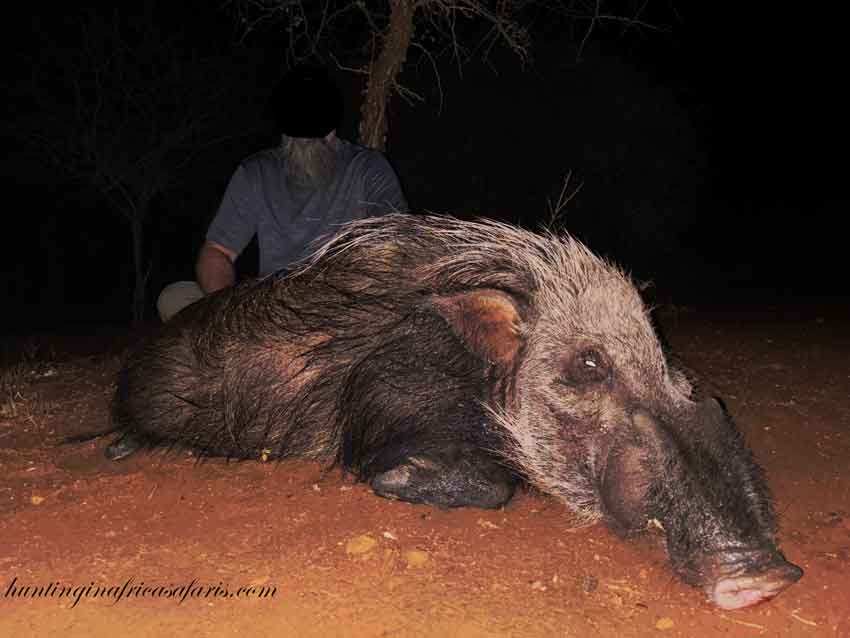
Securing a mature bushpig (Potamochoerus larvatus) is the ultimate testament to a hunter’s field patience and a professional hunter's technical preparation. This dedicated online archive showcases a premium selection of mature, heavy-shielded boars successfully taken under our senior staff’s guidance across our premier South African tracking concessions.
As you browse through these real client success stories, notice the prominent facial markings, coarse manes, and sharp, razor-like tusks that define a premier trophy "ghost of the darkness." Every image in our gallery represents a meticulous fair-chase tracking pursuit, often involving weeks of daily bait station management and hours of silent vigil inside our scent-controlled riverine thicket blinds.
5.1 Meticulous fair-chase baiting and trophy quality
These field photos serve as definitive visual proof of our specialized night hunting methods required to reliably anchor one of Africa’s most elusive wild hogs. By prioritizing low-light target identification and selective harvesting, we ensure that every sportsman visiting our concessions targets an aged, past-prime boar carrying the exceptional body weight and tusk configuration that looks spectacular on a showroom wall.


6. Bushpig hunting Frequently Asked Questions (FAQ's)
Do I need night vision to hunt Bushpig?
While not strictly required, 2027 thermal or night-vision optics are highly recommended for ethical shot placement in the total darkness of the riverine thickets.
What is the best time of year for Bushpig?
The dry winter months (June–August) are best, as natural food is scarce and the boars are more likely to visit baited stations consistently.
Are Bushpigs dangerous?
Yes. A wounded Bushpig is widely considered one of the most aggressive animals in Africa, often turning on the hunter or the hound pack with its razor-sharp tusks.
Services
Contact
hunt@huntinginafricasafaris.com
+27 82 824 7681
on Whatsapp and Telegram
Hours
Mondays from: 06:00 - 20:00 (6 am - 8 pm)
Tuesday - Saturday from: 06:00 - 20:00 (6 am - 8 pm)
Sunday: Closed unless we are hunting.