

1. Hunting ostrich in South Africa: The ultimate exotic plains game add-on
This guide stands as the definitive field resource for hunting ostrich in South Africa, focusing heavily on the technical ballistic precision, specialized field preparation, and ethical standards required to harvest the world's largest bird. The common ostrich (Struthio camelus), frequently referred to across the South African veld as the blue-neck or the big chicken, offers a unique safari challenge that relies entirely on long-range marksmanship and masterful walk-and-stalk woodcraft to defeat the bird’s phenomenal, highly sensitive 360-degree eyesight.
Because very few international sportsmen book a dedicated trip exclusively for this species, most look to include the bird into comprehensive plains game packages with ostrich inclusions. Reviewing the 2026 ostrich trophy fees as a plains game add-on is a vital part of early safari budgeting, allowing you to seamlessly integrate this fast-paced pursuit into your primary hunting itinerary alongside classic species like wildebeest or kudu.
1.1 More than just a trophy: Premium ostrich leather and sustainable resources
The southern blue-neck ostrich represents a flawless model for sustainable, resource-driven hunting within private South African conservancies. Beyond the striking aesthetic of a full-mount display or a traditional feather fan for the trophy room, this massive bird is world-renowned for three highly prized, commercially significant resources:
-
Exotic ostrich leather: The distinct, quill-patterned hide is exceptionally durable and stands as one of the most prestigious materials globally for crafting bespoke hunting boots, custom rifle cases, belts, and luxury briefcases.
-
Premium gourmet venison: Ostrich meat is a remarkably lean, high-protein red meat that possesses a flavor profile mirroring fine beef fillet, making it highly prized by health-conscious chefs and safari camps across South Africa.
-
The luxury plumes: The iconic, flowing black-and-white wing feathers have defined global luxury fashion and traditional European military regalia for centuries.
Whether your primary goal is having a custom handbag crafted from your own harvested leather or preserving a pair of heirloom-quality boots, the ostrich provides an unmatched three-in-one reward for the successful sportsman.
1.2 The technical challenge of the open plains speedster
Hunting the world's largest avian species is a formidable field undertaking that tests the patience of any tracking team. Standing up to 9 feet tall and capable of hitting sustained running speeds over 40 mph across open terrain, the ostrich utilizes its towering height as a constant defensive watchtower.
Because their massive, highly sensitive eyes can detect minor human movements from miles away, traditional stalks are routinely turned back, forcing hunters to take precise shots at extended ranges. This reality makes studying exact ostrich shot placement parameters and understanding the specific minimum caliber for ostrich hunting absolutely vital before chambering a round. It is a pure game of wits, camouflage, and high-end optics where a single misstep or a shifted wind will send this legendary African speedster vanishing over the horizon.
2. Ostrich trophy fees and hunting prices 2026
Financial transparency is the absolute foundation of a successful African safari. When sports hunters evaluate adding this unique species to their safari itinerary, they rely on highly specific digital search queries to calculate their final out-of-pocket expenses. The five most prominent terms utilized globally by international clients are: ostrich hunting price, ostrich hunting cost, ostrich trophy fee, how much does an ostrich hunt cost, and ostrich hunting packages.
To eliminate confusion and ensure a seamless budgeting process for our international clients, all government value-added tax parameters are already accounted for, meaning VAT is included in all prices listed below. We have maintained highly competitive rates for the current 2026 season to ensure this legendary open-plains speedster remains an accessible, premium, high-value addition to any plains game hunting portfolio.
| 2026 Ostrich hunting cost and package inclusions | |
|---|---|
| Ostrich trophy fee (2026) | $850 USD (Flat rate trophy fee with all applicable value-added taxes fully included) |
| Expert PH and field staff | Included in daily rate: Full services of a dedicated Professional Hunter, experienced trackers, and a specialized skinning team trained to preserve the delicate quill-patterned hide and leg leather. |
| Luxury safari accommodation | Included in daily rate: Premium thatch-and-stone lodge accommodation featuring full modern amenities, private en-suite facilities, and daily laundry services in the hunting area. |
| Catering and hospitality | Included in daily rate: All gourmet meals, daily track snacks, and full local beverage selection including premium South African estate wines. |
| Field trophy preparation | Included in daily rate: Meticulous field cape skinning, feather harvesting, salting, and secure transport delivery to our preferred local South African taxidermy studio or specialist leather tannery. |
| Ground logistics and transport | Included in daily rate: All regional ground transportation during the safari, 4x4 hunting vehicle logistics, and scheduled airport transfers. |
Safari planning note: This structured flat-rate fee ensures a turnkey outfitting experience with zero hidden administrative costs. By pairing your primary plains game pursuit with a selective ostrich harvest, you secure a highly diverse safari experience while yielding world-class exotic leather and premium camp venison under a singular, transparent pricing matrix.
3. Best caliber for ostrich hunting: Rifle selection and ballistics
The choice of firearm and bullet configuration for the common ostrich (Struthio camelus) presents a highly unique ballistic problem for the international sportsman. Unlike standard African plains game where you are hitting a solid, predictable hair-and-muscle silhouette, with this giant bird you are targeting a small vital vault hidden beneath a thick, loose layer of shock-absorbing feathers. Because their exceptional 360-degree eyesight routinely keeps tracking teams pinned down at extended distances of 200 to 300 yards, selecting the best rifle for ostrich hunting requires a flat-shooting setup capable of delivering absolute precision in the open veld.
When assessing the absolute minimum caliber for ostrich hunting, standard small-bore centerfires like the .243 Winchester are legally capable, but they leave very little margin for error at long ranges under windy bushveld conditions. Many international sportsmen prefer hunting ostrich with a .30-06 Springfield, .270 Winchester, or a modern flat-shooting magnum like the .7mm Rem Mag or .300 Win Mag. These mid-to-large-bore rifle setups provide the necessary bullet velocity and trajectory stability to punch clean straight-line paths through wind and feathers. By combining the best caliber for ostrich hunting with a detailed understanding of exact ostrich shot placement parameters, you ensure your bullet instantly disrupts the high-pressure vital zone without tearing or destroying the highly valuable, delicate body skin and leg leather prized for custom boot making.
3.1 Recommended calibers for hunting ostrich in South Africa
| Ostrich caliber recommendations and ballistic strategies | |
|---|---|
| .243 Winchester | The light-bore baseline: Represents the practical minimum setup. Because it lacks heavy mass, utilizing a premium controlled-expansion bullet is absolutely critical to punch through loose feathers and reach the vitals. |
| 6.5 x 55 Swedish | The traditional precision tool: A highly popular European medium-bore option celebrated globally for its exceptional inherent accuracy, high sectional density, and remarkably low shoulder recoil. |
| 6.5 PRC | The 2026 open-plains favorite: This specialized high-velocity cartridge delivers a significantly flatter trajectory and superior wind-bucking capability than the standard Creedmoor, making it ideal for pinpoint shots on distant birds. |
| .270 Winchester | The classic plains game versatile choice: An incredibly popular, fast-stepping medium-bore that delivers excellent flat-line velocity and highly reliable terminal shock at extended distances. |
| 7 x 57 Mauser | The soft-shooting heritage standard: A legendary bushveld classic that relies on moderate velocities and smooth recoil management to deliver highly effective, deep terminal performance. |
| 7 mm PRC | The modern precision powerhouse: Purpose-built to stabilize heavy, high-ballistic-coefficient projectiles. This cartridge cuts through crosswinds on open salt pans far more efficiently than the older 7mm Rem Mag. |
| 7 mm Remington Magnum | The proven long-range staple: An exceptional, highly versatile belted magnum option that provides increased effective range and decisive stopping power across open valley country. |
| .308 Winchester | The global reliability standard: Exceptionally consistent and universally available. This short-action cartridge serves as a highly dependable staple for the traveling international sportsman. |
| .30-06 Springfield | The gold standard of versatility: A flawless match for large avian species when deploying 150gr to 165gr premium bullet configurations, offering the perfect balance of trajectory and frontal energy. |
| .300 PRC | The heavy long-range king: Completely optimized for long, heavy, match-grade hunting projectiles. This modern setup eliminates the trajectory guesswork when crosswinds pick up and shots stretch past 300 yards. |
| .300 Winchester Magnum | The premium high-performance magnum: A globally recognized long-range favorite that provides the raw speed and flat trajectory needed for absolute confidence at extended distances. |
| 12 Gauge (Buckshot) | The close-range thicket exception: A highly specialized and practical close-quarters option reserved strictly for thick brush block encounters where rapid tracking situations occur under 40 yards. |
3.2 PH field note: Why the precision rifle cartridge excels on the blue-neck
In the open terrain of the Free State, Northern Cape, and North West provinces, wind management is the single greatest obstacle to a clean harvest. Because a mature blue-neck ostrich possesses a vital target area roughly the size of a dinner plate—and their 360-degree eyesight routinely prevents tracking teams from closing the distance under 200 yards—the 6.5 PRC and 7mm PRC have completely modernized the technical approach to ostrich hunting in South Africa.
The primary ballistic advantage of these modern precision rifle calibers lies in their modified chamber geometries and faster barrel twist rates, which are engineered specifically to stabilize long, heavy, high-ballistic-coefficient (high-BC) projectiles. Traditional cartridges often experience severe wind drift and rapid velocity decay when crosswinds pick up across wide-open salt pans. In contrast, the streamlined profile of a high-BC PRC bullet cuts through heavy wind gusts with minimal aerodynamic deflection, maintaining a remarkably flat trajectory and high remaining kinetic energy. When a big male bird stands broadside at 250 yards in an unshielded crosswind, utilizing a PRC cartridge eliminates the dangerous guesswork of holding off-target, allowing the hunter to hold dead-on and trust the rifle to place the bullet cleanly into the vitals.
4. Ostrich shot placement: The absolute anatomical guide
Achieving precise ostrich shot placement is frequently misunderstood by international sportsmen who are primarily accustomed to tracking four-legged African plains game. Because avian anatomy is structured around a centralized, high-vantage bone framework, the traditional heart-lung crease shot placed directly behind the front shoulder joint will completely miss the vitals. To secure a clean, ethical anchor, your point of aim must adjust to the bird's unique internal organ alignment.
4.1 The anchor shot at the base of the neck
For the vast majority of veteran Professional Hunters managing an active walk-and-stalk safari, targeting the lower neck junction is the preferred field choice.
-
The visual mark: Squeeze your crosshairs precisely onto the anatomical node where the long, featherless neck meets the dark, heavy feathering of the main body mass.
-
The terminal result: A high-velocity bullet impacting this specific intersection instantly disrupts the cervical spine, central nervous system, and primary carotid arteries. This produces an immediate drop-on-the-spot harvest. This particular strategy is exceptionally deadly when deploying flat-shooting precision cartridges like the
6.5 PRC,.270 Winchester, or.7mm Rem Mag.
1.2 The broadside vital vault presentation
If a hunter prefers a traditional body-mass shot over a skeletal spine shot, the aiming point must sit substantially higher up the rib skeleton than it would on an antelope ram.
-
The visual mark: Visually trace the massive upper thigh bone (often termed the drumstick) upward, and shift your reticle forward into the center of the dark body feathers, tracking approximately one-third of the total distance down from the top edge of the back line.
-
The terminal result: This precise entry vector drives the bullet straight through the protective wing rib layers to collapse the high lungs and upper heart chambers.
PH Field Warning: Never aim for the low center or rear belly section of the feather mass. An ostrich's lower abdominal cavity consists entirely of heavy, complicated digestive organs. A low-placed projectile will inevitably create a wounded bird that can still leverage its powerful leg structure to cover miles of thick bushveld territory at 40 mph, making tracking recoveries exceptionally difficult.
5. Male vs female ostrich: Advanced field identification
Accurately recognizing the visual differences between a male and female ostrich is the foundational first step of a successful walk-and-stalk safari. This distinct physical variance, scientifically classified as ostrich sexual dimorphism, is most immediately apparent in the coloration of their plumage. However, their physical behavior and reproductive roles across the veld are significantly more complex than standard folklore suggests.
5.1 Identifying male and female ostrich plumages
-
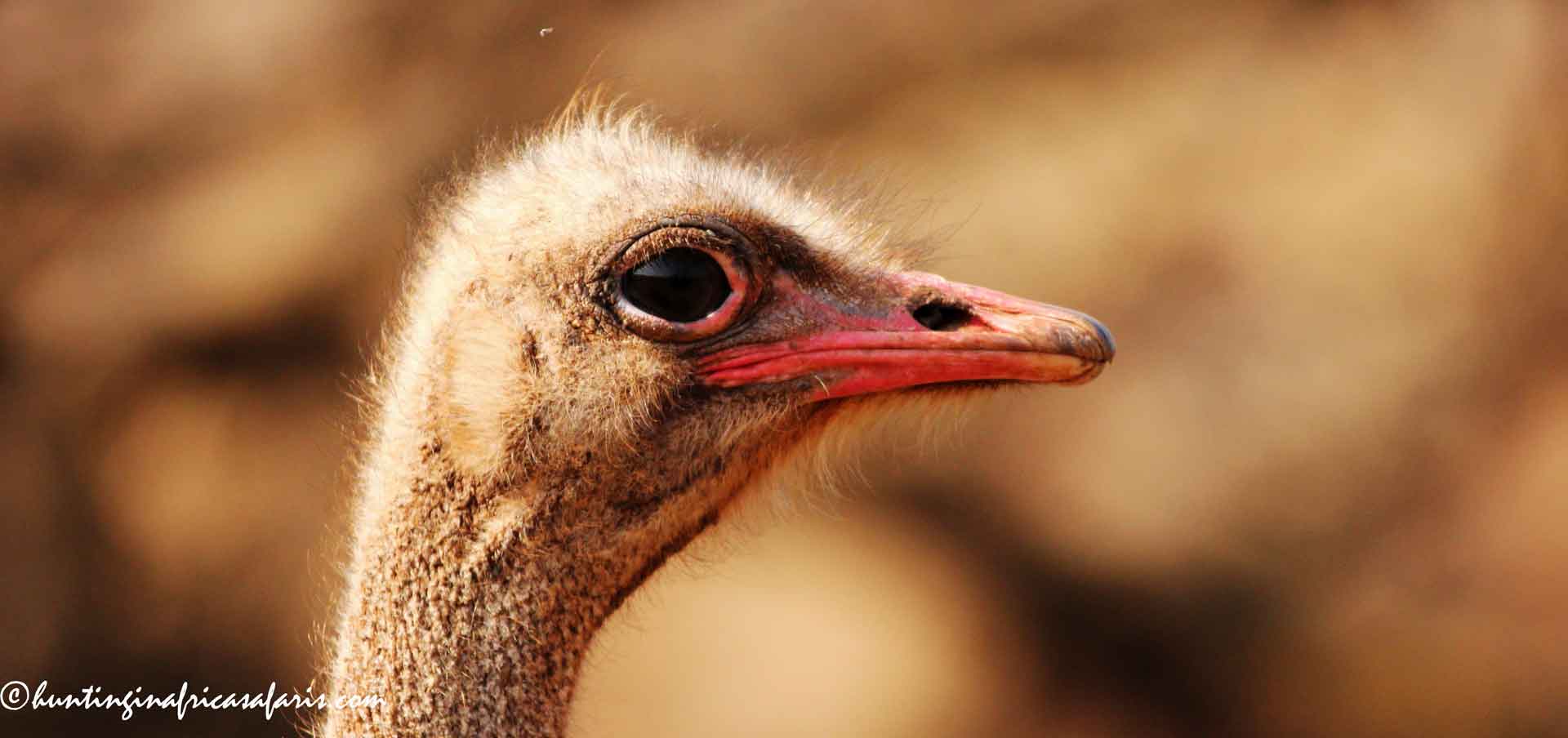
The mature male cock: The cock is completely unmistakable on the open plains, carrying a coat of stark, jet-black body feathers accented by brilliant white wing and tail plumes. When assessing a prime trophy male during the active breeding season, the bird will also display a vibrant, flush pink or deep red coloration along the shins of the legs and across the beak skin, serving as an excellent indicator of maturity.
-
The adult female hen: The hen sports a highly cryptic, dull gray-brown coat across her entire body frame. This specialized, earthy plumage is adapted entirely for survival and concealment, allowing her to instantly blend into the dry grass silhouettes of the Free State, North West, or Limpopo bushveld.
5.2 PH field note: Debunking the rigid nesting rotation myth
A widespread myth among traveling sports hunters is that the nesting pair follows a mathematically perfect, uninterrupted 12-hour incubation shift—where the cryptic gray hen sits exclusively by day and the jet-black cock sits exclusively by night to maintain perfect visual camouflage.
While that behavioral baseline is the evolutionary strategy, the brutal reality of the African bushveld routinely disrupts this rigid schedule. The intense caloric demands of managing their own basic survival—specifically severe midday heat, dehydration, and localized predator pressures—frequently force both birds to break their alignment.
In the field, it is incredibly common to spot a dominant black cock actively feeding out on the open plains during the blistering heat of the afternoon, or to find a gray hen cautiously moving through the brush lines under full starlight. When conducting a selective safari, never assume a bird's gender simply by the hour of the day; always trust your tracking team to carefully analyze the physical plumage markers and shin flushes before finalizing your setup.

Above: Male / Cock ostrich
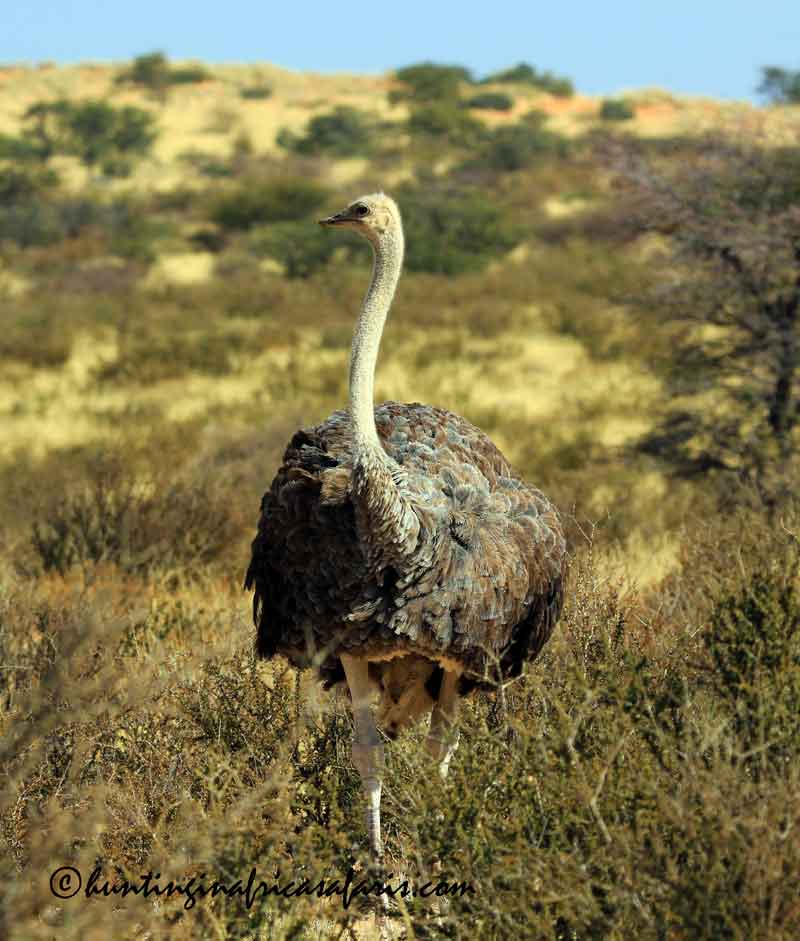
Above: Female / Hen ostrich
6. Species biology and conservation (Struthio camelus)
The common ostrich (Struthio camelus) is an absolute marvel of specialized African evolution. Ranking decisively as the world’s largest and heaviest living avian species, these giants occupy a highly distinct ecological niche across the arid grasslands of the North West, Limpopo, and Free State provinces. Gaining a deep understanding of their unique physical capabilities and structural makeup is the ultimate key to executing a successful walk-and-stalk safari approach.
6.1 Ostrich facts at a glance
| Biological field detail | Technical specification |
| Scientific name | Struthio camelus (Common Ostrich / Blue-neck) |
| Average height and weight | Standing up to 2.8 meters (9 ft) tall; weighing 90–150 kg (200–330 lbs). |
| Maximum ostrich speed | Capable of reaching sustained running speeds up to 70 km/h (43 mph). |
| Anatomical feature | The only living avian species possessing just two toes per foot for high-speed traction. |
| Primary natural habitat | Wide-open grasslands, sandy salt flats, and semi-arid thornveld savannas. |
6.2 Commercial value: The three-in-one sustainable trophy resource
While a mature common ostrich offers an incredibly striking, conversational full-mount addition to any custom trophy room, the vast majority of international sports hunters pursue this fast-plains giant for its multi-layered practical and commercial value. The harvest yields three separate, highly prestigious luxury resources:
-
Exotic ostrich leather: The distinctive quill-patterned body hide is prized globally for its remarkable tensile strength, suppleness, and long-term durability. It remains an elite staple material within high-end custom footwear boot making, bespoke gun cases, and luxury automotive upholstery.
-
Gourmet lean venison: Ostrich meat represents an incredibly high-protein, exceptionally low-cholesterol red meat. It possesses a rich texture and fine grain that tastes remarkably like premium beef fillet, making it a favorite culinary delicacy for health-conscious sports hunters and safari camps alike.
-
Luxury avian plumes: The classic, pure black-and-white wing feathers are harvested with intense care, remaining a highly sought-after, premium component within the international fashion houses, costuming industries, and high-end interior decor sectors.
6. Species biology and conservation (Struthio camelus)
The common ostrich (Struthio camelus) is an absolute marvel of specialized African evolution. Ranking decisively as the world’s largest and heaviest living avian species, these giants occupy a highly distinct ecological niche across the arid grasslands of the North West, Limpopo, and Free State provinces. Gaining a deep understanding of their unique physical capabilities and structural makeup is the ultimate key to executing a successful walk-and-stalk safari approach.
6.1 Ostrich facts at a glance
| Biological field detail | Technical specification |
| Scientific name | Struthio camelus (Common Ostrich / Blue-neck) |
| Average height and weight | Standing up to 2.8 meters (9 ft) tall; weighing 90–150 kg (200–330 lbs). |
| Maximum ostrich speed | Capable of reaching sustained running speeds up to 70 km/h (43 mph). |
| Anatomical feature | The only living avian species possessing just two toes per foot for high-speed traction. |
| Primary natural habitat | Wide-open grasslands, sandy salt flats, and semi-arid thornveld savannas. |
6.2 Commercial value: The three-in-one sustainable trophy resource
While a mature common ostrich offers an incredibly striking, conversational full-mount addition to any custom trophy room, the vast majority of international sports hunters pursue this fast-plains giant for its multi-layered practical and commercial value. The harvest yields three separate, highly prestigious luxury resources:
-
Exotic ostrich leather: The distinctive quill-patterned body hide is prized globally for its remarkable tensile strength, suppleness, and long-term durability. It remains an elite staple material within high-end custom footwear boot making, bespoke gun cases, and luxury automotive upholstery.
-
Gourmet lean venison: Ostrich meat represents an incredibly high-protein, exceptionally low-cholesterol red meat. It possesses a rich texture and fine grain that tastes remarkably like premium beef fillet, making it a favorite culinary delicacy for health-conscious sports hunters and safari camps alike.
-
Luxury avian plumes: The classic, pure black-and-white wing feathers are harvested with intense care, remaining a highly sought-after, premium component within the international fashion houses, costuming industries, and high-end interior decor sectors.


8. Ostrich hunting: Frequently Asked Questions
1. What is the best shot placement for an Ostrich?
Unlike an antelope, the Ostrich’s vitals are positioned high and forward in the body cavity. The most effective "anchor" shot is at the base of the neck where it joins the body. For a broadside shot, aiming for the high-center of the "drumstick" area (the lungs) is recommended. Avoid aiming too low, as the bird's lower body consists mostly of digestive organs and thick muscle.
2. Can I use my 6.5 Creedmoor or 6.5 PRC for Ostrich?
Absolutely. In 2026, the 6.5 PRC and 6.5 Creedmoor have become favorite choices for the "Blue-neck." Because Ostrich hunting often requires precision at 200+ yards, these high-BC cartridges provide the flat trajectory and wind-bucking capability needed to hit the relatively small vital zone of a bird.
3. How do I get my Ostrich leather and boots made?
This is one of the biggest draws of the hunt. After your successful safari, our specialized skinning team prepares the hide for the tannery. We can facilitate the delivery of your skins to renowned South African exotic leather specialists. From there, you can have custom boots, belts, or handbags crafted and shipped directly to your home.
4. Is there a 15% VAT saving on Ostrich trophies?
Yes. Under South African law, 15% VAT is not payable on trophy fees for animals that are exported. Since the Ostrich is a commercially significant species, this tax benefit applies to the $850 trophy fee, provided the skin, feathers, or mount are sent to your home country. If you have the leather tanned and made into boots in South Africa the VAT becomes appliccable.
5. Why is the Ostrich called the "Blue-neck"?
This refers to the Southern Ostrich (Struthio camelus australis). While the body is black, the neck and legs have a distinct blue-gray hue. During the breeding season, the shins and beak of the cock will "flush" a bright pink or red—this is a primary indicator for your PH that the bird is a mature, dominant male.
6. Are Ostrich dangerous to hunt?
While they are birds, they are formidable. An Ostrich can kick with immense power, and their inner toe is equipped with a 4-inch nail that can be lethal. However, with the 360-degree eyesight of a "Blue-neck," the real danger is usually just the bird spotting you at 500 yards and disappearing before you can get a shot off!

Services
Contact
hunt@huntinginafricasafaris.com
+27 82 824 7681
on Whatsapp and Telegram
Hours
Mondays from: 06:00 - 20:00 (6 am - 8 pm)
Tuesday - Saturday from: 06:00 - 20:00 (6 am - 8 pm)
Sunday: Closed unless we are hunting.