
Nile crocodile hunting South Africa: 2026 Prices & Technical Guide
Hunting the formidable Nile Crocodile (Crocodylus niloticus) in South Africa is widely regarded as the ultimate test of a marksman’s nerves and stealth. Known as a living fossil, this apex predator possesses an unmatched ability to perceive the slightest movement or sound, effortlessly slipping back into the water at the first sign of danger. At African Bushbuck Adventures, we specialize in the technical patience required to secure a massive trophy bull, often matching wits with reptiles that have survived for nearly a century.
Whether you are targeting a massive 12-foot flatdog on a riverbank or planning a dedicated Crocodile hunting safari, this comprehensive guide covers every technical detail. From the precision required for the one-inch brain shot to the latest 2026 Crocodile trophy fees and caliber recommendations, we provide the expert insights gained from nearly three decades of professional hunting. Prepare yourself for an exhilarating challenge as you pursue one of Africa’s most wily and dangerous reptiles in the heart of the South African wilderness.
Once you have selected your rifle and load, view our Dangerous Game Safari Packages to start planning your pursuit.
1. Nile Crocodile Trophy Fees 2026
At African Bushbuck Adventures, we provide full price transparency for your 2026 safari planning. Unlike plains game, Nile Crocodile (Crocodylus niloticus) trophy fees in South Africa are calculated on a progressive scale based entirely on the total length of the animal, measured in a straight line from the tip of the snout to the end of the tail.
Because securing a mature bull is a significant investment and requires specialized conservation oversight, we ensure our clients understand this cost-to-length ratio before the safari begins. The tiered pricing reflects the decades required for a wild crocodile to reach dominant lengths, making the animal's physical size the definitive factor in its conservation value.
1.1 How the costs are calculated
Our pricing framework maintains strict boundaries to give international sportsmen absolute financial clarity before arriving in camp:
-
Length-based asset structure: The baseline flat fee is determined by the physical bracket your trophy falls into upon field measurement.
-
Permit integration: Due to the strict legal framework surrounding dangerous game, all necessary CITES allocations and provincial P3 Exemption permit processing fees are already built directly into the tracking itinerary.
-
Tax exemption on trophies: Value added tax (VAT) is already fully factored into your primary safari's daily rates. For the trophy fee itself, all animals harvested by international clients for export are legally VAT exempt, meaning the prices listed below are the exact amounts you pay.
| 2026 Nile Crocodile Pricing Structure | |
|---|---|
| Length (Nile Crocodile Fee) | Fee in US $ |
| Under 10 ft (3.0 m) | $5,500 |
| 10 ft – 12 ft (3.0 m – 3.7 m) | $7,500 |
| 12 ft – 13 ft (3.7 m – 4.0 m) | $9,500 |
| CITES & P3 Permit Processing | Included in Safari Package |
2. Recommended Nile crocodile hunting calibers
A successful and ethical Nile Crocodile (Crocodylus niloticus) hunt relies entirely on precise shot placement to the brain. Because a crocodile can slide back into the water and be lost forever in a matter of seconds, energy transfer is secondary to pinpoint accuracy. My 29 years of experience have proven that the best caliber is the one you can shoot most accurately under the intense pressure of a stalking scenario.
2.1 Shot placement dynamics
When hunting these prehistoric predators on a riverbank, sandbar or a lake, the target area is exceptionally small—typically a one-inch space on the cranial platform. A bullet that misses the brain by even a fraction of an inch will fail to anchor the animal instantly, allowing its nervous system response to slide it deep into the water where recovery becomes almost impossible.
For this reason, rifle familiarity, a crisp trigger break, and solid field rests are far more critical than raw muzzle energy.
| Technical Nile Crocodile Caliber Guide | |
|---|---|
| Caliber Selection | Professional Recommendation and Performance |
| .30-06 Springfield | The Gold Standard: This is the ultimate choice for crocodile. It offers the perfect balance of bullet weight and inherent accuracy for the brain shot. |
| .308 Winchester | Excellent Balance: A magnificent all-around caliber. The manageable recoil allows for the extreme precision required to hit a one-inch target. |
| .375 H&H Magnum | Heavy Game Choice: The ideal "peace of mind" caliber. It provides massive knockdown power while remaining exceptionally accurate at riverbank distances. |
| .300 Win Mag / WSM | High Velocity Option: Perfect if this is your primary plains game rifle. The flatter trajectory is effective, provided you use a controlled-expansion bullet. |
| .416 Rigby / .458 Lott | The "Brute" Choice: Recommended for hunters pursuing heavy, old bulls over 13 feet. These calibers offer maximum energy for thick cranial bone. |
| .270 Winchester | Minimum Recommendation: A capable choice for skilled marksmen. Precision and a deep understanding of crocodile anatomy are mandatory. |
Ballistics note for trophy preservation
When hunting Crocodylus niloticus, I recommend using a high-quality heavy-for-caliber soft point or a monolithic solid. The goal is to penetrate the thick, bony skull and reach the brain instantly. A bullet that "splashes" or breaks up on the surface can result in a lost trophy.
Ready to discuss your dangerous game safari?
Inquire about availability4. Nile crocodile trophy Gallery and success stories
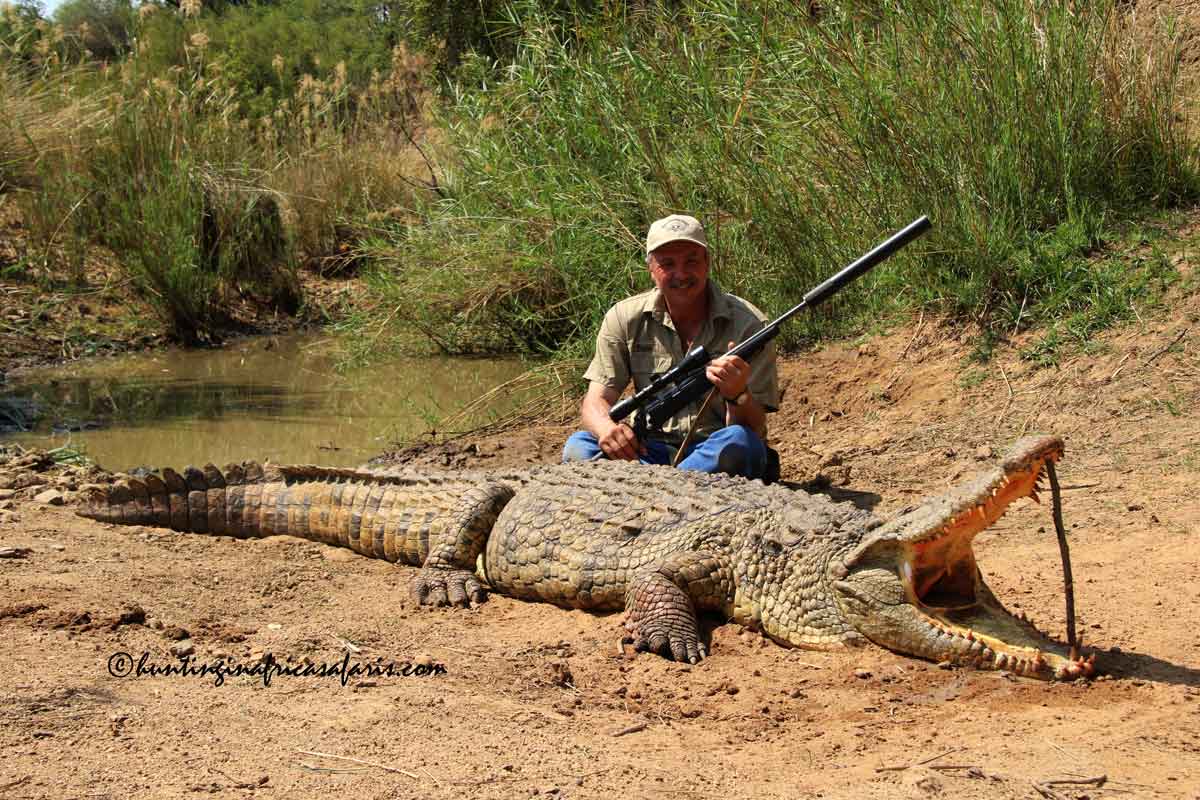
Our Nile Crocodile gallery features a curated selection of successful safaris from South Africa’s most productive river systems and dams. These images showcase the prehistoric scale and impressive trophy quality of Crocodylus niloticus when pursued through ethical, fair-chase methods. From 10-foot management crocs to massive, 14-foot+ trophy bulls, each photo represents a technical triumph of patience and pinpoint accuracy.
As you browse these success stories, notice the incredible detail of the armored scutes and the sheer mass of these ancient reptiles. We take immense pride in our high recovery rates, ensuring that every well-placed shot results in a world-class trophy for your collection. Explore the results of our specialized South African crocodile hunts and see why we are a preferred outfitter for international sportsmen seeking a living fossil.
4.1 Nile crocodile success stories
| Trophy Length & Location | Safari Highlights & Professional Notes |
| 13.5-Foot Trophy Bull | Method: Blind hunting over bait. A massive, heavy-set bull harvested with a single brain shot from a .375 H&H at 60 yards. |
| The "River Monster" (14ft+) | Method: Spot and stalk. A true prehistoric brute taken on the banks of the Limpopo. An exceptional example of a gold-medal class Nile Crocodile. |
| Limpopo River Success | Method: Early morning basking intercept. This old bull featured incredible girth and deep, well-defined armored scutes. |
| Technical 12-Foot Harvest | Method: Precision calling session. A perfect demonstration of the one-inch rule, anchoring the croc instantly on a steep riverbank. |


Nile crocodile hunting: Frequently Asked Questions
Do I need a special permit for Crocodile?
Yes. As a CITES Appendix II species, a CITES Export Permit and a South African TOPS (Threatened or Protected Species) permit are mandatory. We handle all local permit applications for you.
Can I import my Crocodile trophy to the USA?
Absolutely. Nile Crocodiles from South Africa are legal for US import. You will need a US Fish & Wildlife Form 3-177 and the original CITES document. Our taxidermy partners specialize in this paperwork.
What is a P3 Exemption permit?
This is a provincial permit (often in the North West) that allows for more flexible hunting hours or methods on registered properties. We manage these exemptions to maximize your success.
How long does it take to get my trophy home?
CITES processing and tanning for crocodile hides typically take 6 to 12 months. We recommend using a South African taxidermist to ensure the hide is "salted" and "tagged" correctly for export.
When is the best time to hunt Crocodile?
While they can be hunted year-round, the dry winter months (May to September) are best. Crocodiles bask longer in the sun during the day to regulate their temperature, making them easier to spot.
Is it possible to bow hunt a Crocodile?
In South Africa, bow hunting for Nile Crocodile is strictly prohibited. By law, a rifle of sufficient caliber must be used to ensure an instant, ethical harvest.
Can I hunt Crocodile at night?
In South Africa, a "wounded and lost" animal is considered a harvested animal. We prioritize precision shots to avoid this, as a crocodile that reaches the water is almost impossible to recover.
Services
Contact
hunt@huntinginafricasafaris.com
+27 82 824 7681
on Whatsapp and Telegram
Hours
Mondays from: 06:00 - 20:00 (6 am - 8 pm)
Tuesday - Saturday from: 06:00 - 20:00 (6 am - 8 pm)
Sunday: Closed unless we are hunting.