
Baboon hunting South Africa: Prices 2026, Calibers & trophy fees
1. The ultimate African sentinel trophy
While often referred to simply as a baboon, we specify the Chacma baboon (Papio ursinus) to distinguish this larger, darker, and more formidable southern African species from its smaller Yellow- and Olive cousins found further North on the African continent. The Chacma baboon is one of the most intelligent and challenging trophies to hunt in Southern Africa. Known for their incredible eyesight and wary nature, outsmarting a troop’s alpha male is a true test of a hunter’s patience and stalking ability. Often called the "sentinel of the bush," their loud, barking alarm calls are a constant reminder of their vigilance.
A large, mature "dog" baboon, with its formidable canines and weathered features, is a unique and conversation-starting addition to any collection, representing a successful hunt against one of Africa’s most sharp-witted primates.
2. The trophy and the magnetism of outsmarting the sentinel
| Feature | Detail and significance |
| Trophy class | Mature dog baboon. Focus is on large body size and the length of the canine teeth. |
| The allure | A highly opportunistic hunt that requires extreme stealth. They are notorious for spotting movement from miles away. |
| The hunt | Often hunted while glassing for other species or via a dedicated blind. They are extremely tough and wary. |
| Rarity | Common across Southern Africa, but a truly large, record-class male is a prize of opportunity and skill. |
3. Trophy fees: baboon hunting prices 2026
When planning an international safari, understanding the pricing structure for a Chacma baboon requires distinguishing between an opportunistic field harvest and a focused pursuit. For many collectors, the opportunity to take a large male arises naturally while pursuing other species, whereas others require a specialized itinerary tailored to the complex scouting and habitat requirements of these highly intelligent primates.
To provide complete financial transparency for your safari planning, our pricing is divided into two distinct options: an incidental add-on fee or a dedicated, multi-day primate safari.
3.1 How the costs are calculated
Our 2026 fee structure is designed with clear operational boundaries to ensure there are no unexpected adjustments at the conclusion of your safari:
-
Incidental add-on vs. dedicated safari: If a mature baboon is harvested opportunistically as an add-on during an active plains game or dangerous game safari, only the flat trophy fee applies with zero additional daily rates. For clients seeking a dedicated baboon hunting safari, a focused multi-day itinerary can be arranged at our standard daily rates.
-
Tax regulations on export trophies: Value added tax (VAT) is fully included within our listed standalone daily rates. However, for the trophy fee itself, all harvested animals destined for international export are legally VAT exempt and carry no added tax burdens.
-
Trophy fee application: The fixed trophy fee applies strictly to a mature male baboon successfully harvested or wounded in the field under fair-chase conditions.
| Chacma Baboon Trophy Fee & Safari Rates | |
|---|---|
| Trophy & Service Specification | 2026 Hunting Rate (USD) |
| Chacma baboon | $300 (Flat Trophy Fee) |
| Incidental safari add-on | $0 Additional Daily Rates |
| Dedicated daily rate (1x1) | $425 per day (VAT Included) |
| Non-hunting observer rate | $200 per day (VAT Included) |
4. Baboon hunting caliber selection and hunting tactics
The pursuit of a trophy Chacma baboon is a highly specialized endeavor that demands surgical accuracy, often under challenging field conditions. Unlike traditional bushveld hunting, these incredibly sharp-sighted primates are typically encountered at extended ranges across deep valleys, open plains, or perched high up onto rocky krantzes. Because a mature troop leader is light-bodied yet remarkably tough and tenacious, selecting a rifle combination built for high velocity and flat trajectories is essential to prevent a wounded animal from escaping into inaccessible terrain.
While heavy dangerous game calibers are completely unnecessary here, light to medium centerfire rifles are the absolute standard. The ideal setup involves small, fast calibers that allow for precise shot placement over long distances, ensuring bullet expansion occurs instantly upon impact. Choosing the correct rifle and bullet configuration ensures you can confidently anchor this highly intelligent and watchful trophy cleanly at any distance.
| Recommended Baboon Calibers & Applications | |
|---|---|
| Caliber | Recommendation and application |
| .22 Hornet & .222 Rem | High velocity, short to mid-range. Very effective for their intended purpose with minimal recoil, allowing for precise shot placement. |
| .22-250 Remington | The long-range specialist. Ideal for reaching out across open ground, though best utilized on windless days due to the high-velocity, lighter projectile. |
| .223 Remington | Versatile and reliable. A highly effective caliber when using premium soft-point ammunition; it handles wind slightly better for those longer shots. |
| .243 Winchester | The "king" of small calibers. Highly recommended for its versatility. It is the superior choice for long shots where moderate wind is a factor. |
| Professional hunter’s note | Accuracy is everything. While these calibers are smaller than those used for plains game, the baboon's intelligence means you often only get one long-range opportunity. |
Caliber considerations for baboon hunting
Our caliber advice is forged from 29 years of professional hunting experience. These recommendations have been field-tested under diverse African conditions to ensure an ethical and successful harvest. To supplement this practical expertise, our guidelines are aligned with authoritative ballistics standards, including John Taylor’s African Rifles & Cartridges and the specialized data found in Ammo & Ballistics.
When selecting your rifle, prioritize bullet expansion and optical clarity over raw power. A heavier rifle may assist in steadying long-range shots, but the ability to deliver a rapid-expanding soft-point accurately is the ultimate factor in anchoring a wary Chacma male or female.
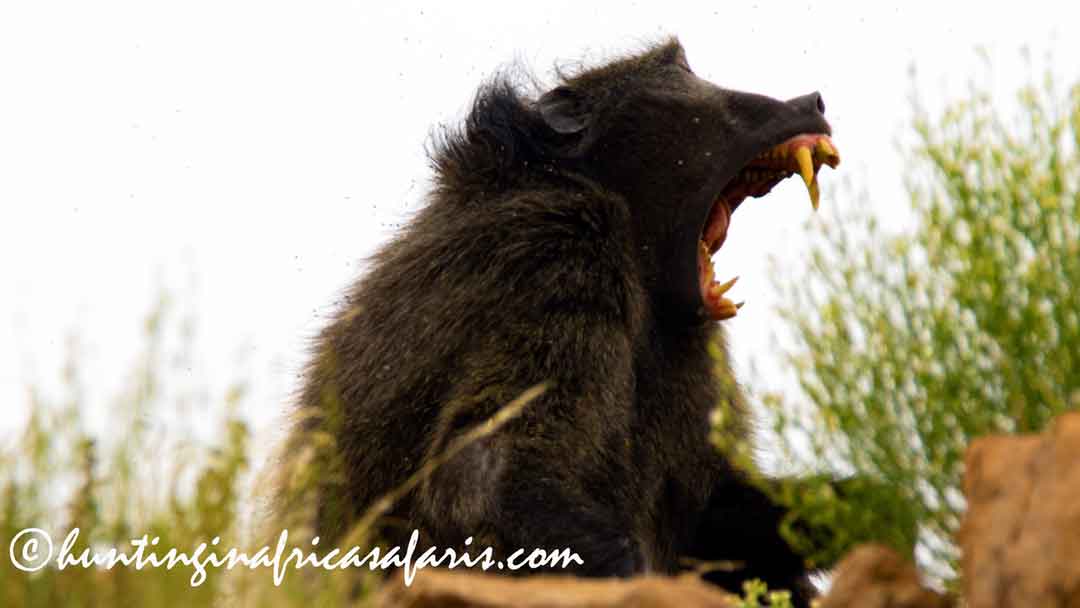
6. The baboon trophy gallery: a testament to field craft
This gallery showcases successful hunts of the Chacma Baboon (Papio ursinus), often regarded as one of Africa's most challenging and intelligent trophies. Each image represents a successful conclusion to a hunt that demanded extreme patience, stealth, and long-range precision.
View the variety of mature males taken and appreciate the effort required to outwit this highly vigilant primate. The weathered features and formidable canines shown here are markers of old, solitary "dogs" that have been successfully harvested through superior field craft.


7. Species biology and conservation (Papio ursinus)
Providing detailed, accurate biological data is highly valued by search engines and provides the technical context necessary for the discerning hunter to appreciate the Chacma Baboon as a high-value trophy.
| Category | Detail and significance |
| Scientific name | Papio ursinus |
| Taxonomy | Order: Primates; Family: Cercopithecidae; Genus: Papio. |
| Size and weight | Significant sexual dimorphism. Shoulder height: 50–80 cm. Males are substantially larger, weighing 30–45 kg, while females average 15–20 kg. |
| Longevity | Up to 45 years. In the wild, their lifespan is a testament to their intelligence and survival instincts. |
| Habitat | Southern Africa. They thrive across savannas, grasslands, and high-altitude rocky cliffs (krantzes). |
| Social structure | Hierarchical troops. They live in complex social groups of up to 150 members, led by dominant alpha males. |
| Behavior note | Aggressive defenders. Dominant males rule with severe discipline and are known to aggressively fight off predators, including leopards. |
8. Shot placement: The broadside challenge
Baboon hunting shot placement is the married partner to high-velocity ammunition. Because they are soft-skinned and small-framed, premium bonded ammunition is not a requirement; however, pin-point accuracy is paramount to ensure an immediate anchor.
| Target area | Placement detail and rationale |
| Broadside aim | The high-shoulder shot. Aim for the center of the shoulder blades or the high chest. Because they are "tenacious of life," a high-shoulder hit often anchors them instantly. |
| Seated/Upright | The center of the "V". If the baboon is sitting upright, aim for the center of the chest where the collarbones meet. This ensures a direct hit to the heart/lung vitals. |
| The "Anchor" rule | Stop the retreat. A wounded baboon will instinctively flee into the most inaccessible rock faces (krantzes). Precise placement is the only way to avoid a grueling recovery in vertical terrain. |

Services
Contact
hunt@huntinginafricasafaris.com
+27 82 824 7681
on Whatsapp and Telegram
Hours
Mondays from: 06:00 - 20:00 (6 am - 8 pm)
Tuesday - Saturday from: 06:00 - 20:00 (6 am - 8 pm)
Sunday: Closed unless we are hunting.