
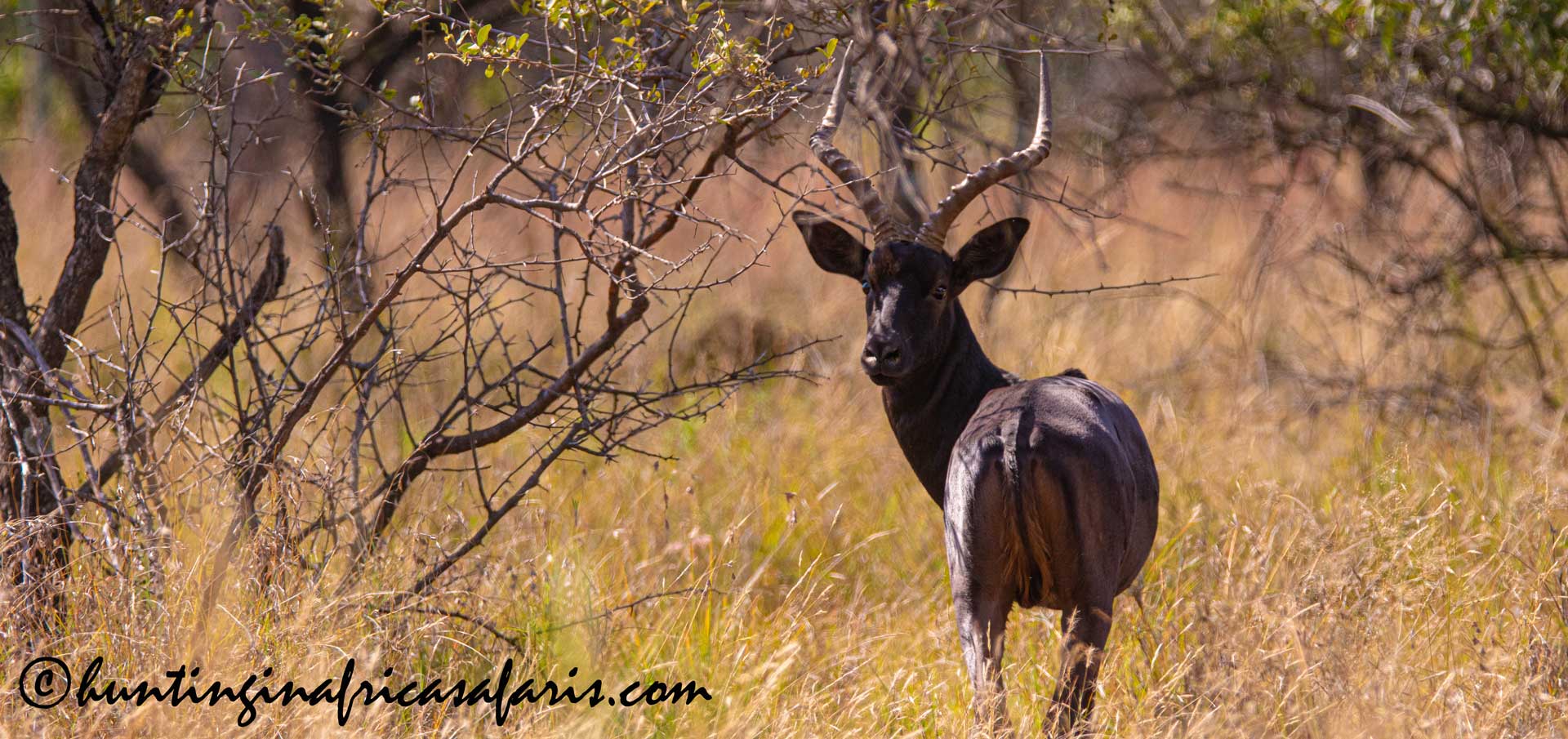
Black impala hunting South Africa: Prices, calibers, and info
Tracking the melanistic variant of the bushveld
The black impala (Aepyceros melampus) stands as a striking, highly coveted example of natural genetic diversity within the African plains game species. Once a rare anomaly encountered only by chance, expert wildlife management and sustainable breeding initiatives have allowed us to offer these exceptional, dark-phased trophies to discerning international collectors.
Hunting black impala presents a unique tactical challenge in the field. Unlike common plains game, their deep, melanistic coats offer a stark, highly visible contrast against the golden winter grass and red sands of the savanna dunes. Despite this visibility, they remain every bit as flighty, alert, and intensely sharp-senses as their common counterparts, demanding absolute silence and flawless wind management during the stalk. Our professional hunting approach focuses entirely on tracking these alert rams through low-pressure concessions, ensuring an authentic fair-chase experience that honors the animal.
Custom itineraries and color mutations
Rather than offering rigid, mass-market hunting packages, we prefer to engineer a bespoke safari around your specific trophy aspirations. If your primary objective is to complete a prestigious, multi-species impala slam hunting package—incorporating common, black, saddleback, or white-flanked rams on a single safari—we advise coordinating directly with the safari director to discuss a tailored 2026 itinerary.
This photographic record represents an elite opportunity and meticulous field preparation on our concessions. This successful safari stands as a testament to the patient persistence required when pursuing this high-value, melanistic color variant. To prevent unsustainable hunting pressure and protect our exceptionally high trophy standards, our team only allocates a strictly limited number of black impala safaris each season.
Inquire about a custom impala slam
Our premium, limited-quota allocations are structured individually based on current availability and trophy maturity. To review the precise baseline investment required for this color mutation, please view our detailed financial table regarding the
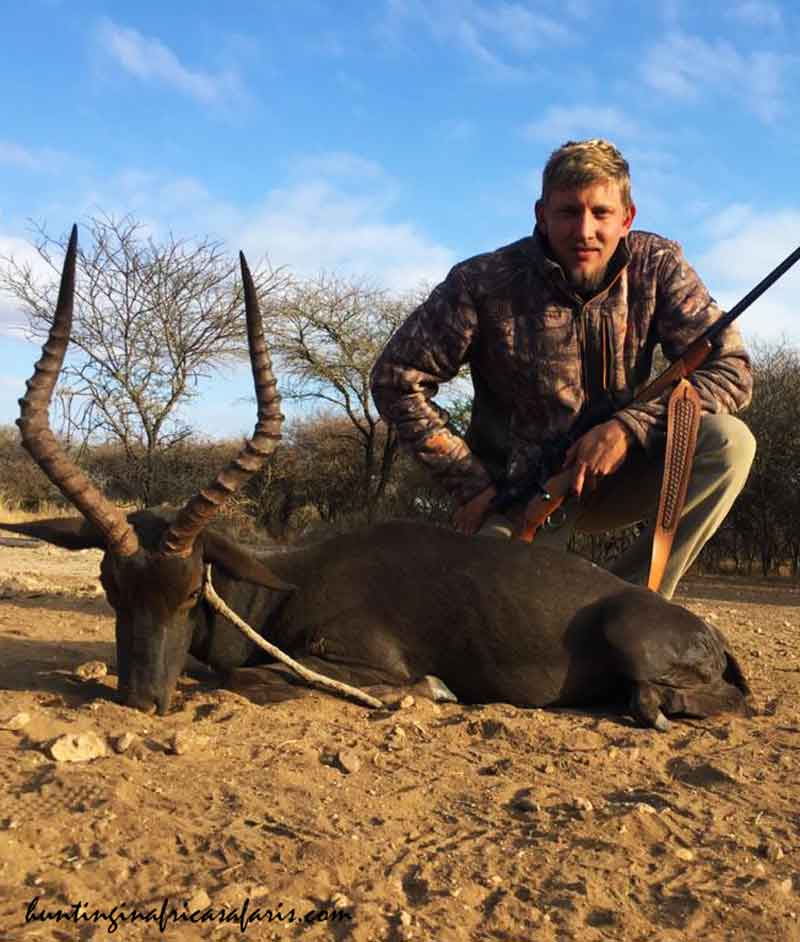
This photo represents a rare opportunity and meticulous field preparation. This successful safari is a testament to the patient persistence required when pursuing this high-value, melanistic color variant. We only offer a select number of black impala safaris each season to ensure unsustainable hunting is avoided and we maintain our exceptionally high trophy standard.
Black impala trophy fees and hunting prices 2026
Transparent asset valuation for elite collectors
Providing accurate and completely transparent pricing structures remains a core cornerstone of our professional outfitting service. The specific financial allocation detailed below is structured for the addition of a world-class, mature black impala ram to an existing custom safari itinerary.
What is the trophy fee for a black impala in South Africa?
For the current safari season, the standalone investment allocation for a mature black impala ram is set at $2,500 USD. This specialized color mutation fee operates as an add-on price to your currently secured plains game schedule. For international sportspeople wishing to coordinate a dedicated black impala safari, or a multi-species impala slam, please utilize the direct communication portals in the introduction above to secure a bespoke, all-inclusive quotation tailored to your exact trophy requirements.
Black impala hunting prices South Africa 2026
| 2026 Impala Trophy Investment Rates | |
|---|---|
| Black impala trophy fee |
2026 Rate: $2,500 USD Policy: Limited annual quota allocation; payable only upon successful harvest or confirmed field wounding. |
| Common impala trophy fee |
2026 Rate: $550 USD Policy: Standard baseline package add-on for mixed bag portfolios. |
| Safari accommodation | Includes fully integrated stays at luxury, Department of Economic Development, Environment, Conservation and Tourism (DEDECT) approved hunting lodges. |
PH Field Note on Concession Lodging: While our chosen wilderness accommodations are strictly maintained to a premium professional standard, specific lodge aesthetics and micro-facilities vary naturally by province and individual concession area. Rest assured, every base camp provides elite comfort, authentic South African cuisine, and full laundry service to complement your high-end safari experience.
Caliber considerations for black impala hunting
Balancing terminal ballistics with premium cape preservation
Choosing the best caliber for black impala hunting requires a calculated balance between immediate terminal performance and meticulous cape preservation. Because a pristine melanistic hide is of paramount value to an international collector, minimizing entry and exit damage is a critical consideration. While Aepyceros melampus is structurally classified as a medium-sized antelope, its hyper-alert sensory status and the incredibly varied terrain of our South African concessions—stretching from the thick bushveld of Limpopo to the wide, open plains of the Free State—demand a highly versatile ballistic approach.
What is the best caliber for black impala hunting?
The classic .30-06 Springfield remains the absolute gold standard for all-around African plains game hunting. However, any flat-shooting cartridge ranging from the nimble .243 Winchester up to the heavy-hitting .300 Winchester Magnum is thoroughly effective on a mature ram, provided the setup is paired with premium, controlled-expansion bullet construction and precise shot placement.
Recommended calibers for black impala
| Cartridge Selection & Field Notes | |
|---|---|
| .243 Winchester |
Classification: Absolute baseline minimum. Field Note: Demands highly disciplined shot placement. Best utilized in open terrain with 100-grain premium expanding projectiles. |
| .270 Winchester |
Classification: Exceptionally versatile choice. Field Note: Delivers excellent velocity and flat trajectories across open plains. We strongly suggest loading 140-grain premium bonded structural bullets. |
| .308 Winchester |
Classification: Trusted bushveld standard. Field Note: High knockdown efficiency in dense cover. Proven to be highly effective when paired with a 150-grain Nosler Partition or similar bonded core bullets. |
| .30-06 Springfield |
Classification: Best all-round caliber. Field Note: The most reliable, forgiving choice for this antelope's physical build. Ideal when utilizing 150-grain or heavier premium bonded soft-points. |
Critical ballistic factors for dark mutations
-
Shot placement: Regardless of your choice in bore diameter, accurate placement within the primary vital cluster remains paramount. A well-placed shot from a smaller, light-recoiling rifle will always out-perform a poor, pulled shot from a heavy magnum.
-
Bullet construction: Always load high-quality, controlled-expansion projectiles. Black impala are incredibly hardy, and a tough, bonded bullet ensures a rapid, ethical harvest while preserving the rare, dark cape from excessive exit wounding.
-
Recoil management: We strictly advise visiting hunters to use the specific caliber they are most comfortable operating. High personal confidence in your rifle setup consistently translates to precise field accuracy when resting on the shooting sticks.
-
Concession rules: Be aware that certain South African provinces or individual private concessions enforce specific legislative minimum caliber restrictions for pursuing plains game species.
PH Pro Tip on Color Slam Uniformity: If you are booking a dedicated color slam or collecting multiple antelope variants on a single safari itinerary, choose a versatile, mid-range caliber like the .30-06 Springfield. Settling on one reliable all-rounder allows you to transition seamlessly from a black impala ram to a common or saddleback variant without switching platforms or altering your mastered muscle memory.
To explore our extensive, technical breakdown of firearm selection, bullet weights, and export regulations across Southern Africa, view our
Shot placement for black impala
Applying surgical precision to rare color mutations
Absolute precision on the shooting sticks is the defining hallmark of a professional hunter. While your target is a rare and highly prized color variant, the internal biological anatomy of the black impala (Aepyceros melampus) is completely identical to that of the common impala. However, given the immense collection value of this specific trophy, extreme field caution and surgical accuracy are required before expanding your trigger sear.
Where do you aim on a black impala?
The ideal aiming point is the high heart and lung area. On a broadside presentation, visualize a clean vertical line running straight up the back edge of the front leg structure. Position your crosshairs exactly one-third of the way up the body line from the brisket, placing the bullet directly on or slightly behind the front shoulder.
Black impala shot placement guide
| Anatomical Targeting Specifications | |
|---|---|
| Broadside shot alignment |
Primary Target: The high heart and lung cavity. Execution: Squeeze the trigger at a point exactly one-third up from the belly line, vertically tracking the rear silhouette of the front leg. |
| Vital organ zones |
Heart Area (Red Matrix): Positioned low and forward in the chest. Lung Area (Blue Matrix): Sitting directly above and behind the heart. Refer to our graphic diagram for exact skeletal orientation. |
| The anchoring shot |
Alternative Placement: High shoulder alignment. Execution: A premium monolithic projectile placed slightly higher up the shoulder blade breaks down heavy bone structure and disrupts the central nervous system. |
Expert field notes for tracking melanistic game
-
Melanistic contrast challenges: Because of the dense, uniform black coat texture, identifying the exact shadows of the vital triangle can be significantly more difficult during low-light tracking conditions at dawn or dusk. Ensure you have adjusted your optics to maximum clarity and possess a high-contrast view before squeezing the trigger.
-
The field follow-up: As with the common variety, Aepyceros melampus is an incredibly hardy antelope capable of cover-dashing on pure adrenaline. If the animal does not drop immediately to the dirt upon impact, stay firmly on your glass, monitor the herd's escape path, and be prepared to execute an immediate follow-up shot.
-
Anatomical consistency: Biologically speaking, the skeletal frame, muscle density, and vital organ placement remain entirely unchanged from the common variety. Treat this premium hunt with the exact same technical discipline and calculated approach you would afford any world-class trophy antelope.

PH Field Note on Diagram Interpretation: Use our provided anatomical outline overlay to accurately visualize the core vitals in the field. The highlighted Red zone represents the center of the heart, while the surrounding Blue zone indicates the lungs. Placing a premium expanding bullet solidly within this color zone ensures an immediate, highly ethical harvest.
Species biology and conservation (Aepyceros melampus)
The genetics of natural melanistic variation
The black impala is a striking, visually magnificent color variant of the common impala, occurring as the direct result of a rare, natural genetic mutation known as melanism. While they are biologically the exact same species as the common impala (Aepyceros melampus), their deep, charcoal-black coats provide a unique, dramatic aesthetic that has established them as one of the most highly sought-after plains game trophies in South Africa.
These remarkable animals are exceptionally gregarious and adaptable, thriving across our diverse, low-pressure hunting concessions throughout the Limpopo, Free State, and KwaZulu-Natal provinces. Despite their distinct dark appearance, their social behavior and herd dynamics remain completely identical to the common variety—they are hyper-alert, lightning-fast, and possess an incredible jumping ability that they use to confuse and evade apex predators in the dense bushveld.
Black impala biological specifications
| Taxonomic & Biological Data | |
|---|---|
| Shoulder height | 75 to 95 centimeters (comprising 30 to 37 inches) at the spine. |
| Weight (Adult ram) | 45 to 80 kilograms (comprising 100 to 175 pounds) for mature males. |
| Weight (Adult ewe) | 30 to 50 kilograms (comprising 65 to 110 pounds) for mature females. |
| Horn length (Average) | 45 to 70 centimeters (comprising 18 to 28 inches) measured along the front curve. |
| Life expectancy | 12 to 15 years within a well-managed wild habitat. |
| Gestation period | Approximately 200 days, resulting in a single lamb harvest cycle. |
Sustainable wildlife management footprint
Our absolute commitment to conservation guarantees that the professional hunting of black impala directly supports the broader, complex wilderness ecosystem. By selectively harvesting past-prime, mature rams that have already handed down their robust genetic traits to the breeding herd, we secure the vital funding required for continuous habitat maintenance, anti-poaching security, and the active protection of overall biodiversity across South African private game reserves. This sustainable, hunter-backed conservation model ensures that Aepyceros melampus continues to thrive beautifully in its natural environment for generations to come.
PH Field Note on Color Inheritance: Because melanism is a recessive genetic trait, a black ram covering common ewes will often yield common-colored lambs that carry the recessive gene. True field stability relies on pristine, low-pressure sanctuary zones where these unique color phases can naturally interact and anchor their lineage within the ecosystem.
5. Frequently asked questions about black impala hunting
Is the black impala a separate species?
No. The black impala is the same species as the common impala (Aepyceros melampus). It is a natural color variant caused by melanism. They look different, but their biology, behavior, and the technical requirements for hunting them remain the same.
What is the best time of year to hunt black impala in South Africa?
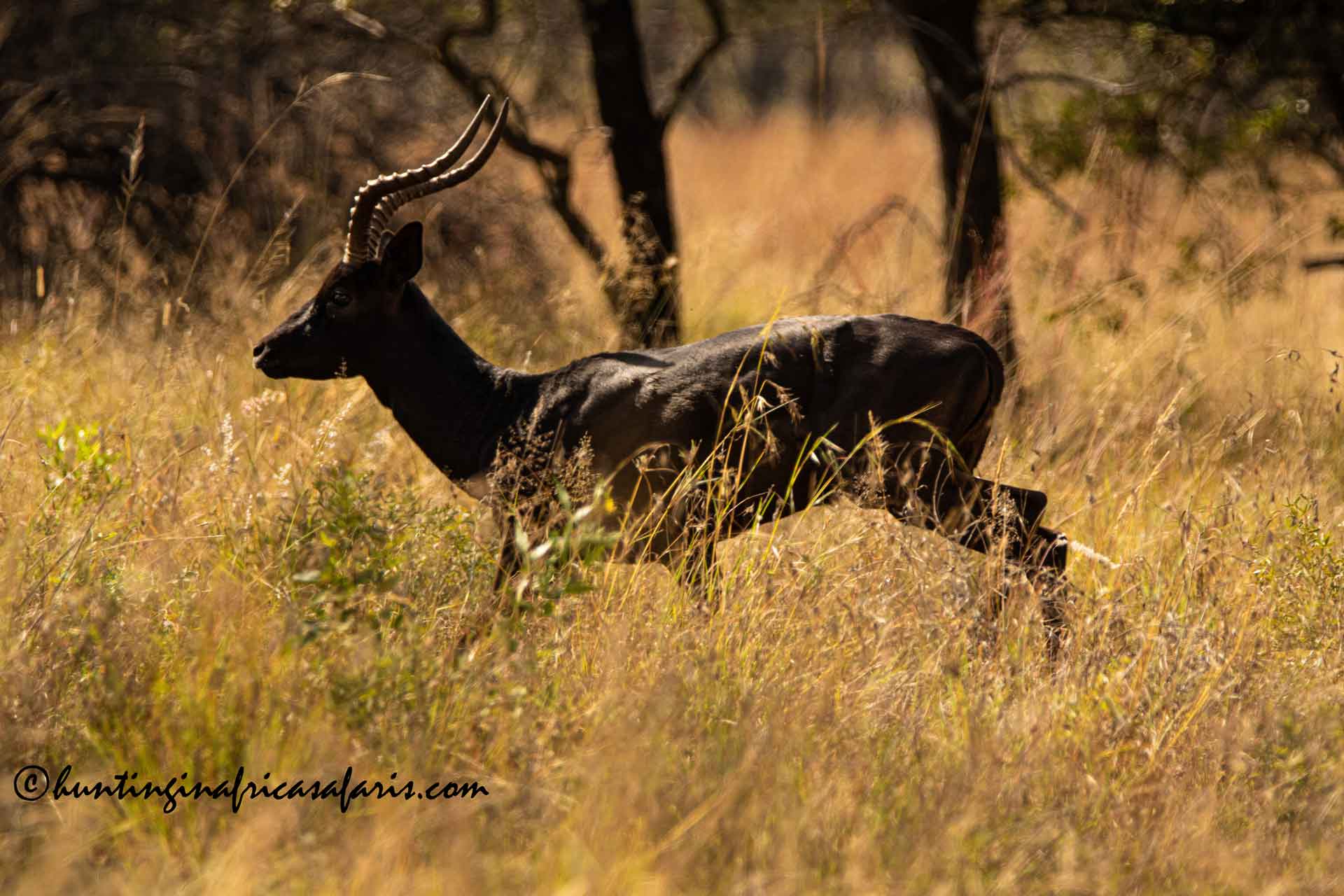
While they can be hunted year-round in many provinces, the best months are from May to September. During these cooler winter months, the vegetation is thinner, making it easier to spot the dark silhouette of a black impala ram against the bush.
Can I add a black impala to my existing plains game safari?
Yes. Most of our clients hunt the black impala as an add-on trophy to their primary safari. Because they are found in the same areas as common impala, wildebeest, and kudu, it is very easy to incorporate a black impala into your itinerary if a high-quality ram is spotted.
What is a realistic shooting distance for a black impala?
Depending on the province—whether the thick bush of the Limpopo or the open plains of the Free State—you should be prepared for shots between 100 and 250 yards. We recommend a flat-shooting caliber and high-quality optics to account for these varying distances.
Are black impala recognized by the SCI (Safari Club International)?
Yes, the SCI recognizes the black impala as a distinct trophy category for record book purposes. We can assist with the measuring and documentation required for your SCI submission following a successful hunt.
Services
Contact
hunt@huntinginafricasafaris.com
+27 82 824 7681
on Whatsapp and Telegram
Hours
Mondays from: 06:00 - 20:00 (6 am - 8 pm)
Tuesday - Saturday from: 06:00 - 20:00 (6 am - 8 pm)
Sunday: Closed unless we are hunting.