
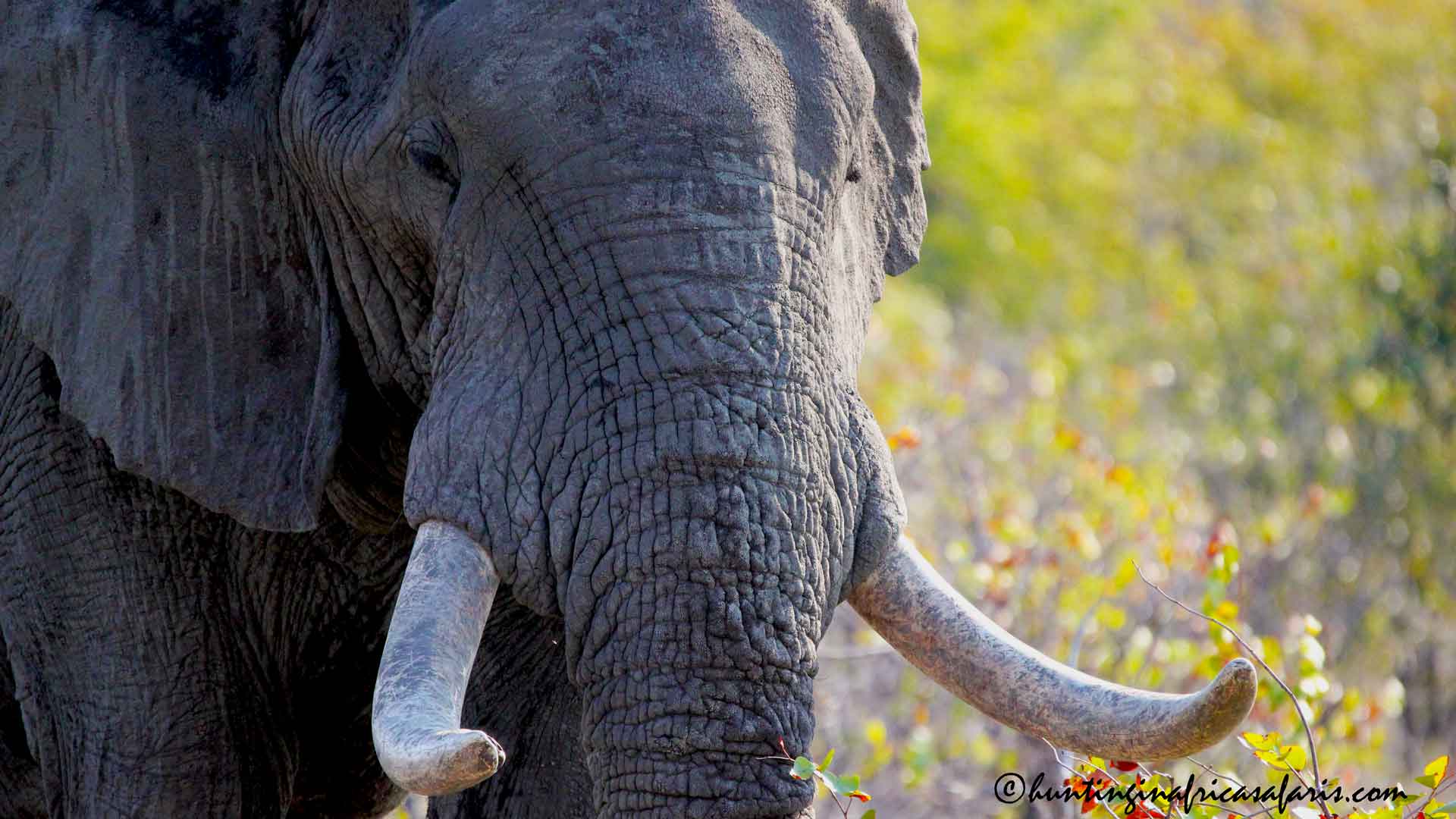
Trophy elephant hunting in Africa | daily rates South Africa, Namibia & Botswana
Welcome to the ultimate guide for an African elephant hunting safari. This page provides comprehensive, transparent information to help you plan your 2026 hunt, including current pricing, permit requirements, and the legal calibers required for a safe and ethical harvest.
Hunting the African elephant (Loxodonta africana) is the pinnacle of dangerous game hunting. It demands exceptional skill, courage, and a powerful, reliable rifle. We prioritize sustainable practices that contribute directly to the conservation of this magnificent species.
Once you have selected your rifle and load, view our Dangerous Game Safari Packages to start planning your pursuit.
1. Elephant hunting prices 2026
Elephant hunting costs vary by country based on trophy exportability and concession types. In South Africa, permits are often management-based, whereas Botswana and Namibia operate on a structured quota system.
| Category | Estimated 2026 pricing (USD) |
| South Africa (Trophy Bull) | $35,000 – $45,000+ (Size dependent) |
| Botswana (Exportable Bull) | $45,000 – $75,000+ (Region dependent) |
| Namibia (Trophy Bull) | $30,000 – $55,000 |
| Daily rates (Dangerous game) | $850 – $1,500 per day (1x1) |
| Observer daily rates | $250 – $300 per day |
2026 African elephant trophy fees price update
We offer a transparent, all-in-one fee structure for the elephant bull trophy. Please note the distinction between the trophy fee and the mandatory export-related costs.
| Core trophy fee | Details |
| African elephant trophy fee | Trophy bull up to 40 lbs per side (estimated) |
| 2026 price | $40,000 (All-inclusive of daily rates) |
| Larger available | POA (Price On Application) |
| Non-hunter companion rate | $250 per day (Minimum 10 days) |
2. Understanding Price On Application (POA)
The POA designation is reserved for exceptional trophy bulls carrying tusks above the standard 40 lbs per side.
| Aspect | The process |
| Why POA? | Cost is determined by ivory rarity and limited advanced permits. |
| Premium bulls | Applicable for bulls with 50 lbs, 60 lbs, or 70 lbs ivory. |
| Advance booking | Private consultation is required to secure prime hunting areas. |
3. Legal import status and trophy tags
South Africa remains one of the primary destinations where elephants can be legally hunted and imported to the USA. Currently, our standard 2026 elephant hunting tags are reserved for bulls carrying tusks between 35 lb and 40 lb per side.
| Permit type | Status |
| Standard tag | Bulls with 35 lb – 40 lb ivory per side. |
| Big tusker permit | Limited access to mature bulls with ivory up to 70 lbs. |
| CITES/TOPS | Fully compliant permits provided for legal international export. |
4. Excluded costs: the final investment
The elephant trophy fee covers the complete hunting safari experience, but it does not cover the following necessary logistics:
| 1. Trophy export & processing | Requirement |
| Dip & pack | Veterinary treatment and preparation of hide, tusks, and skull. |
| Crating & documentation | Secure custom crating and all required export paperwork. |
| Freight & shipping | International transport from South Africa to your port of entry. |
| Customs brokerage | Fees for clearing the trophy through customs (e.g., USFWS). |
| 2. Services and logistics | Requirement |
| Airfare | All international and domestic flights. |
| Extra accommodation | Hotel stays required outside of the contracted safari dates. |
| Rifle import | Government charges for the SAPS 520 permit. |
| Rifle rental | Daily fee and ammunition costs if not bringing your own rifle. |
| 3. Taxidermy and gratuities | Requirement |
| Taxidermy | Professional mounting performed in South Africa or at home. |
| Gratuities (Tipping) | Customary tips for the PH, trackers, skinners, and camp staff. |
| Personal expenses | Souvenirs, side excursions, and personal items. |
Species biology and conservation (Loxodonta africana)
The African elephant is the largest land mammal on earth, and the bulls found on our properties—particularly those bordering the Kruger National Park—display exceptional genetics. These bulls often carry symmetrical ivory, with mature trophies frequently reaching the 45 to 50 lbs per side mark.
Hunting these giants in the dense Mopane bushveld requires patience and a deep understanding of their behavior. Because these elephants are part of a managed ecosystem, they often maintain a calm demeanor, though they remain incredibly unpredictable when approached within 20 yards.
| Aspect | Details |
| Typical Habitat | Mopane bushveld and riverine forests |
| Average Ivory | 35 – 50 lbs per side for mature bulls |
| Conservation Status | Managed through sustainable utilization |
| Economic Impact | Funds anti-poaching and local community growth |
Recommended Elephant hunting calibers and Ammunition: The Professional Standard
For an ethical, successful elephant hunt, the intersection of ballistics, bullet construction, and shot placement is absolute. While African game laws provide a baseline for legality, they should never be mistaken for a recommendation of the optimal tool for the task.
At African Bushbuck Adventures, we advocate for the Philosophy of Over-Penetration. When pursuing Loxodonta africana, your objective is to deliver deep, straight-line terminal energy through massive bone and dense muscle to reach vital zones. Our professional field experience dictates that while a .375 H&H Magnum is the legal minimum in many jurisdictions, the most effective caliber is the largest bore you can shoot with absolute calm, precision, and confidence under the high-pressure conditions of a close-quarter encounter.
Whether you are utilizing a modern bolt-action or the traditional double rifle, your rifle-and-ammunition system must be selected for total reliability and the ability to maintain structural integrity upon impact. Below, we outline our professional caliber recommendations and the stringent ammunition requirements necessary for your safari.
| 2026 Elephant hunting caliber guide | |
|---|---|
| Minimum: .375 H&H Magnum | Legal minimum. Suitable only for experienced marksmen; generally reserved for the precise brain shot. Requires premium 300-grain monometal solid ammunition. |
| Highly recommended: .416 Rigby | The versatile classic. Offers an excellent balance of penetration, terminal energy, and manageable recoil. Requires premium 400-grain solid ammunition. |
| The gold standard: .458 Lott | Top-tier choice. Provides a significant power advantage and the best margin of error. Requires premium 500-grain solid ammunition. |
| Traditional: .470 Nitro Express | The ultimate choice for a classic double rifle, offering a fast, reliable second shot. Requires heavy 500-grain solid ammunition. |
| Essential Ammunition Requirements | |
| Bullet type | Only solid (full metal jacket or monolithic solid) bullets. Expanding bullets are strictly forbidden for elephant. |
| Bullet construction | Premium-grade, monometal solids (e.g., Barnes Banded Solid) to guarantee structural integrity upon impact. |
| Rifle reliability | 100% reliability is mandatory. Controlled-round-feed (CRF) actions or double rifles are highly recommended. |
| Shot objective | Deep, straight-line penetration is the only way to reach the brain or vitals through massive bone. |
Optimal elephant hunting season
The dry winter months are considered the best for elephant hunting, as it simplifies tracking and forces animals to congregate near perennial water sources.
| Feature | Details |
| Best time (Dry season) | May to October |
| Peak months | August to October |
| Visibility | Excellent; vegetation is thin and ground tracking is predictable. |
| Success rates | Higher success due to limited water sources in the Mopane bush. |
Monthly breakdown for elephant hunting
| Month | Hunting conditions |
| May – July | Cooler temperatures; tracking is comfortable but vegetation can still be dense. |
| August – September | Prime tracking season; watering holes become the primary focal points. |
| October (Peak) | The hottest and best month; extreme water scarcity makes bulls highly predictable. |
| November – April | Rainy season; vegetation is lush and elephants disperse, making tracking difficult. |
Largest elephant tusks ever recorded
This section celebrates the incredible history and scale of the largest African bull elephants (Loxodonta africana) ever recorded, highlighting the ultimate aspiration of the serious hunter. The weight of an elephant’s tusks is influenced by genetics, diet, and age, often only reaching their true potential late in the bull’s life.
| Elephant | Details |
| The ‘Crone’ elephant | 450 lbs (225 lbs per side) |
| Location & year | Kilimanjaro, Tanzania (1898) |
| Notes | The heaviest set of tusks ever recorded. The ivory was too heavy to be moved by a single person. |
| Sauer’s bull | 440 lbs (220 lbs per side) |
| Location & year | Mount Kenya (1899) |
| Notes | Shot by the famous professional hunter J.J. ‘Karamoja’ Bell; a benchmark for the Golden Age of Safari. |
| Yankele bull | 354 lbs (177 lbs per side) |
| Location & year | Angola (1970) |
| Notes | The heaviest tusks taken in the latter half of the 20th century, cementing Angola’s reputation for massive tuskers. |
| Mandevu | 232 lbs (116 lbs per side) |
| Location & year | Selous Game Reserve, Tanzania (1993) |
| Notes | One of the largest tuskers of modern record and a symbol of successful conservation efforts. |
It is a rare and profound honour to encounter a bull with tusks exceeding 100 lbs per side—these are known as 'Tuskers.' A bull with tusks over 130 lbs per side is known as a 'Hundred-Pounder,' representing one of the most sought-after trophies in the world.
Image below from: https://za.pinterest.com/pin/216876538292540245/

Ready to discuss your dangerous game safari?
Inquire about availabilityThe elephant hunt gallery
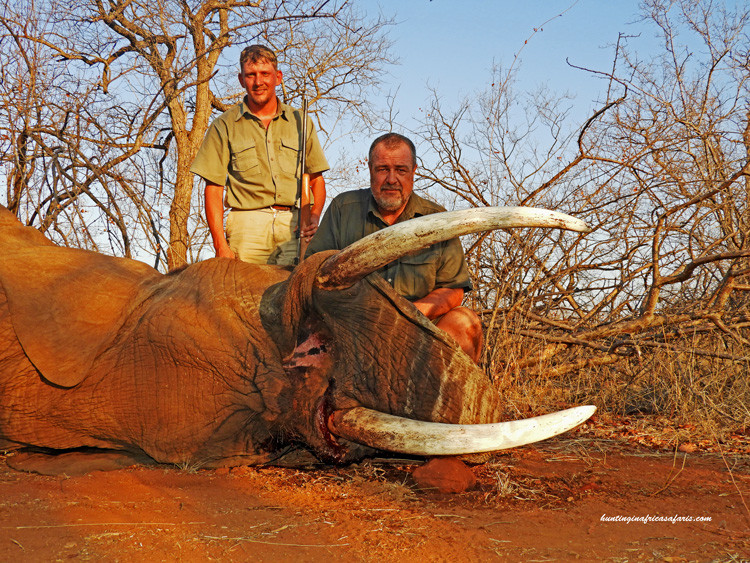
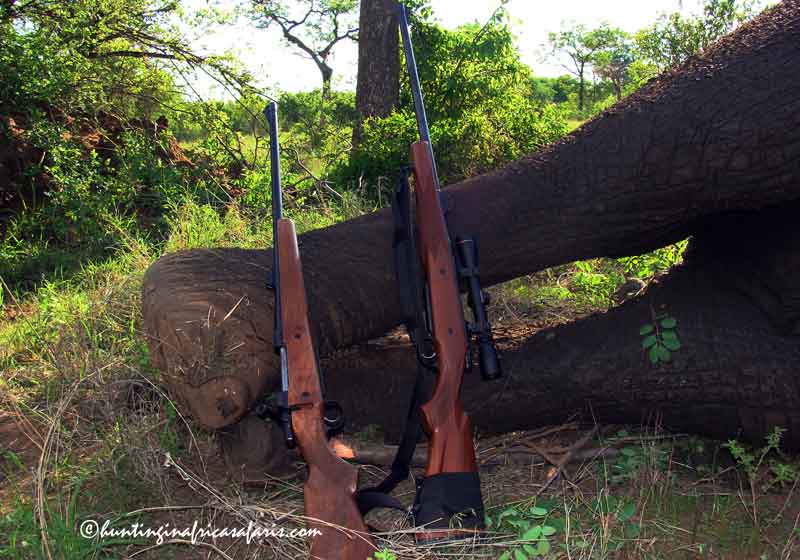
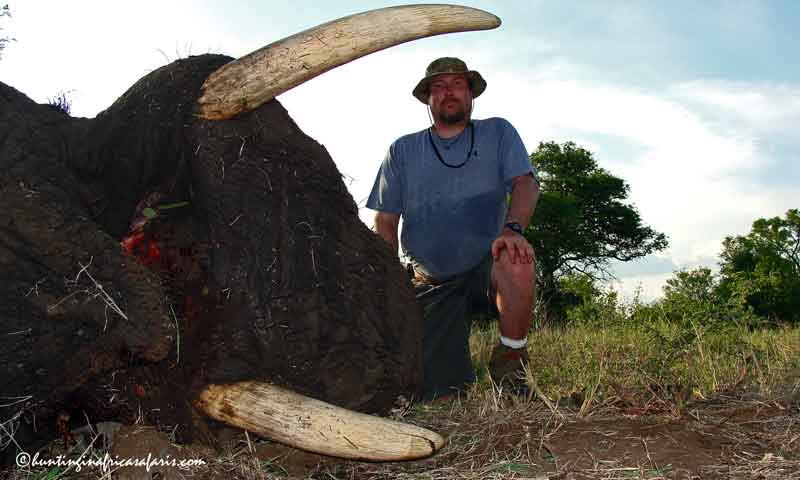
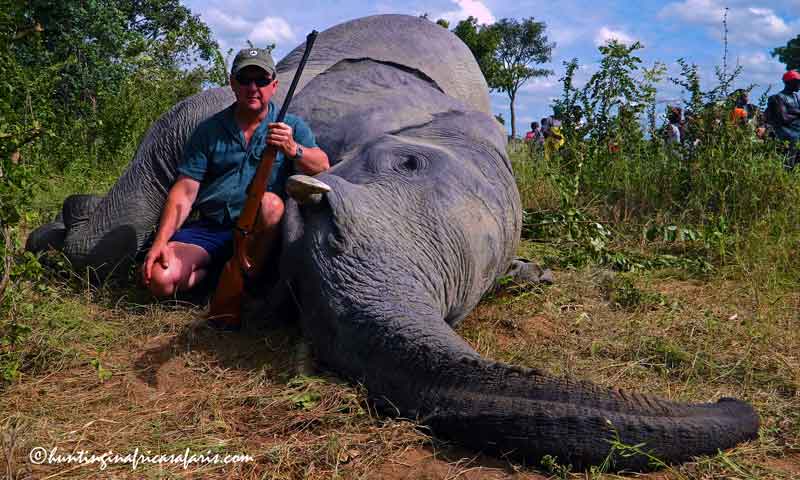
Experience the majesty and intensity of the African elephant ($Loxodonta africana$) safari. This gallery showcases the scope and scale of the hunt, from days spent tracking deep within the concession to the moment of triumph with a hard-earned bull. These images reflect our commitment to ethical hunting, conservation, and providing a safe, world-class dangerous game experience.



Shot placement: African Elephant (Loxodonta africana)


Services
Contact
hunt@huntinginafricasafaris.com
+27 82 824 7681
on Whatsapp and Telegram
Hours
Mondays from: 06:00 - 20:00 (6 am - 8 pm)
Tuesday - Saturday from: 06:00 - 20:00 (6 am - 8 pm)
Sunday: Closed unless we are hunting.